Reptiles can spark wonder—or uncertainty—in young children, and a thoughtful introduction can turn both reactions into meaningful learning. Pairing a Reptile Coloring Activity with close observation and open-ended conversation gives children a welcoming way to notice animal features and practice early science skills. For a deeper foundation in planning inquiry-rich experiences, explore ChildCareEd’s Basic Science in Early Childhood Buy Now $25.00, a two-hour training focused on helping educators support children’s questioning, investigating, and scientific reasoning.
Why introduce reptiles through art and conversation?
Reptiles are a useful invitation to explore the living world because children can study them through photographs, books, illustrations, and models without needing direct contact with an animal. A drawing or coloring page offers an accessible starting point: children can notice body shape, patterns, scales, and ways different reptiles move. These details build the habits of #observation and comparison that underlie early scientific thinking.
Art also gives children a low-pressure way to share what they already know or wonder about. A child who feels unsure about snakes, for example, can begin with a picture and choose how much to participate. Educators can validate feelings while gently expanding understanding: “You’re not sure about snakes. Let’s look at this picture together. What do you notice?”
The goal is not to teach every fact or require realistic artwork. Instead, create space for children to look closely, make choices, ask questions, and express ideas. Reptile-themed experiences can also connect science with language, fine-motor practice, and creative expression. Learning about varied animals can nurture respect for wildlife and a sense of curiosity about the natural world.
How can you prepare a developmentally appropriate reptile art activity?
Begin with a few clear, accurate images of familiar reptiles, such as a turtle, lizard, or snake. Choose high-quality photographs or realistic illustrations, and introduce one or two images at a time. A reptile coloring activity Buy Now $0.99 can serve as the art invitation; provide crayons, colored pencils, or washable markers and let children decide how to use them.
Before children begin, explain that the activity is an opportunity to notice and create—not a test of drawing ability or factual recall. Offer a brief prompt such as, “Look at the turtle’s shell. What shapes or lines do you see?” Encourage children to select colors based on the image or invent their own, making clear that imaginative choices are welcome.
- Set out a small number of materials to avoid visual overload.
- Offer larger crayons, adaptive grips, or pre-positioned paper when helpful.
- Provide picture cards or toy models for children who prefer to explore before drawing.
- Invite children to dictate a caption or label a feature with support.
- Choose images that represent different reptile types, sizes, and habitats.
For younger children, keep the invitation brief and sensory-friendly, and supervise materials according to age and program policy. A thoughtful setup helps children engage at their own pace while ensuring that every child has a meaningful way to participate.
What questions help children observe and talk about reptiles?
Open-ended questions invite children to look again, describe evidence, and build on one another’s ideas. Begin with what is visible before introducing technical terms. For example: “What do you notice?” “What is the animal’s body covered with?” “How might it move?” and “Where might it live?” Give children time to think, point, gesture, or answer in their home language.
Then add useful words naturally: scales, shell, claws, tail, habitat, and pattern. You can model accurate language without turning the exchange into a vocabulary drill. If a child says, “The turtle has a house,” respond, “Its shell is a hard covering that protects its body.” If you are unsure of a fact, say so and look for a reliable source together.
Reptiles include snakes, lizards, turtles, and crocodilians. They are a diverse animal group, so avoid suggesting every reptile looks or behaves the same way. Invite children to compare two images: “What is similar? What is different?” or “Which details help you decide these are different animals?”
- Pause after asking a question; silence gives children processing time.
- Accept pointing, drawing, movement, and communication-device responses.
- Follow children’s questions instead of rushing to the next planned fact.
- Record memorable comments to revisit during later activities.
In this way, conversation becomes a shared investigation rather than a quiz with one expected answer.
How can you extend the activity into a simple investigation?
After coloring, invite children to compare their artwork with photographs or models. Ask them to identify one feature they included and one detail they noticed only after looking again. A class chart can capture observations under simple headings such as “body covering,” “shape,” and “movement.” Children may dictate their ideas while an educator writes them down.
Use the same images for sorting and re-sorting. Children might group reptiles by whether they have a shell, how their bodies are shaped, or the habitat shown in a picture. Explain that the sorting rule can change, and that an animal may fit into more than one group depending on the question. This flexible approach supports classification and reasoning without turning the activity into memorization.
Continue the inquiry with short nonfiction read-alouds, toy figures, or a pretend habitat made from safe classroom materials. Children can design a picture habitat and explain what their animal might need. Keep claims grounded in age-appropriate, reliable information; for instance, reptiles breathe air, but their diets and habitats vary widely across species.
Document learning with photos of the process, dictated captions, or brief notes about children’s questions. A child’s revised idea—“I thought all turtles lived in water, but this one lives on land”—is valuable evidence of developing scientific thinking. For ideas about hands-on reptile themes, educators can also consult reptile theme activities and adapt them to their group and setting.
How can providers keep reptile learning safe and inclusive?
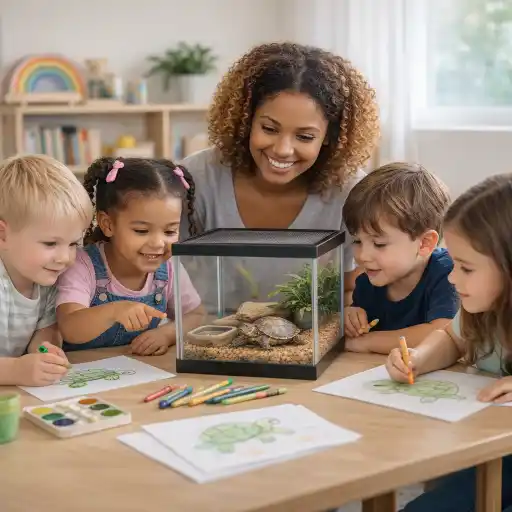
Pictures, books, puppets, and models offer rich learning opportunities without the health considerations involved in bringing live animals into a classroom. This distinction is especially important for programs serving young children. The CDC advises that reptiles and amphibians are not suitable for settings with children under five because of the risk of germs such as Salmonella. If a live-animal encounter is being considered for another setting or age group, consult current public-health guidance, local regulations, program policies, and families before making plans.
For visual materials and art supplies, check for choking hazards, allergies, and individual access needs. Use washable, age-appropriate supplies and supervise children as required. Children should never be encouraged to handle wild reptiles or disturb animals outdoors; observation from a respectful distance is a safer way to appreciate wildlife.
Inclusion also means recognizing that children bring different experiences and feelings to the topic. Some may be fascinated, while others may feel uneasy. Offer choices: a child can color a turtle instead of a snake, observe without drawing, or participate through a partner. Use varied images and vocabulary, and welcome family knowledge about animals and nature without placing any child in the role of spokesperson for a culture or community.
- Use image-based exploration rather than live reptiles with children under five.
- Let children opt for a different reptile or a quieter way to participate.
- Offer adapted tools, alternative response modes, and extra processing time.
- Model respect for animals and avoid presenting reptiles as frightening or harmless in every situation.
State requirements vary - check your state licensing agency when planning animal-related experiences or verifying professional-learning requirements.
How can educators tell what children are learning?
Assessment can be woven into the experience rather than added as a formal test. Observe whether children look closely, describe a feature, compare images, ask a question, or change an idea after hearing new information. These actions reveal more about developing scientific habits than whether a child colors within an outline or remembers a label.
Use brief, objective notes. For example: “Kai pointed to the turtle’s shell and said it was hard,” or “Mina changed her drawing after noticing the lizard’s long tail in the photograph.” Avoid interpreting a child’s feelings or abilities from a single moment. Revisit the activity later with the same images and invite children to share what they notice now.
Common pitfalls are easy to prevent: avoid overloading children with facts, correcting every imaginative detail, or treating the page as a product-focused craft. Keep the emphasis on inquiry and conversation. Also avoid broad claims such as “all reptiles lay eggs” or “all reptiles live in warm places”; specific traits vary by species. When a question is unanswered, model curiosity: “Let’s find out together.”
Directors can support staff by making reliable books and images available, discussing age-appropriate safety practices, and sharing simple observation tools. Professional learning can deepen educators’ planning: ChildCareEd’s Basic Science in Early Childhood Buy Now $25.00 focuses on intentional science experiences, investigation, and children’s reasoning. State requirements vary - check your state licensing agency to confirm whether a specific course meets local professional-development needs.
Conclusion: How can art make reptile learning meaningful?
Introducing reptiles through coloring, observation, and conversation helps children explore an unfamiliar animal group in a calm, engaging, and developmentally responsive way. A coloring page can be more than an art task when educators use it to encourage children to notice features, express ideas, ask questions, and compare evidence.
Keep the experience simple: choose accurate images, offer accessible materials, ask open-ended questions, extend the inquiry with sorting or books, and document children’s thinking. Use images and models rather than live reptiles with children under five, and respect every child’s comfort level. With those practices, a Reptile Coloring Activity can become a thoughtful starting point for early science, language, creativity, and care for wildlife.
- Many Colors, One Canvas: MD ECE Conference
- Power of Art: Bldg Self-Esteem & Positive Behavior for ALL Abilities
- Children at the Wheel: Emergent Curriculum
- Pediatric RSV First Aid & CPR/AED
- Art from the Heart for Preschoolers: Open Ended Art Projects that Build Self-Esteem
- Early Childhood Education
- Texas Director Credential
- Montessori Cultural Activities: Exploring the World Through Play and Learning
- CDA Certification en Español: Recursos y Consejos para Educadores Bilingües
- 🔍 ¿Qué ves cuando observas a un niño aprender?
- Cómo Abrir Una Quardería En Casa Sin Dinero?
- Apoyo en Español para Capacitaciones Grupales Presenciales y por Zoom en Cursos Selectos
- Capacitación en Salud y Seguridad Preventiva en Línea para Proveedores de Cuidado Infantil
- Regulaciones de Licenciamiento de Cuidado Infantil en California para Centros y Hogares de Cuidado Infantil Familiar
- Proporciones de Cuidado Infantil y Tamaños de Grupo por Edad en Maryland (Guía Rápida para Centros y Hogares)
- Proporciones de Cuidado Infantil y Tamaños de Grupo por Edad en Nueva Jersey (Guía Rápida para Centros y Hogares)
- Proporciones de Cuidado Infantil y Tamaños de Grupo por Edad en Virginia (Guía Rápida para Centros y Hogares)
- Lista para Abrir una Guardería en Casa en Georgia: Cómo Empezar
- Lista para Guardería en Casa en Texas: Cómo Iniciar una Guardería en el Hogar
- Consejos de Supervisión Activa para Salones de Preescolar y el Juego al Aire Libre
- Cómo Trabajar en el Cuidado Infantil en California: Requisitos y Pasos
- Cómo Trabajar en el Cuidado Infantil en Wisconsin: Requisitos y Pasos
- Capacitación Previa al Servicio para Proveedores de Cuidado Infantil en Georgia
- Las Mejores Ideas de Excursiones para Guarderías en Dakota del Norte
- Capacitación CDA gratuita en Illinois
- Canciones, juegos y preguntas de círculo para niños
- Cómo simplificar la capacitación para sus empleados de daycare
- How Can Child Care Providers Introduce Reptiles Through Art, Observation, and Conversation?
