Cleaning up quickly should never mean leaving chemicals within a child’s reach. A clear storage routine protects children and helps staff finish classroom resets with confidence; begin with the focused Handling and Storage of Hazardous Materials  Buy Now $10.00 course to strengthen your team’s knowledge and support relevant training needs. For a quick, practical cleanup prompt, explore the 5-Minute Classroom Reset Checklist featured in this guide.
Why does cleaning-product storage matter during classroom cleanup?
Classroom cleanup often happens during transitions, when children are moving, curious, and eager to help. A spray bottle left on a table, a disinfectant wipe packet on a shelf, or a cleaner parked beside a sink can quickly become accessible. Safe storage is not just an end-of-day task; it must be part of the cleanup routine from the moment a product is taken out until it is secured again.
Young children may encounter chemicals by swallowing them, touching treated surfaces, or breathing vapors. Poison-safety guidance from the National Pesticide Information Center and poison control organizations emphasizes storing cleaning supplies out of children’s reach and keeping them in their original containers. The federal Caring for Our Children guidance on toxic substances also advises caregivers to keep hazardous substances away from children and food, use products as directed, and not use them when children are present.
A dependable approach supports safety while keeping the room usable. Children can take part in appropriate tasks—such as putting blocks in a bin—while adults handle chemicals and contaminated materials. Think of chemical storage as a fixed step in every cleanup, not something to remember only when the room looks finished.
Where should cleaning products be stored when they are not in use?
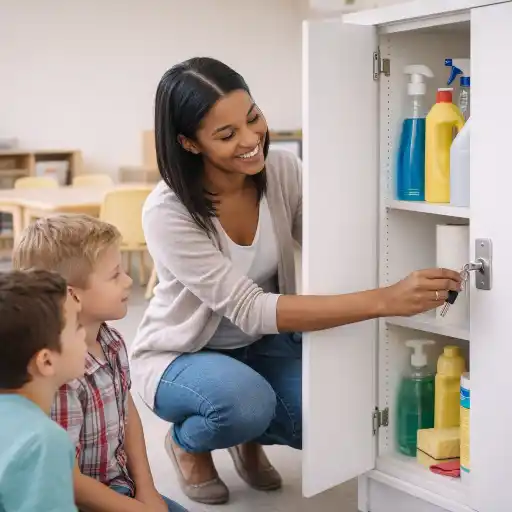
Store cleaners, disinfectants, sanitizers, and other products with hazard warnings in a secured area that children cannot access. A locked cabinet or dedicated locked utility closet is generally a safer choice than an open shelf or a high cabinet without a lock. Keep products separate from food, formula, medications, and food-service supplies. Follow the product manufacturer’s directions about storage conditions, including any warnings about heat or ventilation.
Rules differ by state and program type, so check your licensing manual for specific requirements. For example, Washington’s early learning regulation on poisonous or dangerous substances requires child-inaccessible storage, separation from food areas, labeled containers, and locking doors or other methods to prevent access. This is a state-specific example, not a substitute for your own jurisdiction’s rules.
- Use a working lock, and keep keys or access codes under adult control.
- Keep chemical storage separate from food and food-preparation areas.
- Do not rely on a high shelf as the only barrier unless your licensing agency explicitly permits that arrangement.
- Return products to secured storage as soon as the task is complete.
State requirements vary - check your state licensing agency. Make the storage location known to authorized staff, but do not put access information where children can obtain it.
How should staff manage products while cleaning?
Before starting, read the product label and gather only the supplies needed for the task. Use cleaning chemicals according to the manufacturer’s directions, including dilution, protective equipment, ventilation, and the full contact time when required. Keep children away from the area while products are being used, and never leave a container unattended on a counter, cart, or floor. The CDC’s guidance for cleaning and disinfecting early care settings recommends following label instructions, ensuring ventilation, and storing chemicals out of children’s reach after use.
Keep the cleanup sequence simple and consistent:
- 🧹 Clear children and learning materials from the immediate cleaning area, maintaining active supervision elsewhere.
- Clean visible dirt first; sanitize or disinfect only where appropriate for the surface and task.
- Use the product as labeled, and do not mix cleaners or disinfectants. Some combinations can release dangerous gases.
- After use, close the container and return it immediately to locked storage before moving on.
- Wash hands after handling products and after removing gloves, following your program’s procedures.
When staff are rushed, a small reset station can help—provided it holds only nonhazardous supplies and does not become a place where chemicals are left between tasks. Keep hazardous products with an adult throughout use, then secure them promptly.
What labels and records help staff use products safely?
Keep products in their original containers whenever possible, with labels intact and readable. If a product is transferred to a secondary container, follow applicable licensing and workplace rules for labeling it clearly; never leave an unidentified liquid in a spray bottle. Staff should be able to identify the product and understand its hazards and directions before use.
Maintain Safety Data Sheets (SDS) for hazardous products as required by applicable workplace and licensing rules, and make them accessible to staff. A current inventory can make this easier: list product names, storage locations, and where each SDS is kept. Directors can also use a short orientation or refresher to confirm that staff know the storage procedure, label directions, and who to contact with questions.
- Review labels when choosing a product and before using it.
- Remove products that are expired, damaged, unlabeled, or no longer needed, using proper disposal procedures.
- Keep SDS documents and emergency contacts available to staff, not children.
- Use the program’s written cleaning schedule so staff know which tasks require cleaning, sanitizing, or disinfecting.
For a deeper review of product handling, storage, and disposal practices, the English-language ChildCareEd course Handling and Storage of Hazardous Materials Buy Now $10.00 offers a focused learning experience for child care providers.
What common storage mistakes should programs avoid?
Many unsafe situations arise during ordinary routines rather than major cleaning projects. Staff may set a bottle down “for just a moment,” transfer a solution without labeling it, or assume a product is harmless because it is marketed as natural. Make the program’s rule straightforward: if a cleaning product is hazardous or carries a warning, staff follow the applicable storage requirements regardless of brand or marketing claims.
- Leaving products out between tasks: Return each product to the locked area right after use, even if another cleaning task is coming next.
- Using height instead of secure storage: A shelf can be climbed. Use a locking barrier where required.
- Leaving chemicals in buckets or carts: Do not leave product solutions or containers accessible when children are present.
- Using unlabeled bottles: Keep original labels intact and label any permitted secondary containers correctly.
- Mixing products or ignoring directions: Follow the label; never combine chemicals unless the label specifically directs it.
Use a quick visual check during classroom reset: Are cleaning products put away and locked? Are bottles labeled? Is the route to the cabinet clear for staff but inaccessible to children? The 5-Minute Classroom Reset Checklist can complement this scan by prompting staff to notice room hazards as they reset materials and pathways.
How can programs make safe storage part of every classroom reset?
A short routine is easier to maintain when every staff member knows the sequence and the responsibility is clear. Add chemical storage to the end of each cleanup task rather than saving it for the final room check. Directors can model the steps, post a staff-facing reminder near the locked storage area, and review the routine when products or procedures change.
Children can contribute to cleanup in safe, age-appropriate ways—returning toys, putting books on shelves, or matching picture labels—while an adult handles products and verifies that the room is safe. This makes cleanup a shared classroom habit without assigning children tasks involving chemicals or treated surfaces.
Keep the routine practical and consistent:
- Before cleanup: identify which adult will use cleaning products and maintain supervision.
- During cleanup: keep chemicals with the responsible adult and follow product directions.
- After each use: return products to locked storage immediately.
- At the end: check labels, cabinet security, room pathways, and the cleaning schedule.
If an exposure is suspected, follow your emergency plan and contact Poison Control in the United States at 800-222-1222; seek emergency services when the situation requires it. Keep the number readily available to staff.
Conclusion: Where should cleaning products be kept during classroom cleanup?
Cleaning products belong in a child-inaccessible, secured storage area—typically a locked cabinet or closet—and should be returned there immediately after use. Keep products labeled, separate from food and medications, and use them only according to their instructions. During classroom cleanup, maintain supervision, keep children away from active chemical use, and never leave products in a bucket, on a cart, or on a counter.
The core takeaway is simple: a safe reset includes both tidying the room and securing every hazardous product. Build that step into staff routines, confirm your local rules, and use focused training such as Handling and Storage of Hazardous Materials Buy Now $10.00 to reinforce safe practices. A short checklist and a consistent locked-storage habit help protect children while supporting a clean, ready-to-learn classroom.
- 😫🧸 ¿Qué hacer cuando un bebé no quiere dormir la siesta en el aula?
- ❄️ ¿Qué actividades al aire libre funcionan bien para los niños de Illinois en cada estación? 🌷🍂
- Recursos en Español sobre el Sueño Seguro del Bebé
- ¿Cómo pueden los equipos de cuidado infantil practicar habilidades rápidas de primeros auxilios en situaciones reales?
- Consejos de Supervisión Activa para Salones de Preescolar y el Juego al Aire Libre
- Retraso del Habla en la Guardería: Cómo Pueden Ayudar los Proveedores
- What 'Invisible' Skills Do Children Learn During Cleanup Time?
- How to Set Up a Preschool Classroom That Makes Cleanup Easier
- Child Care Facility Rules and Regulations DCF Practice Test: What Should You Study?
- How Can Child Care Providers Strengthen Fine Motor Development Through Play and Daily Routines?
- How Does Cleanup Time Reveal Hidden Learning in Early Childhood Classrooms?
- How Can Providers Prepare for a Smooth Licensing Visit?
- How Can Child Care Providers Strengthen Food Safety Practices?
- How Can Cleanup Time Become a Lesson in Sorting, Counting, and Teamwork?
- How Can Child Care Providers Help Families See the Learning Hidden Inside Messy Play?
- What Should You Check During a Daily Child Care Toy Inspection?
- How Often Should Daycare Toys and Classroom Materials Be Cleaned and Sanitized?
- How Can You Plan a Food-Learning Activity for Children with Different Dietary Needs?
- Where Should Cleaning Products Be Kept During Classroom Cleanup?
- How Can Child Care Providers Separate Hazardous Products from Classroom Supplies?
