Cleanup does not have to compete with learning—it can become one of the day’s most purposeful, playful routines. Explore the Role of Play in Learning  Buy Now $16.00 course to deepen your understanding of how play supports development, while the Early Mathematics Through Play Buy Now $24.00 course can help you connect sorting, counting, and reasoning to everyday classroom experiences.
Why does cleanup time deserve a place in the curriculum?
When children return materials, they are doing far more than making the room look orderly. They are remembering steps, classifying objects, coordinating movement, communicating with peers, and contributing to a shared environment. A child who places cars in the correct basket is practicing categorization; a child who waits while a peer carries a tray is practicing self-regulation and cooperation.
Cleanup is especially valuable because it occurs repeatedly. Unlike a single planned activity, the routine gives children many opportunities to practice and refine skills. DREME explains that routines such as cleaning up can become meaningful math moments with minimal preparation. Similarly, NAEYC’s discussion of playful learning emphasizes that children learn best when experiences are active, engaging, meaningful, social, and iterative.
- Executive function grows as children stop play, remember directions, and complete steps.
- Language develops through words such as same, different, more, fewer, and belongs.
- Motor skills develop through carrying, grasping, placing, sweeping, and reaching.
- Community grows when children understand that everyone contributes.
The goal is not perfect speed or adult-level organization. The goal is meaningful participation. When providers view cleanup as a teachable routine rather than a compliance test, children’s strengths and emerging skills become easier to notice.
How can labels transform storage into a learning tool?
Clear labels reduce the amount of verbal prompting children need and make the environment easier to understand. Picture-and-word labels are useful for emerging readers, multilingual learners, and children who benefit from visual information. A photograph of the actual contents of a bin is often more meaningful than a generic illustration.
Begin with one high-use area, such as blocks, books, or dramatic-play materials. Place the label at children’s eye level on both the container and, when helpful, the shelf. Keep categories simple and avoid mixing unrelated materials in one basket. If a bin contains too many items, children may not know what belongs there.
- Use durable, high-contrast photographs or illustrations.
- Pair images with clear, simple words.
- Keep frequently used materials within safe reach.
- Teach children how to match each object to its label.
- Invite families to contribute home-language words for familiar materials.
Labels should be introduced through modeling: “I found a puzzle. I see the puzzle picture, so I will place it here.” Then invite children to try. Some children may point, gesture, use AAC, or speak another language; all are legitimate ways to participate.
The sellable Cleanup Learning Labels and Challenge Cards resource can make this process easier by providing consistent visual cues and prompts. Used thoughtfully, the cards support independence without replacing warm, responsive interaction.
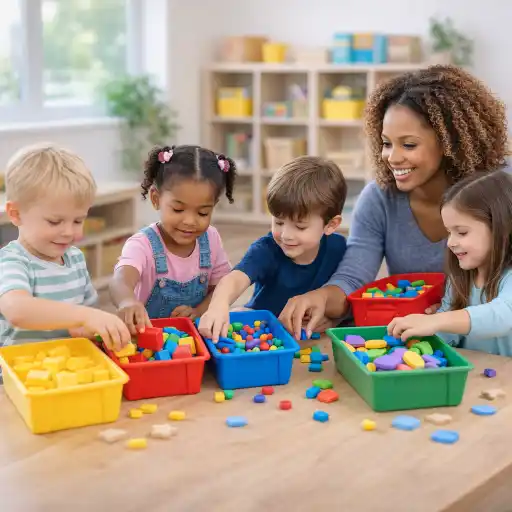
How can cleanup challenges build sorting and counting skills?
Challenge cards turn a broad direction—“Clean up”—into a manageable invitation. Begin with one attribute at a time. Children might sort by color, shape, size, function, or location. Once they understand the routine, increase the complexity by asking them to sort the same objects in a new way or explain their reasoning.
- “Find all the red materials and place them in the red basket.”
- “Count five blocks before you return to the shelf.”
- “Which basket has more? Which has fewer?”
- “Put the largest animals away first.”
- “Can you find two objects that belong together? Why?”
DREME’s Math Moments resources identify cleanup as a natural context for number, counting, measurement, patterns, and spatial relations. Providers can use positional language such as inside, beside, under, above, and between while children put materials away.
Keep the interaction playful and open-ended. Instead of correcting immediately, ask, “What made you decide those go together?” A child’s explanation may reveal more understanding than a perfectly completed basket. For younger children, match one object to one picture. For older preschoolers, invite them to invent a category and teach it to a peer.
Remember that mathematics is not limited to numeral recognition. Comparing, classifying, sequencing, estimating, and describing spatial relationships are foundational mathematical practices.
How can cleanup become a lesson in teamwork?
Teamwork develops when children have a shared goal, meaningful roles, and opportunities to communicate. Rather than asking everyone to clean the entire room, divide the work into small, visible responsibilities. One child can collect books, another can check the block shelf, and two children can carry a lightweight tray together.
- Rotate roles such as basket helper, shelf checker, label matcher, and song leader.
- Use partner tasks that require children to coordinate movement.
- Model language such as “Can I help?” “You carry this side,” and “Let’s decide together.”
- Recognize cooperation specifically: “You waited for Maya before moving the tray.”
- Allow children to choose between two approved tasks when possible.
Collaboration should not require every child to work in the same way. A child who needs more processing time might check one shelf with an adult. A child with mobility differences might sort objects at a table. A multilingual child might demonstrate a category through gestures or home-language discussion. Inclusion means preserving the child’s role as a valued contributor.
Cleanup also offers authentic opportunities to repair conflict. If two children want the same job, help them negotiate: “You both want to be basket helper. What could we try?” A timer, role rotation, or shared task may solve the problem without turning the interaction into a contest.
How can providers make cleanup predictable, inclusive, and safe?
Children are more successful when the routine follows a consistent sequence. Give a brief warning, show the visual cue, name one or two tasks, allow time to participate, and end with a quick check before moving on. The CSEFEL transition brief recommends advance warnings, visual cues, individualized support, purposeful waiting, and positive feedback.
- Give a two- to five-minute warning.
- Use a familiar song, rhythm, bell, or visual card.
- State one concrete expectation.
- Offer a challenge card or helper role.
- Check the area together and acknowledge effort.
Avoid turning cleanup into a race. Speed can cause unsafe carrying, bumping, and careless placement. Offer a quieter signal for children who are sensitive to sound, and provide additional visual or tactile supports when needed.
Children may participate in safe tasks such as sorting toys, returning books, carrying lightweight objects, or wiping a low surface with water when permitted by program policy. Adults must handle disinfectants, bleach, bodily fluids, broken glass, and hazardous waste. State requirements vary - check your state licensing agency before changing sanitation procedures, supervision practices, or approved products.
Common mistakes include vague directions, too many available materials, unrealistic expectations, and redoing children’s work without explanation. Prevent these pitfalls by reducing clutter, teaching one step at a time, using accessible tools, and documenting progress through brief observations.
How can directors use cleanup to strengthen curriculum and staff practice?
Directors can make cleanup learning visible by including it in lesson planning, coaching, and observation. Ask each classroom team to select one goal for the week: classification, counting, vocabulary, cooperation, sequencing, or self-regulation. Then introduce one label, challenge card, or helper role connected to that goal.
Documentation can remain brief and useful:
- “Ava sorted eight animals by location without prompting.”
- “Luis counted six blocks with one-to-one correspondence.”
- “Mina waited for a peer before carrying the tray.”
- “Jordan followed the picture sequence but needed support with the final check.”
Use the observations to improve the environment. Repeated misplaced items may indicate unclear labels, not defiance. A lengthy cleanup may indicate too many materials. Disengagement may signal that a child needs a smaller task, movement break, communication support, or a meaningful role.
Staff reflection questions can include:
- What learning did children practice today?
- Which visual or verbal cue was most effective?
- Who needed additional support, and what adaptation helped?
- Did the routine protect children’s play while creating a manageable transition?
For deeper professional learning, Every Moment Matters: Schedules and Transitions Buy Now $55.00 can help teams examine routines and transitions, while Early Mathematics Through Play Buy Now $24.00 offers strategies for embedding mathematical thinking throughout the day.
Conclusion: What can cleanup time teach children?
Cleanup time can teach far more than putting toys away. With clear labels, playful challenge cards, thoughtful questions, and shared roles, children practice sorting, #counting, spatial language, self-regulation, #independence, and #teamwork in a meaningful context.
Start small: choose one classroom area, add a picture-and-word label, teach a three-step routine, and introduce one challenge card. Observe how children participate, then adjust the materials or expectations. The strongest cleanup routines are predictable, inclusive, developmentally appropriate, and safe. Most importantly, they communicate a powerful message: every child has something valuable to contribute to the classroom community.
Frequently asked questions
Can toddlers participate in learning-focused cleanup?
Yes. Toddlers can place large objects in an open bin, match familiar objects to photographs, or wipe a low surface with a dry cloth. Keep directions brief and tasks concrete.
How many challenge cards should be available?
Begin with one or two cards in a familiar area. Too many choices can overwhelm children and reduce the clarity of the routine.
Should cleanup be timed?
A consistent song or timer can signal the transition, but avoid making speed the goal. Participation, safety, and thoughtful sorting matter more than finishing first.
What if a child refuses to clean up?
Acknowledge the difficulty, offer a small defined task, provide a choice between two jobs, and consider whether the environment or expectation needs adjustment.
Can children use cleaning products?
Children should not handle bleach, disinfectants, or harsh chemicals. Adults must manage hazardous cleaning tasks according to program policy and applicable regulations.
Where can staff learn more about play-based practice?
The Role of Play in Learning Buy Now $16.00 course provides a focused foundation for understanding how play supports children’s development and learning.
- 45 Hour Child Growth and Development
- CDA Bridge Bundle: Preschool
- 45 Hour School Age Methods and Materials
- CDA Bridge Bundle: Family Child Care
- CDA Bridge Bundle: Family Child Care without Portfolio Review
- CDA Bridge Bundle: Infant/Toddler without Portfolio Review
- CDA Bridge Bundle: Preschool without Portfolio Review
- CDA Bridge Bundle: Infant/Toddler
- Texas Director Credential
- Recursos en Español sobre el Sueño Seguro del Bebé
- Lista para Guardería en Casa en Texas: Cómo Iniciar una Guardería en el Hogar
- Cómo Ser Maestra de Preescolar en Maryland
- Can Toddlers Do STEM in the Sandbox at Minnesota Daycares?
- Canciones, juegos y preguntas de círculo para niños
- Cómo simplificar la capacitación para sus empleados de daycare
- What 'Invisible' Skills Do Children Learn During Cleanup Time?
- How can simple science experiments transform my preschool classroom?
- How Can Cut, Sort, and Glue Activities Strengthen Early Learners’ Development?
- How Can Preschool Math Become Meaningful, Playful, and Part of Every Day?
- What School-Age Activities Create Engaging, Inclusive, and Well-Managed Programs?
- How Can Recycled Materials Create Engaging Learning Centers?
- How Can Printable Activities Save Teachers Hours of Prep Time?
- How Can Child Care Providers Turn Everyday Routines into Learning Opportunities?
- How Can Child Care Providers Build Strong Early Math Skills Every Day?
- Why Are Reusable Printables a Smart Investment for Child Care Providers?
- How Can Early Math Activities Build Young Children’s Mathematical Thinking?
- How Can Cleanup Time Become a Lesson in Sorting, Counting, and Teamwork?
- How Can Child Care Providers Document Learning During Ordinary Routines?
- How Can Simple Sorting Activities Build Sustainable Habits in Early Childhood?
