Good teaching starts with good #communication. Teachers who listen and speak clearly help #children learn, feel safe, and grow. Great teachers use simple words, kind tones, and tools so every child and family can join in. This article gives friendly, practical steps for child care providers and directors. It includes short lists you can try today and links to helpful ChildCareEd resources like Communication Skills in Child Care and courses like the 9-Hour Communication Course.
Why does communication matter in child care?
Good communication matters because it helps children learn and feel safe. Here are five big reasons:
- 😊 It builds trust between teachers and #families. When parents know what happens, they feel part of the team. See tips at How Can Child Care Providers Improve Parent Communication Skills?.
- It supports social-emotional growth. When teachers read and respond to children’s messages, kids show fewer behavior problems. This is explained in the Vanderbilt brief on communication and behavior (CSEFEL).
- It helps language and learning. Talking often and using books, songs, and simple questions builds #language skills (Language Development in Early Childhood
 Buy Now $16.00). This aligns with the Montessori concept of a sensitive period for language, a window from birth to about six when children absorb language rapidly and when targeted routines and materials can make talk and vocabulary learning especially effective.
 - It prevents confusion. Clear instructions and routines make transitions easier and reduce frustration.
- It leads to early help when needed. Good notes and friendly talks help spot concerns and link families to services. For tips on sharing progress kindly, see Communicate a Child’s Progress Clearly and Kindly.
Why this matters to you: when your team treats communication as part of everyday care, children feel seen. That makes learning stronger and the classroom calmer.
What skills should every childcare teacher have?
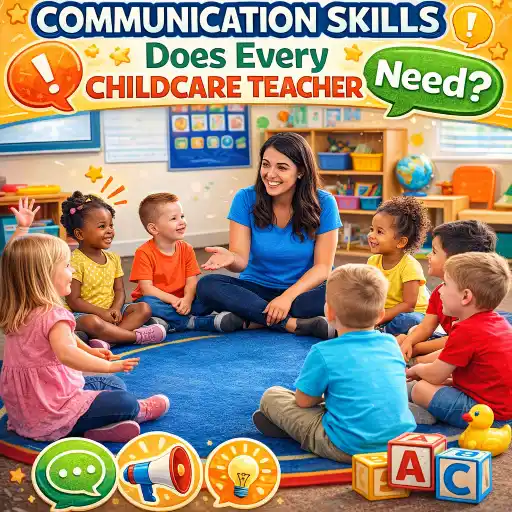
Here are the top skills teachers need. Each skill has a short example you can try tomorrow.
- Active listening — stop, look, and repeat what you heard. Example: Child says "truck." You reply, "You want the truck?" This shows you understand and models words (Language Explosions). For more techniques and examples of active listening and responsive language, see Listening and Communicating.
- Clear short language — use simple sentences and one idea at a time. Example: "Pick up blocks. Put blocks on shelf."
- Kind tone & body language — your face and voice matter. Non-verbal signals help children feel safe; learn more at SkillsYouNeed.
- Using choices — give two simple options to give power and words. Example: "Red cup or blue cup?" This reduces tantrums and teaches speech.
- Modeling and expanding language — repeat a child’s word and add one more word. Child: "ball." Teacher: "Big ball!"
- Documentation & short notes — write daily snapshots that show mood, food, and one learning highlight. Try the WIN format: What we did / Improvement / Next step (Communicating with Parents).
- Using visuals and signs — pictures, simple signs, or a first/then board help children and families who speak other languages.
- Team and family collaboration — share the same words and routines with coworkers and families so children get steady support. ChildCareEd’s family communication guides give scripts and ideas.
Each skill is easy to practice. Small steps, used every day, add up to big change in a child’s #language and behavior.
How can teachers practice and build these skills every day?
Try this simple practice plan. Use it with your team and teach new staff the same steps. Remember: state requirements vary - check your state licensing agency.
- 🧭 Start each day with a short team check-in (5 minutes). Say one goal like: "Today we will model 'help please.'" This keeps everyone using the same words.
- 📚 Use natural moments for talking. Numbered ideas:
- During routines — narrate what you do: "Washing hands. Soap, then rinse."
- During play — follow the child’s lead: "You are building a tall tower!"
- During meals — label foods and ask simple questions: "Do you like apples?"
- 🙂 Practice active listening steps every time:
- Get down to the child’s level.
- Repeat or expand what they say.
- Give wait time (count to five) so they can respond.
- 📸 Use quick notes or photos for families. Keep notes short: mood, nap, one learning highlight. The WIN format helps families read fast and feel included (Family Communication Tips).
- 🎯 Track progress and screen when needed. If a child shows repeated trouble with speech, use a screening tool or refer to specialists. See screening tools like the PLS-5 overview (PLS-5 Screening).
- 💡 Practice with short role-plays in staff meetings. Try scripts for hard talks with families from ChildCareEd and do two-minute role plays to build confidence.
- 📘 Use training and resources. ChildCareEd courses like the 9-Hour Communication Course and Language Development Buy Now $16.00 give tools you can use right away.
Practice makes it easier. When your whole team uses the same language and routines, children feel steady support and learn faster.
How do we share progress with families and avoid common mistakes?
Sharing progress should be clear, kind, and regular. Use these steps and avoid common pitfalls.
- Daily: Send a quick note with three bullets: mood, food/nap, and one learning highlight. Example format (WIN): What we did / Improvement / Next step. See Communicating with Parents for examples.
- Weekly or monthly: Send a one-page snapshot with 1–2 goals and 2 examples of work (photo or drawing).
- When worried: Prepare before the talk. Bring notes, examples, and a calm plan. Start with strengths, share facts, and ask parents what they see at home. ChildCareEd gives scripts and steps in How to Share Progress Kindly. Remember: state requirements vary - check your state licensing agency when you refer for services.
- Use tech carefully: Apps and photos help families, but always follow privacy rules and get permission.
Common mistakes — and how to avoid them:
- ❌ Only call parents for problems. ✅ Instead, share positives often so concerns come from a place of trust.
- ❌ Talk about sensitive issues in public. ✅ Schedule a private time or phone call.
- ❌ Use long reports with jargon. ✅ Keep language simple and specific (4th–5th grade level).
- ❌ Skip documentation. ✅ Write short notes and save examples; this helps follow-up.
FAQ (short answers):
- Q: How long should a parent-teacher meeting be? A: 15–30 minutes. Start with a strength, share facts, and end with a next step.
- Q: When should I screen a child for speech? A: When you see repeated trouble or little effort to communicate. Use screening tools and talk with families; see the PLS-5 guide (PLS-5).
- Q: How can we help families who speak another language? A: Use short sentences, pictures, translated notes, or an interpreter for meetings. ChildCareEd has guides on bridging cultures.
- Q: What if a parent is upset? A: Stay calm, listen, repeat their concern, and offer a short plan. Follow up in writing.
Conclusion
- 1) Use simple, steady steps each day: listen, model words, give choices, and send short notes.
- 2) Train your team and use shared language so children get the same help from every adult.
- 3) Work with families as partners — start with strengths and make a clear plan when concerns appear.
Want quick help? Start today with one sentence of praise for each child and one short note to each family. For training and tools, visit ChildCareEd’s pages on communication, courses, and sharing progress. Your clear, kind #listening and words make a big difference every day.
- Teachers, Assemble! Building Up Staff in Child Care
- Easy Steps to Resume and Interview Success
- Bienvenido! Welcoming All Families
- CDA Bridge Bundle: Family Child Care without Portfolio Review
- CDA Bridge Bundle: Infant/Toddler without Portfolio Review
- CDA Bridge Bundle: Preschool without Portfolio Review
- Equity in Action with Head Start
- Texas Director Credential
- A Guide to Effective Communication
- Bridging Cultures: Family Communication & Collaboration
- Normas de Licenciamiento de Cuidado Infantil en Virginia para Centros Diurnos Infantiles y Hogares Diurnos Familiares
- Lista para Abrir una Guardería en Casa en Virginia: Cómo Empezar
- Celebrando la amistad en el cuidado infantil durante el Día de los Mejores Amigos
- What Should You Say in a Daycare Interview If You Have No Experience?
- First Week of Pre-K Lesson Plans: What Can You Learn About Your New Class?
- Want to Become a Daycare Assistant? Start With These Essential Training Skills
- Child Care Administration Course: Are You Ready to Manage Adults, Not Just Classrooms?
- Active Supervision Examples: 10 Real Classroom Scenarios—Safe or Unsafe?
- Typical Development Meaning: Why Milestones Are Ranges, Not Deadlines
- Special Needs Training for Early Childhood Educators: Which Course Should You Take?
- Is My Preschooler Ready for Kindergarten? Milestones Beyond ABCs and 123s
- When Should a Child Care Provider Be Concerned About Speech Development?
- How Can You Choose a Coaching Format That Fits a Teacher’s Communication Needs?
- How Can Child Care Providers Respond When a Child Publicly Names a Favorite Teacher?
- When Families and Teachers Mean Different Things by “A Good Day,” How Can They Find Common Ground?
- How Can You Explain Montessori Classroom Choices to Families Without Jargon?
- How Can You Introduce a Replacement Teacher to Child Care Families?
- How Can Child Care Educators Rehearse Classroom Voice and Pacing Before Children Arrive?
- How Can You Match a New Preschool Teacher With the Right Mentor?
