Many Florida preschool teachers ask: What do we do when a child keeps acting out, and a time-out does not help? This short guide gives practical, friendly ideas you can try tomorrow. It focuses on steps that teach skills, keep everyone safe, and build strong partnerships with families and the team. You will see simple lists, links to trusted resources, and quick actions for your #Florida #preschool #behavior team.
Why does this matter in Florida preschools?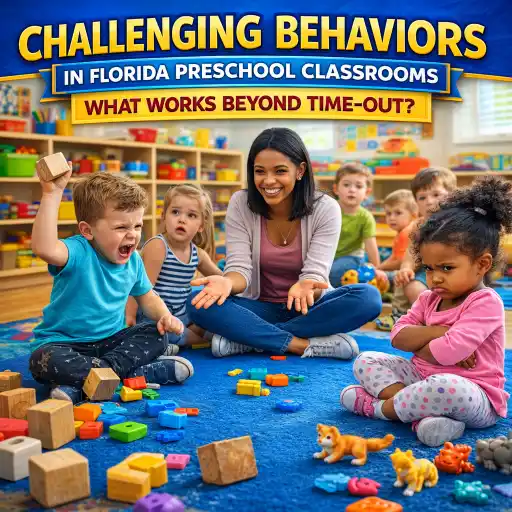
2) Good support helps everyone:
- 🙂 Children learn skills and feel safer.
- 🙂 Staff feel less stressed and more confident.
- 🙂 Families see progress at home and school.
3) Proven programs and frameworks (like PBIS and the Pyramid Model) give us a plan. Florida PBIS shares classroom tools and research that show classroom systems help children do better: Florida PBIS classroom guidance.
Why it matters: Early support saves time and keeps kids in class ready to learn. For directors: investing in training and consistent routines gives big returns for children and staff. Also, state requirements vary - check your state licensing agency.
What works beyond time-out?
- 🔹 Prevent with structure
- 1. Post a simple picture schedule at child's height (morning, lunch, outside).
- 2. Give a 2-minute warning before transitions. See ideas at ChildCareEd: How to Support Children with Challenging Behaviors.
- 🔹 Use calm, teaching responses in the moment
- 1. Get down to child level and breathe.
- 2. Name the feeling: "You look angry."
- 3. Set a short limit: "Hands are for helping."
- 4. Offer one replacement skill: "Take three deep breaths or ask for a turn." See: Managing challenging behavior without shame.
- 🔹 Teach replacement skills often
- 1. Teach words for feelings and practice breathing games.
- 2. Role-play asking for a turn during circle time. ChildCareEd offers lesson ideas: What If Every Challenging Behavior Was a Learning Opportunity?.
- 🔹 Use positive reinforcement
- 1. Catch kids doing the right thing and say exactly what they did well.
- 2. Try classroom jobs or small tokens for helping others.
- 🔹 Track patterns and use data
- 1. Note when, where, and what happens (ABC: Antecedent, Behavior, Consequence).
- 2. If behavior is frequent or risky, use functional assessment and team planning (see Florida PBIS tools: FLPBIS).
- 3. For step-by-step methods to collect behavior data and design team-based plans, see Working with behavioral challenges Part 2.
Quick tip: A time-out can be a short safety step, but it should not be the only tool. Teach the missing skill and repair the relationship after the child calms. For training that teaches these steps, see ChildCareEd courses like "The ABCs of Behavior": The ABCs of Behavior  Buy Now $55.00. If staff are exploring certification or career steps to teach in Florida, review how to become a preschool teacher in Florida for step-by-step guidance on credentials and job options.
How can Florida programs use PBIS, the Pyramid Model, and trauma-informed care?
2) Simple Tier 1 steps (do these first):
- 😊 Teach 3 simple rules with pictures.
- 😊 Use predictable routines and visual schedules.
- 😊 Reinforce positive behavior every day.
3) Use Tier 2 when a small group needs extra help. This can be a short, small-group skill lesson (sharing, calming) or a daily check-in. The Pyramid Model and PBIS both support small-group coaching and targeted supports. ChildCareEd explains small-group plans and tools for toddlers and preschoolers: Turning Behavior Around Buy Now $25.00.
4) Use Tier 3 for individual plans. When behavior is unsafe or very frequent, collect ABC data and consider a Functional Behavioral Assessment. The books and guides on functional assessment are strong tools for schools.
5) Add trauma-informed practices: keep routines predictable, build trusting relationships, and teach calming strategies. ChildCareEd offers trauma-informed tips that fit preschool rooms: Trauma-Informed Care Strategies.
6) Coaching and data matter. Regular coaching and brief data reviews keep practices strong. Florida PBIS and national PBIS centers have tools and coaching ideas: Florida Center for Inclusive Communities PBIS and the FLPBIS site.
Remember: state requirements vary - check your state licensing agency. Use the tiered approach so that supports match the child’s needs and your program’s capacity.
How do we work with families and avoid common mistakes?
Good family partnership is one of the fastest ways to help a child. Use a short, strength-based message and invite the family to share ideas.
- Start with strengths
- 1. "We love how Maya builds with blocks."
- 2. Then share one fact: "This week she grabbed toys at cleanup three times."
- 3. Offer a small plan: "We will try a 2-minute warning and teach ‘my turn.’ What works at home?" See family partnership tips at ChildCareEd: How to Support Children with Challenging Behaviors.
- Keep communication simple and regular
- 📘 Share quick notes, photos of success, or a single strategy to try at home.
- 📘 Invite families to short problem-solving meetings when needed.
- Avoid these common mistakes (and fix them)
- ⚠️ Mistake 1: Shaming language ("You’re bad"). Fix: Use factual, kind words and teach the skill.
- ⚠️ Mistake 2: Inconsistency between staff and home. Fix: Pick 1 strategy and use it for 2 weeks, then review.
- ⚠️ Mistake 3: Long lectures during meltdowns. Fix: Use one short sentence, keep safety, and teach later.
- When to ask for extra help
- 1. Behavior hurts others or happens very often.
- 2. The child’s learning is affected despite consistent strategies.
- 3. Bring in a coach, mental health consultant, or consider the programs at local universities (for example, FIU SELF-Regulation Lab summer programs: FIU STP-PreK).
Quick FAQ (4 short Qs):
- Q: How long before we see change? A: Weeks to months. Track small wins.
- Q: Is time-out never okay? A: It can be a short safety step. Always pair it with teaching and repair.
- Q: Who tells families first? A: The teacher, with director's support for serious concerns.
- Q: Where to get training? A: ChildCareEd courses like "The ABCs of Behavior" and local PBIS coaching.
Summary
1) Start with prevention: routines, visuals, and calm classroom design. 2) Respond with a short, kind, and firm script that teaches one replacement skill. 3) Use PBIS tiers and data to match supports to need. 4) Partner with families using strength-based messages. 5) Seek coaching or specialist help when behavior is unsafe or does not improve.
Good next steps: pick one small change this week (post a picture schedule, teach one replacement phrase, or give a 2-minute warning). For practical courses and guides, visit ChildCareEd: ChildCareEd, and review Florida PBIS classroom tools: FLPBIS classroom. You are not alone — steady, kind steps help children learn and help your team feel stronger.
1) Start with Tier 1 supports (whole classroom). Florida PBIS emphasizes strong classroom systems as the foundation. You can read classroom practices here: Florida PBIS classroom. Here are step-by-step strategies you can try instead of relying on time-out alone. Use these in order: prevent, respond, teach, then track.1) Children who act out are telling us something. The behavior may come from big feelings, hunger, tiredness, language limits, or a noisy room. Understanding typical developmental stages helps you match expectations and choose appropriate strategies; see the importance of understanding child development in managing challenging behaviors. The CDC explains why early help matters for behavior and long-term health: CDC: Behavior or Conduct Problems.
- Character Development for Childcare Professionals
- Administering Basic Health and Safety ONLINE
- Bienvenido! Welcoming All Families
- Birth to Five CDA Credential with Portfolio Review
- Professional Partnerships & Practices
- CDA Bridge Bundle: Preschool
- Balancing Act: Record Keeping & Supervision
- CDA Bridge Bundle: Preschool without Portfolio Review
- It's All About the Timing
- Texas Director Credential
- ❤️ ¿Cómo ayudan los educadores a las familias a acceder a los servicios que necesitan?
- 🤯 ¿Por qué este niño está teniendo un comportamiento difícil de repente?
- 🏡🗣️ ¿Cómo hablo con los padres sobre los comportamientos que su hijo aprendió en casa?
- 🥺👋 ¿Por Qué la Despedida de la Mañana es Tan Emocional?
- 😅❌ ¿Cómo Puedo Manejar a un Niño que Dice “¡NO!” a Todo en el Aula?
- Pascua En El Aula: Actividades Sencillas Para Aprender y Celebrar Con Seguridad
- Recursos en Español sobre el Sueño Seguro del Bebé
- ¿Cómo empiezo mi certificación CDA en Florida en línea?
- ¿Cómo obtengo la certificación CDA en línea en Florida?
- ¿Cómo afecta la dopamina a los niños: señales, efectos e influencias diarias?
- 10 Ejemplos de Cómo la Cultura Influye en el Desarrollo Infantil
- ¿Cuál es la Diferencia Entre la Crianza Respetuosa y la Crianza Permisiva?
- Por Qué la Supervisión Activa Es Clave para la Seguridad en el Cuidado Infantil
- Cómo Ser Maestra de Preescolar en Dakota del Norte
- Cómo Ser Maestra de Preescolar en Wisconsin
- How can Florida early learning programs include every child with exceptionalities?
- Challenging Behaviors in Florida Preschool Classrooms: What Works Beyond Time-Out?
- How can I support inclusion in Florida play and daily routines?
- Celebrando la amistad en el cuidado infantil durante el Día de los Mejores Amigos
- Canciones, juegos y preguntas de círculo para niños
