Every day you care for tiny humans who need safety, warmth, and strong relationships. This short guide helps Texas child care providers and directors with three big goals: safer sleep, stronger early #brain growth, and kinder #routines that work in group care for #infants and #toddlers. Use the simple steps below, share them with staff, and remember: state requirements vary - check your state licensing agency.
Why this matters: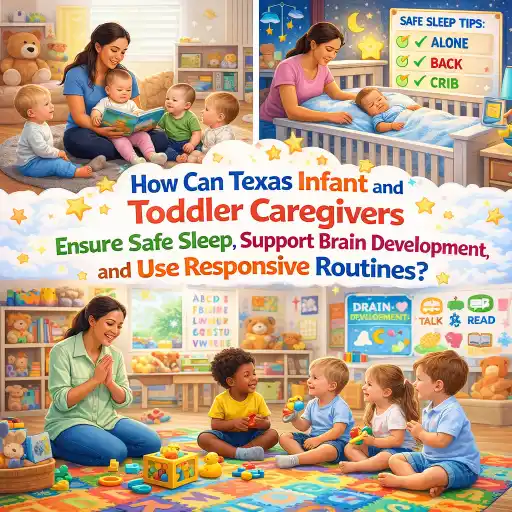
- Babies’ brains grow fast. What you do now shapes lifetime learning and health.
- Safe sleep practices save lives and are required by many funders and licensing rules.
How do we keep babies safe during sleep?
- 🛏️ Use a firm, flat surface: safety-approved crib or bassinet with only a fitted sheet.
- 🙂 Place babies on their backs for every sleep until age 1. If they roll on their own later, it’s okay to leave them in the position they choose.
- ❌ Keep the crib bare: no blankets, pillows, bumpers, or toys.
- 👕 Dress for temperature: sleep sack or light clothing — avoid overheating.
- 📍 Room-share, don’t bed-share. Keep the crib near caregivers during the first months.
These steps match CDC guidance: Providing Care for Babies to Sleep Safely and AAP advice summarized by the AAFP: SIDS and Safe Sleeping Environments. Training and written policies reduce mistakes. ChildCareEd offers SIDS and Safe Sleep courses to help staff stay current: The Importance of SIDS Training.
Quick checks for staff (daily): document crib condition, mattress fit, infant placement, and any family requests. If a medical exception is needed, get it in writing from a physician. And again: state requirements vary - check your state licensing agency.
How does responsive care help early brain development?
Key ideas:
- 1) Serve and return: when a baby coos and you answer, you help form strong connections in the #brain.
- 2) Consistent, calm care lowers stress and helps emotional regulation.
- 3) Sensory play and safe exploration grow thinking skills.
New research shows that contingent responsive parenting — noticing a baby’s signals and responding accurately and quickly — changes brain activity in ways that help emotional control and social behavior. See the study summary: Contingent responsive parenting can shape brains.
Practical steps you can use today:
- 🙂 Tune in: watch for small cues (eye contact, coos, hand-to-mouth) and name them: “You’re looking—let’s talk.”
- 🎯 Be predictable: routines (feeding, diaper, nap) are teaching moments.
- 🧩 Offer simple, safe materials for touch and sight—this supports learning and regulation.
Why this matters for programs: responsive care raises children who are calmer, easier to teach, and healthier long-term. For more classroom ideas, use ChildCareEd courses about infant development and responsive caregiving.
How can routines and reading infant cues make group care calmer and stronger?
Steps to build a responsive routine:
- 🔢 1. Create a room rhythm (not a strict clock): diaper/feeding → connection → play → rest.
- 🙂 2. Assign primary caregivers when possible so babies get consistent faces and care.
- 📋 3. Use simple tracking: who fed, when, naps, diapers; share at every shift change.
- 🎵 4. Make transitions predictable with a song, a visual cue, or a short warning.
- 🧸 5. Offer quiet “break spots” for babies who get overstimulated.
Tips for reading cues:
- Early hunger: rooting, hand-to-mouth.
- Tired: yawns, eye rubs, glassy stare — start nap routine early.
- Overstimulation: turning away or stiffening — move to a calm spot.
Tools: use the Infant and Toddler Weekly Lesson Plan Template from ChildCareEd (lesson plan template Buy Now $0.00) to plan sensory and language moments inside routines. Good notes to families build trust and continuity. Offer parent education such as our Parenting Seminars to help families learn to read infant cues and support routines at home.
What training and policies help Texas providers stay compliant and improve care?
Texas has specific training needs for infant and toddler providers. ChildCareEd offers Texas-focused bundles and courses to meet licensing hours and build skills. See Texas course listings: Childcare Courses in Texas, the All-in-One 24-hour bundle: All-in-One 24-Hour Training for Texas Infant & Toddler Providers, and the 30-hour home provider bundle: 30-Hour Training Bundle for Texas Family Child Care.
Practical compliance steps:
- 📚 1. Complete required training hours on time (use approved Texas bundles or courses).
- 📝 2. Have a written safe-sleep policy that follows AAP/CDC guidance and document staff training.
- 🔍 3. Do daily spot checks and monthly audits of sleep, cribs, and records.
- 👪 4. Share policies with families at enrollment and get signatures. If families request different care, document and seek medical notes when needed.
- ✅ 5. Keep copies of course completion and refresh training yearly.
Resources for health and safety and provider qualifications are available on ChildCareEd: Health and Safety Training Resources Buy Now $0.00 and the Texas Primary Caregiver Qualification: Texas Primary Caregiver Qualification  Buy Now $450.00. Remember: state requirements vary - check your state licensing agency before you schedule training or change policy.
Conclusion and quick FAQs
Summary: Keep sleep safe, respond with warmth, use flexible routines, and stay trained. These steps keep babies safer and support strong early development.
Common mistakes and how to avoid them:
- ❌ Mistake: Letting soft items stay in cribs. Fix: Use a checklist and spot checks each nap.
- ❌ Mistake: Following only the clock, not cues. Fix: Train staff to spot early cues and use flexible blocks.
- ❌ Mistake: Poor family communication. Fix: Use clear written policies and daily notes.
FAQ (short):
- Q: Can a baby sleep on the side? A: No — place babies on their backs until 1 year, per AAP/CDC guidance.
- Q: What if a parent asks for a blanket? A: Use a sleep sack and get the family on board with policy; medical exceptions need doctor notes.
- Q: How do we teach staff to read cues? A: Use short practice sessions, cue charts, and share patterns at shift change.
- Q: Where to get Texas training? A: See ChildCareEd Texas bundles and course listings linked above.
You don’t need perfection—just consistent care, clear policies, and teamwork. For more tools, training, and printable templates, visit ChildCareEd and pick the courses and resources that fit your program.
Babies build the foundation of learning in the first years. Every loving response you give is like adding a brick to their brain. Read about how early educators shape future learners: The Brain Architects. Safe sleep is one of the most important parts of infant care. Follow clear steps every nap and night. See ChildCareEd’s short guide for practical checks and family talk tips: Understanding Safe Sleep and Reducing the Risk of SIDS.In group care you balance each child’s needs with the room’s flow. Use routines that are flexible and responsive. ChildCareEd has practical articles and templates on infant schedules and cues: Infant schedules in group care and Infant cues 101.
- Positive Attention: Interactions and Supervision of Infants and Toddlers: For Workforce Solutions
- 45 Hour Infant and Toddler Methods and Materials
- 24 Hour Texas Pre-Service
- CDA Bridge Bundle: Infant/Toddler without Portfolio Review
- 45-Hour Infant and Toddler Curriculum
- Positive Attention: Interactions & Supervision for Infants & Toddlers
- Safe Sleep Training
- Texas Director Credential
- 16 Hour Texas Pre-Service
- Infant and Toddler Trainings
- CDA Certification en Español: Recursos y Consejos para Educadores Bilingües
- 😫🧸 ¿Qué hacer cuando un bebé no quiere dormir la siesta en el aula?
- Recursos en Español sobre el Sueño Seguro del Bebé
- 45 horas para infantes y niños pequeños: cómo certificarse en línea
- ¿Cuáles son los pasos, requisitos y opciones en línea para la certificación de 90 horas en cuidado de Infantes/Toddlers en Maryland?
- 10 Ejemplos de Cómo la Cultura Influye en el Desarrollo Infantil
- Capacitación en Salud y Seguridad Preventiva en Línea para Proveedores de Cuidado Infantil
- Proporciones de Cuidado Infantil y Tamaños de Grupo por Edad en Virginia (Guía Rápida para Centros y Hogares)
- Lista para Guardería en Casa en Texas: Cómo Iniciar una Guardería en el Hogar
- Cómo Ser Maestra de Preescolar en Dakota del Norte
- Capacitación Previa al Servicio para Proveedores de Cuidado Infantil en Nevada
- How can Texas infant and toddler caregivers ensure safe sleep, support brain development, and use responsive routines?
- 45-Hour Child Care Training in Texas: Requirements and Options
- What is responsive caregiving for infants and how do we do it well?
- How Can Child Care Providers Support Infant Brain Development?
- Cómo simplificar la capacitación para sus empleados de daycare
- How Do Infants Learn Through Everyday Caregiving Routines?
- How Can We Create a Calm and Nurturing Infant Classroom?
- How Can Child Care Providers Support Infant Development?
