A disagreement over a block or a place in line can quickly become a teachable moment in communication, self-regulation, and care for others. The most helpful adult response keeps children safe while giving them a chance to practice finding a solution. For practical strategies you can bring into daily interactions, explore ChildCareEd’s You’re Not My Friend Anymore: Learning Conflict Resolution  Buy Now $16.00; providers who want a broader foundation in positive guidance can also consider Social Foundations and Responsive Classrooms Buy Now $24.00.
Why is peer conflict a valuable learning opportunity?
Young children are learning to manage strong feelings, communicate needs, wait, take another person’s perspective, and negotiate. Those abilities do not develop overnight, so disputes are a normal part of early relationships. A child who grabs a toy or shouts may need a safer, clearer way to express a need—not a label that defines them as unkind or difficult.
When educators respond with warmth and firm limits, children can learn that feelings are acceptable while harmful actions are not. They also begin to understand that peers have their own ideas, needs, and boundaries. The goal is not a conflict-free classroom; it is a community in which children gradually become more capable of handling disagreements safely and respectfully.
As Eastern Connecticut State University’s early childhood education resource explains, conflict can be a learning opportunity: adults can coach skills rather than simply impose an immediate solution. This takes time, especially when children are upset, but repeated practice supports growing independence. The NAEYC guidance on peacemaking also highlights the value of noticing children’s efforts to communicate feelings, solve problems, and make peace.
- Children practice #communication and listening in meaningful situations.
- They build #empathy by noticing that others may feel differently.
- They gain confidence as they help shape solutions and repair relationships.
How can educators prepare children before disagreements arise?
Children are more likely to use a skill during a difficult moment if they have practiced it during calm, playful times. Introduce a small set of simple phrases and demonstrate them through puppets, books, songs, or short role-play. Examples include “Stop, please,” “I’m using it,” “Can I have a turn next?” and “I need help.” Keep the words appropriate to each child’s age, language, and communication abilities.
Visuals can make expectations easier to understand and remember. Use pictures, gestures, feeling cards, or communication supports alongside spoken language. A child may point, sign, use an augmentative communication device, or accept an adult’s model rather than say a phrase independently. Offer time to respond; language and emotional regulation develop at different rates.
Make the classroom environment part of your prevention plan. Observe when and where conflicts tend to happen, then consider whether materials, space, or routines are contributing. The ECE Resource Hub recommends anticipating common disputes, practicing problem-solving in advance, and giving children an active role in solutions.
- 🧸 Add duplicate high-interest materials when feasible and organize play areas to reduce crowding.
- Use visual timers or turn cards to make waiting more predictable.
- Give transition warnings and allow enough time to finish or pause play.
- Set up a quiet, welcoming place with feeling visuals and simple calming tools.
Teach positive expectations such as “safe hands and kind words,” and show children what those actions look like. State requirements vary - check your state licensing agency for applicable behavior-guidance requirements.
What should teachers do in the moment?
When conflict becomes intense, safety and regulation come before discussion. Move close enough to prevent harm, use a calm voice, and check whether anyone is hurt. If needed, block unsafe actions with a brief, clear limit: “I won’t let you hit. Hitting hurts.” You can acknowledge a feeling without approving an unsafe behavior: “You both wanted the truck, and you look frustrated.”
NAEYC’s three-step approach to helping children navigate conflict offers a useful structure: describe the behavior, explain its implications, and guide children toward an appropriate alternative. Keep statements concrete and brief. For example: “You pulled the shovel from Maya. She fell. Pulling can hurt; you can ask for a turn or choose another shovel.”
Once children are calm enough to participate, help each child communicate what happened and what they need. Avoid turning the exchange into a search for a culprit. Acknowledge each perspective and tailor your support: one child may need you to supply the words, while another may be ready to suggest a solution.
- Stop unsafe actions and attend to anyone who needs comfort or care.
- Name what you observe and acknowledge emotions without assigning blame.
- Prompt a useful phrase, such as “I need a turn” or “Please stop.”
- Offer two or three safe options—trade, take turns, play together, or choose another material.
- Check whether the plan works for both children and follow up if needed.
Adults should remain present and responsive without taking over every decision. Some children will need a supported choice; others can brainstorm independently.
How can children practice empathy, problem-solving, and repair?
Make room for both children to express their points of view. For preschoolers, brief prompts can be enough: “What happened?” “How did you feel?” “What did you need?” and “What could we try?” Younger children may respond better to a choice of words, a picture, a gesture, or an adult narrating what they notice. The aim is not to demand a sophisticated explanation, but to help each child feel heard and move toward a safe next step.
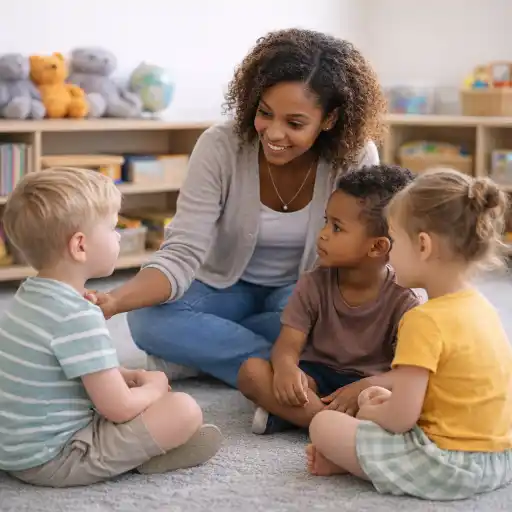
Invite children to think of more than one solution before choosing a plan. They might use a timer, trade materials, find another item, play alongside one another, or ask an adult for help. Help them check that the proposed plan is safe and acceptable to everyone involved. Follow up with a specific observation: “You both listened and agreed to take turns.” This recognizes the strategy rather than praising compliance alone.
When harm has occurred, guide children toward meaningful repair after they are regulated. Repair might mean returning an item, helping rebuild a tower, checking whether a peer is okay, offering space, or giving a sincere apology when ready. Do not force a hug, eye contact, or an immediate apology; respect the other child’s boundaries and the children’s readiness.
Stories, puppets, and dramatic play provide low-pressure ways to rehearse these skills. Pause a story when characters disagree and ask what they could say or do. Celebrate everyday moments of cooperation, listening, and respectful problem-solving so children can recognize their own growing strengths.
How can providers build consistent practice across the classroom?
Children learn more readily when adults respond in predictable, respectful ways. Directors and teaching teams can agree on a few shared scripts, practice them in staff meetings, and post simple visual prompts near areas where conflict commonly occurs. Coaching can focus on practical details: adult proximity, tone of voice, the words used, time given for children to respond, and whether the adult taught a safer alternative.
Families are valuable partners. Share objective observations, describe the skill the classroom is practicing, and invite families’ perspectives without blame. For example: “We’re practicing asking for a turn at the block area. What words work well for your child at home?” When appropriate, adapt key phrases and visuals to reflect children’s home languages and family communication practices.
Consistency does not mean using one script for every child. A toddler may need a brief phrase and immediate adult support; a preschooler may be ready to hear a peer’s perspective or help choose a plan. Children who communicate in different ways may benefit from individualized visual or other communication supports. The NAEYC discussion of preschool peer interactions reminds educators that children’s social relationships can be complex; careful observation can reveal what is happening beneath an apparent disagreement.
- Choose one or two conflict-resolution phrases to practice consistently this week.
- Rehearse them in a calm moment with puppets or a familiar classroom scenario.
- Notice and describe children’s attempts to listen, ask, negotiate, and repair.
- Review recurring patterns as a team and adjust routines or the environment where helpful.
For additional professional learning, explore ChildCareEd courses that extend these classroom strategies: Teach with Respect ONLINE Buy Now $24.00 focuses on respectful relationships and conflict guidance; Supporting Social Learning: Creating Classrooms that Care Buy Now $24.00 addresses community and children’s problem-solving; and Raising Peaceful Learners: The Montessori Advantage Buy Now $16.00 explores grace, courtesy, and peace education.
Conclusion: What are the best ways to teach young children to solve peer conflicts?
The strongest approach combines prevention, calm coaching, developmentally appropriate practice, and meaningful repair. Prepare children with simple language and playful rehearsal; design routines and spaces that reduce avoidable friction; and during conflict, prioritize safety, acknowledge feelings, and guide children toward choices they can help make.
There is no expectation that young children will resolve every disagreement independently. Progress may look like pausing before grabbing, pointing to a visual, accepting a turn-taking plan, or helping rebuild a peer’s structure. Notice these small steps. With steady support from educators and families, ordinary disagreements can become practice in #problem-solving, #self-regulation, and respectful relationships.
- 45 Hour Child Growth and Development
- You're Not My Friend Anymore: Learning Conflict Resolution
- CDA Home Visitor Subject Area 3 Part 3 Birth to 5
- Basic Health & Safety and Breastfeeding Awareness
- Birth to Five CDA Credential with Portfolio Review
- Pediatric RSV First Aid & CPR/AED
- Emergent Learning & Development
- Texas Director Credential
- Prevention of Sudden Infant Death Syndrome and Use of Safe Sleep Practices
- CDA Certification en Español: Recursos y Consejos para Educadores Bilingües
- ❄️ ¿Qué actividades al aire libre funcionan bien para los niños de Illinois en cada estación? 🌷🍂
- Consejos de Supervisión Activa para Salones de Preescolar y el Juego al Aire Libre
- Best Friends Day: Helping Children Learn Kindness and Friendship
- Celebrando la amistad en el cuidado infantil durante el Día de los Mejores Amigos
- Canciones, juegos y preguntas de círculo para niños
- How can we teach kindness and friendship in our classroom?
- How Can School-Age Programs Teach Conflict Resolution That Actually Works?
- Team-Building Games for Preschoolers That Teach Cooperation
- Time-In or Time-Out? 7 Real Classroom Scenarios and What to Try
- How Can Child Care Providers Build Young Children’s Problem-Solving Skills?
- How Can Child Care Providers Help Children Build Healthy Friendship Skills?
- How Can Child Care Providers Teach Young Children About Fairness and Equity?
- How Can Child Care Providers Teach Children to Solve Conflicts With Each Other?
- How Can Child Care Providers Teach Young Children to Take Turns?
- How Can Child Care Providers Teach Sharing Without Forcing It?
- Why Do Young Children Tattle, and How Should Teachers Respond?
- What Are the Best Ways to Support Cooperative Play in Preschool?
- What Are the Best Ways to Teach Young Children to Solve Peer Conflicts?
