Frequent tattling can interrupt play, learning, and your own ability to respond calmly—but it also signals that children are still learning rules, relationships, and problem-solving. For a practical foundation in positive guidance, explore Social Foundations and Responsive Classrooms Buy Now $24.00, which helps providers strengthen self-regulation, conflict resolution, and age-appropriate problem-solving while earning professional development hours. If you want a broader behavior framework, The ABCs of Behavior: Turning Challenges into Learning Opportunities  Buy Now $55.00 can help you examine what happens before and after recurring behavior.
Why does tattling happen so often in early childhood?
Tattling is usually developmental communication, not evidence that a child is manipulative or “bad.” Young children are learning classroom rules and may believe that reporting every rule violation is responsible. They often understand rules before they can consistently apply them to themselves, regulate strong emotions, take another child’s perspective, or negotiate a solution.
Children may also tattle to seek adult attention, gain approval, restore a sense of fairness, avoid a difficult interaction, or get a peer in trouble. A child who says, “Maya is building in the reading area!” may be demonstrating rule awareness, requesting reassurance, or testing whether the teacher notices them. Looking beyond the words helps teachers respond to the underlying need.
Chronic tattling can increase when children receive the most intense adult attention after making complaints. Conversely, a child who feels overlooked may use tattling as a reliable path to connection. Observe when it occurs: during transitions, crowded centers, competitive games, or moments when the child is tired or uncertain. Patterns can reveal whether the classroom needs clearer expectations, more supervision, additional language support, or stronger opportunities for positive connection.
That does not mean every complaint should be dismissed. The teacher’s task is to distinguish a minor, safe problem from a situation requiring adult help while preserving the child’s trust.
How can teachers explain tattling versus telling?
Use simple, consistent language. A helpful distinction is: tattling means reporting a peer’s wrongdoing when everyone is safe and the child can handle the problem or let it go. Telling means alerting an adult because someone is hurt, unsafe, threatened, unable to stop a harmful behavior, or needs help managing the situation.
Young children need concrete examples rather than abstract lectures. During circle time, sort short scenarios with the group:
- “He touched my lunchbox.” This may be a minor problem that can be handled with words.
- “She took my lunch, and I have no food.” This requires adult assistance.
- “He took the block I wanted.” The children might negotiate or request a turn.
- “The tower fell on me, and I am hurt.” An adult should respond immediately.
Invite children to ask three questions: Is anyone hurt or in danger? Is the problem continuing or frightening? Have I tried a safe strategy, and do I still need help? Clarify that asking for help is always appropriate when safety is involved. Avoid labels such as “tattletale,” which can shame children and discourage important reporting.
Revisit the distinction through role-play, puppets, photographs, and classroom books. Repetition is not a sign that children failed; it is how a developing concept becomes usable during emotionally charged moments.
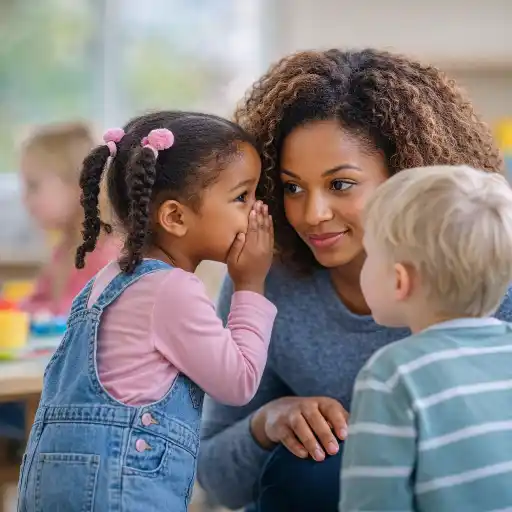
What should a teacher say when a child tattles?
Start with calm acknowledgment rather than immediate judgment: “You noticed something and wanted me to know.” This validates the child’s communication without automatically rewarding the complaint with a lengthy investigation. Then briefly assess safety: “Is anyone hurt? Is someone in danger? Does someone need my help right now?”
If the situation is safe, return responsibility to the children with supportive prompts:
- “What happened, and what could you say to your friend?”
- “Did you ask for a turn?”
- “Would you like help practicing the words?”
- “You can say, ‘Please stop,’ ‘I’m using that,’ or ‘Can I have a turn when you are finished?’”
When a child reports a genuine concern, respond promptly and specifically: “Thank you for telling me. I see that Jordan is crying, so I will help.” This teaches that reporting is a responsible act. A brief, predictable response is especially useful when the same child repeatedly seeks adult attention. After addressing safety, provide positive attention at other times—during play, arrival, or helping routines—so connection is not dependent on complaints.
Reframing can also shift the interaction. If a child reports that a peer has not cleaned up, say, “You noticed the area needs help. Would you like to invite your friend to clean with you?” The goal is not to make the child responsible for enforcing every rule, but to redirect rule-monitoring toward constructive participation.
How can teachers build children’s conflict-resolution skills?
Problem-solving must be taught before it can be expected. Teach a short routine and practice it when children are calm: stop, name the problem, express a feeling or need, listen, suggest solutions, and ask for adult help when necessary. In conflict, teachers can scaffold rather than take over.
A practical guidance sequence is:
- Describe the behavior and feelings: “You are both reaching for the truck. You look frustrated.”
- Explain the implication: “Grabbing can hurt hands, and both children need a safe way to play.”
- Offer an alternative: “You can ask for a turn, use the timer, trade, or choose another truck.”
When emotions are intense, regulate first. Kneel nearby, block unsafe actions gently, reduce language, and offer breathing, water, movement, or a quiet space. Children cannot reliably negotiate while overwhelmed. Once calm, help each child describe what happened without assigning a permanent villain or victim.
Use puppets and role-play to rehearse language such as “I feel upset when you take it,” “Please stop,” “Can I join?” and “I need teacher help.” Offer choices suited to children’s developmental levels. Some children need exact words; others can generate their own solutions with a prompt. Celebrate effort: “You used words and stayed safe while solving that problem.”
For additional professional learning on conflict resolution, consider You’re Not My Friend Anymore: Learning Conflict Resolution Buy Now $16.00. It focuses on developmentally appropriate ways to teach young children creative solutions.
How can the classroom environment reduce unnecessary tattling?
Many tattles are predictable responses to preventable friction. Directors and teachers can examine the environment, schedule, and supervision patterns before treating the behavior as an individual problem. Crowded centers, scarce materials, long waits, unclear turn-taking, and abrupt transitions create conditions in which children need more adult support.
- Post a visual “safe to solve” and “tell an adult” chart at children’s eye level.
- Provide duplicate high-interest materials, timers, turn-taking cards, and clearly defined spaces.
- Teach expectations positively: “We keep bodies safe” and “We use words to solve problems.”
- Schedule regular role-play and review rather than waiting for conflict to occur.
- Notice cooperation, helpfulness, flexible thinking, and safe reporting aloud.
- Coordinate language with assistants and families so children hear consistent messages.
🧩 A problem-solving area can include emotion cards, puppets, “I” statement prompts, and a small visual sequence. It should never replace supervision or become a place where children are sent away alone to manage emotions beyond their capacity. A delayed-concern basket or private check-in time may reduce interruptions for older preschoolers, but safety concerns should never be postponed, and children should not be required to write what they cannot yet express.
Review classroom data informally: When do tattles increase? Which materials or peer groupings are involved? Is one child being targeted? Environmental changes are often more effective than repeated reminders to “stop tattling.”
How should teachers avoid common mistakes?
The most common mistake is treating all tattling as identical. A complaint about a missing puzzle piece is not equivalent to disclosure of repeated intimidation, injury, discrimination, or unsafe supervision. Teachers should investigate concerns involving harm, patterns of exclusion, power imbalances, or a child’s inability to stay safe. State requirements vary—check your state licensing agency—and follow your program’s safety, supervision, and mandated-reporting policies.
Another pitfall is publicly shaming the child or demanding an apology before the children understand the impact of their actions. Guidance should protect dignity while addressing behavior. Avoid conducting a dramatic courtroom-style investigation over every minor disagreement; it can intensify attention and competition. Instead, gather enough information to ensure safety, then coach the next step.
Do not rely on planned ignoring when a child may be seeking help. A neutral response to a minor complaint is different from refusing to listen. Likewise, avoid forcing children to solve conflicts independently when there is aggression, fear, persistent harassment, or a significant developmental or communication barrier.
Finally, do not expect one lesson to eliminate tattling. Track progress over weeks, reflect with colleagues, and adapt supports. If a child’s reports are frequent, fearful, unusually intense, or accompanied by withdrawal, aggression, regression, or signs of anxiety, consult families and appropriate specialists according to program procedures.
Conclusion: What is the most supportive response to tattling?
Young children tattle because they are learning rules, seeking connection, pursuing fairness, and developing the language and self-regulation needed to solve problems. The most effective teacher response is neither automatic dismissal nor adult arbitration of every complaint. It is a balanced process: check safety, distinguish telling from tattling, acknowledge the child, coach a developmentally appropriate strategy, and provide immediate protection when help is needed.
Over time, consistent guidance transforms interruptions into learning opportunities. Children become more capable of saying what they need, listening to peers, negotiating, and recognizing when adult involvement is necessary. Teachers also gain a calmer, more responsive classroom culture when they design environments that prevent avoidable conflicts and intentionally notice cooperation.
In short, the goal is not simply to stop tattling. It is to help children become safe, empathetic, and confident communicators while ensuring that every legitimate concern is heard.
Related ChildCareEd courses
- Social Foundations and Responsive Classrooms Buy Now $24.00
- The ABCs of Behavior: Turning Challenges into Learning Opportunities Buy Now $55.00
- You’re Not My Friend Anymore: Learning Conflict Resolution Buy Now $16.00
- Viewing Guidance in a Positive Light Buy Now $24.00
- From Tantrums to Triumphs: Equipping Preschoolers with Self-Regulation Skills Buy Now $25.00
- 45 Hour Child Growth and Development
- CDA Home Visitor Subject Area 3 Part 3 Birth to 5
- 45 Hour Preschool Methods and Materials
- The ABCs of Behavior: Turning Challenges into Learning Opportunities
- 45 Hour School Age Methods and Materials
- CDA Bridge Bundle: Family Child Care without Portfolio Review
- CDA Bridge Bundle: Infant/Toddler without Portfolio Review
- CDA Bridge Bundle: Preschool without Portfolio Review
- Connections That Count: Building Relationships in Child Care
- 🔍 ¿Qué ves cuando observas a un niño aprender?
- 🤯 ¿Por qué este niño está teniendo un comportamiento difícil de repente?
- 🚨 Reporte Obligatorio en Nevada
- Recursos en Español sobre el Sueño Seguro del Bebé
- ¿Cómo pueden los equipos de cuidado infantil practicar habilidades rápidas de primeros auxilios en situaciones reales?
- Capacitación en Salud y Seguridad Preventiva en Línea para Proveedores de Cuidado Infantil
- Proporciones de Cuidado Infantil y Tamaños de Grupo por Edad en Nueva Jersey (Guía Rápida para Centros y Hogares)
- Lista para Abrir una Guardería en Casa en Virginia: Cómo Empezar
- Lista para Abrir una Guardería en Casa en Carolina del Norte: Cómo Empezar
- Cómo Celebrar el Día Nacional del Kindergarten
- Lista para Guardería en Casa en Illinois: Cómo Iniciar una Guardería en el Hogar
- Lista para Guardería en Casa en California: Cómo Iniciar una Guardería en el Hogar
- Lista para Guardería en Casa en Texas: Cómo Iniciar una Guardería en el Hogar
- Apoyo en Preescolar para Retrasos del Habla: Estrategias Simples que Ayudan
- Retraso del Habla en la Guardería: Cómo Pueden Ayudar los Proveedores
- Capacitación Previa al Servicio para Proveedores de Cuidado Infantil en Dakota del Norte
- Canciones, juegos y preguntas de círculo para niños
- Cómo simplificar la capacitación para sus empleados de daycare
- Why Do Young Children Tattle, and How Should Teachers Respond?
