When two children reach for the same truck, the moment can become either a power struggle or a meaningful lesson in cooperation. Intentional turn-taking practice helps children build communication, patience, empathy, and self-regulation; for deeper guidance, explore Supporting Social Learning: Creating Classrooms that Care  Buy Now $24.00, which offers practical strategies for building relationships, problem-solving, and open dialogue in early childhood classrooms.
Taking turns is not a single behavior. It includes waiting, noticing another person’s needs, communicating a request, relinquishing an object or speaking role, and returning to the interaction. These capacities develop gradually, so educators should view conflict as information and an opportunity for supported practice rather than as evidence of defiance.
Why does turn-taking matter in early childhood?
Turn-taking is woven into nearly every part of group care: children wait for snack, listen during circle, use shared materials, join games, and participate in conversations. The skill supports social reciprocity—the back-and-forth exchange through which children learn to attend, respond, initiate, and remain connected. Research and professional guidance in the references connect these interactions with language growth, emotional communication, peer relationships, and problem-solving.
Developmental expectations matter. Very young children are still developing perspective-taking, impulse control, working memory, and an understanding of time. An unwillingness to share is therefore often typical, especially for toddlers. Educators can maintain high expectations while remaining realistic: the goal is not instant generosity, but increasing participation with appropriate support.
- Turn-taking supports communication and listening.
- Waiting strengthens #selfregulation and flexible thinking.
- Shared play creates opportunities to practice #empathy.
- Negotiating turns helps children solve problems with words.
Warm relationships are the foundation. Children are more likely to attempt a difficult social behavior when an adult responds calmly, respectfully, and predictably. NAEYC and Head Start guidance emphasize that trusting relationships, consistent routines, and intentional teaching work together to promote social and emotional competence.
How can educators teach the language of taking turns?
Children need usable words and gestures before they can reliably use them during conflict. Introduce short phrases during calm moments, model them repeatedly, and practice them with puppets, dolls, or familiar classroom materials. Pair spoken language with gestures, picture cards, or signs so that children with emerging language have multiple ways to participate.
- Request: “Can I have a turn when you are finished?”
- Predict: “You go first, then me.”
- Relinquish: “I’m all done. Your turn.”
- Wait: “I can wait. I can play with this while I wait.”
- Repair: “I’m sorry. Are you okay?”
Use a simple prompt-and-practice cycle: give one brief cue, provide an immediate chance to try, and acknowledge the specific behavior. For example, say, “Ask Maya for a turn,” then praise, “You asked with words and waited for her answer.” Specific feedback is more useful than general statements such as “Be nice.”
Conversational turns deserve equal attention. During conversations, pause after a child speaks, listen carefully to verbal and nonverbal responses, and avoid doing all the talking. Invite children to comment, answer, or ask a question. A talking object can make the turn visible during group discussions, but children should also learn that facial expressions, pauses, gestures, and questions can signal a conversational turn.
Which classroom routines provide meaningful practice?
Short, repeated routines are more effective than occasional lectures. Plan opportunities across the day so children practice turn-taking in authentic contexts rather than only during a designated social-skills lesson.
- 😊 Buddy jobs: Pair children to pass napkins, water plants, or return materials. Rotate roles so each child experiences leading and assisting.
- Circle exchanges: Pass a beanbag or picture card; the child holding it may share, point, sign, or answer.
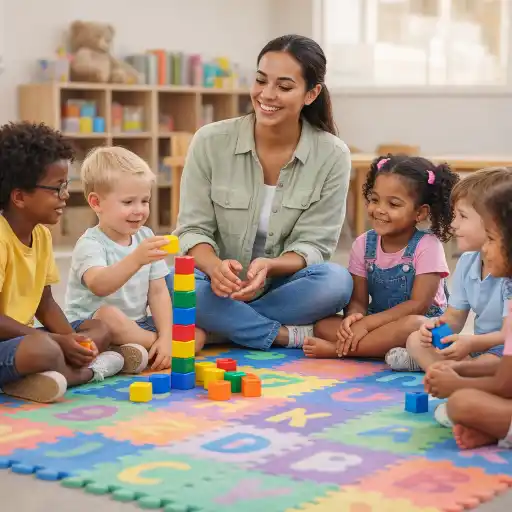
- Cooperative construction: Invite children to add one block at a time to a shared structure.
- Storytime: Let children take turns turning pages, lifting flaps, predicting what happens next, or choosing a book.
- Movement games: Roll a ball, pop bubbles, freeze during music, or alternate being the caller in “Simon Says.”
- Shared responsibilities: Rotate helper roles during snack, cleanup, and transitions.
Begin with activities that have short waits and predictable outcomes. A back-and-forth ball game may be more developmentally appropriate for a toddler than a competitive board game with multiple rules. Increase complexity only when children are demonstrating success.
Play is especially valuable because it gives children a reason to communicate and cooperate. The ChildCareEd course The Best Promotion is Play Buy Now $24.00 can extend this work by helping providers plan play experiences that foster cooperation, creativity, problem-solving, and social-emotional growth.
How should adults support waiting and shared materials?
Waiting is easier when it is concrete, brief, and predictable. Use a sand timer, countdown clock, first-then board, turn card, or name list when those tools clarify the sequence. Say exactly what will happen: “First Jordan has the truck. When the sand is gone, it is Kai’s turn. While you wait, you may build with these blocks.”
Timers are not universally helpful. Some children become distressed when an alarm abruptly interrupts complex play. In those situations, use a verbal cue such as, “When you are finished, Elena is next,” or invite the child to identify a natural stopping point. The tool should reduce uncertainty, not create a new source of stress.
Sharing does not always mean surrendering a beloved object immediately. Consider the context and offer equitable options:
- Give the child a reasonable uninterrupted turn when the activity permits it.
- Offer a trade or a parallel role: “You can build the road while Amir drives.”
- Provide duplicate or open-ended materials when competition is predictable.
- Use a visual turn chart for high-interest equipment such as tricycles or tablets.
- Invite children to help create the classroom rule and practice it before conflict occurs.
When conflict begins, move close and protect safety: “I can’t let you hit. Hands stay safe.” Then narrate neutrally: “You both want the red truck.” Validate the feeling without endorsing grabbing, and offer two or three realistic choices. Children learn more from this brief coaching than from a long lecture during distress.
How can providers support inclusion and individual differences?
Turn-taking is influenced by language, temperament, attention, sensory processing, executive functioning, and prior experience. A child who grabs may not yet understand the sequence, may be unable to wait for the language response, or may be overwhelmed by noise and proximity. Individualizing support is not lowering expectations; it is providing access to the skill.
- Prime: Before free play, tell the child who they can approach and rehearse the exact phrase.
- Visualize: Use photos, symbols, first-then boards, or a simple social story.
- Reduce complexity: Begin with one peer, one material, and very short turns.
- Offer communication choices: Accept pointing, signing, eye gaze, a speech device, or a picture exchange.
- Adapt the environment: Create quieter areas, increase space, or provide accessible materials.
- Use peer support thoughtfully: Teach peers how to invite, wait, and respond rather than assigning a child an unprepared helper.
Family partnership strengthens consistency. Share one or two classroom phrases with families and invite information about cultural expectations around possessions, waiting, and sharing. Document patterns rather than labeling a child: note the context, the adult support provided, the child’s response, and what helped. If concerns persist, collaborate with families and appropriate specialists. State requirements vary - check your state licensing agency.
Directors can support staff by selecting common language, modeling responses, and reviewing brief observations during team meetings. The course Social Foundations and Responsive Classrooms Buy Now $24.00 is another relevant professional-development option for strengthening positive guidance, prosocial behavior, conflict resolution, and age-appropriate problem-solving.
What common mistakes should educators avoid?
Even caring adults can unintentionally turn turn-taking into a compliance test. A strengths-based approach protects children’s dignity while still establishing clear limits.
- Forcing immediate sharing: Avoid taking an object from one child simply because another child wants it. Teach a request, a waiting plan, or a trade when safety allows.
- Expecting adult-level patience: Start with seconds, not lengthy waits. Increase the challenge gradually.
- Using vague directions: Replace “Share” with “Ask for a turn,” “Wait beside the shelf,” or “Choose the blue blocks while you wait.”
- Lecturing during a meltdown: Use one calm safety statement, help the child regulate, and teach the social lesson later.
- Praising only the outcome: Notice attempts, gestures, waiting, asking, recovering, and repairing—not only successful sharing.
- Using one strategy for every child: Observe whether timers, verbal cues, visuals, or natural stopping points actually help.
When a child refuses, remain calm and avoid framing the interaction as a contest of wills. You might say, “You are not ready to give it up. You may finish this part, then we will check again,” or “You may trade for the blue truck.” If aggression occurs, stop it immediately and separate materials as needed for safety. Removal should protect people, not replace instruction.
How can teams measure progress without making children perform?
Observation should guide teaching, not rank children. Choose one small goal, collect brief notes, and review progress over time. Useful indicators include whether a child can attend to a cue, wait briefly with support, request a turn, accept a peer’s request, use a calming strategy, or repair after conflict.
A simple team plan might include:
- Select one target phrase, such as “Your turn next.”
- Practice it for two to five minutes during a predictable routine.
- Use the same cue across classrooms and with families when appropriate.
- Record one success and one next step per child each week.
- Adjust the environment or level of support based on observations.
Progress may look small: a child points to the next name on a turn chart, waits while holding a fidget, or accepts a peer’s “not yet” without grabbing. These are meaningful developmental steps. Celebrate them privately or naturally rather than turning every interaction into a public performance.
For providers seeking additional training, Brighter Futures: Social Emotional Development Buy Now $16.00 explores emotional development, compassionate interactions, and the social-emotional foundations that make turn-taking possible. Course relevance and training-hour acceptance can vary by state, so verify requirements with the appropriate licensing agency.
Conclusion: How can educators make turn-taking part of everyday care?
Young children learn to take turns through warm relationships, clear language, predictable routines, meaningful play, and repeated supported practice. The most effective approach is neither forcing children to surrender materials nor ignoring conflict. Instead, educators keep children safe, name the problem, validate feelings, teach practical scripts, offer fair choices, and acknowledge each attempt to cooperate.
Keep this checklist visible:
- Model “my turn,” “your turn,” “when you’re finished,” and “I can wait.”
- Use short waits and concrete visual supports.
- Embed practice in play, conversation, snack, cleanup, and transitions.
- Adapt materials, communication, and group size for individual learners.
- Coach repair and celebrate small gains.
- Partner with families and use observations to plan next steps.
Ultimately, taking turns is not merely about sharing a toy. It is about learning to participate in a community—to listen, communicate, wait, negotiate, and reconnect. With consistent, respectful guidance, everyday classroom conflicts become opportunities for children to develop skills that support #friendships, learning, and lifelong relationships.
- Turning Behavior Around for Toddlers and Preschoolers
- Lesson Planning for Preschoolers
- Emergent Learning & Development
- The ABCs of Behavior: Turning Challenges into Learning Opportunities
- Birth to Five CDA Credential with Portfolio Review
- Pediatric RSV First Aid & CPR/AED
- Play with Purpose: Supporting Children with Autism
- Creating Environments that Nurture Growth and Community
- Texas Director Credential
- Trauma-Sensitive Care: Supporting Young Children with Empathy
- 🔍 ¿Qué ves cuando observas a un niño aprender?
- Regulaciones de Licenciamiento de Cuidado Infantil en California para Centros y Hogares de Cuidado Infantil Familiar
- Proporciones de Cuidado Infantil y Tamaños de Grupo por Edad en Maryland (Guía Rápida para Centros y Hogares)
- Proporciones de Cuidado Infantil y Tamaños de Grupo por Edad en Nueva Jersey (Guía Rápida para Centros y Hogares)
- Proporciones de Cuidado Infantil y Tamaños de Grupo por Edad en Virginia (Guía Rápida para Centros y Hogares)
- Cómo Trabajar en el Cuidado Infantil en Carolina del Norte: Requisitos y Pasos
- Cómo Trabajar en el Cuidado Infantil en California: Requisitos y Pasos
- Capacitación Previa al Servicio para Proveedores de Cuidado Infantil en Virginia
- How can Georgia preschool teachers use positive guidance to help preschoolers share during indoor play?
- How can rainy day indoor activities help preschoolers learn kindness and cooperation in Georgia?
- Celebrando la amistad en el cuidado infantil durante el Día de los Mejores Amigos
- Canciones, juegos y preguntas de círculo para niños
- How can Michigan providers teach community and citizenship for the 250th anniversary?
- How can child care providers teach sharing and turn-taking without forcing it?
- What Does Ms. Rachel Get Right About Talking to Babies and Toddlers?
- How can we effectively teach children to wait, share, and take turns?
- How can we help children learn to wait, take turns, and manage frustration?
- Child Keeps Hitting Other Kids? Look for These 7 Patterns Before Reacting
- What Does Compassion Look Like in Child Care? 10 Everyday Moments That Matter
- How Can Child Care Providers Teach Young Children to Take Turns?
