Healthy friendships do not develop from reminders to “be nice” alone; young children need repeated opportunities to practice joining play, communicating, cooperating, and repairing mistakes. Supporting Social Learning: Creating Classrooms that Care  Buy Now $24.00 can extend these ideas through practical training on relationships, community building, problem-solving, and open dialogue—helpful professional learning for strengthening everyday classroom practice.
Why Do Friendship Skills Deserve Intentional Teaching?
Friendship skills support far more than pleasant play. When children learn to invite others, listen, wait, negotiate, and repair harm, they are also developing emotional regulation, language, self-awareness, and problem-solving. Positive peer relationships can increase children’s sense of belonging and participation in learning. NAEYC describes socially and emotionally healthy young children as children who form close relationships, recognize emotions, show empathy, enter ongoing play, negotiate, and compromise.
These abilities are developmental, not automatic. Some children readily approach peers, while others need time, language support, or a smaller social setting. Children learning English, children with disabilities, children affected by stress, and children with quieter temperaments may require intentional scaffolding rather than pressure. A strengths-based approach asks, “What support will make this interaction more accessible?” rather than, “Why will this child not join?”
Providers can make friendship visible by naming specific behaviors: “You invited Maya to build,” “You waited for your turn,” or “You noticed that your friend was sad.” This descriptive feedback helps children connect words with actions. The ChildCareEd guidance on friendship skills emphasizes short scripts, guided play, thoughtful classroom design, and consistent adult coaching.
Which Friendship Skills Should Children Practice?
Begin by defining friendship as a collection of observable, teachable behaviors. Avoid broad directions such as “Share nicely,” which may not tell a young child what to do. Instead, choose one skill at a time and provide language children can imitate.
- Joining play: “Can I play?” or “Can I be the driver?”
- Taking turns: “Your turn, then my turn.”
- Expressing needs: “Please stop. I don’t like that.”
- Offering help: “Do you need help?”
- Showing empathy: “Are you okay?” or “You look sad.”
- Repairing harm: “I’m sorry. How can I help fix it?”
Model one short phrase, practice it with a puppet or willing adult, and then use it during authentic play. Keep the script brief—three to six words is often enough for preschoolers. Children may communicate through gestures, home-language expressions, pictures, sign language, or assistive communication; the goal is meaningful participation, not one prescribed form of speech.
Practice should be frequent and low pressure. A two-minute rehearsal before centers may be more effective than a lengthy lesson after a conflict. The ChildCareEd resource on role-play and friendship activities recommends puppets, cooperative art, team building, timers, and reflective questions that allow children to rehearse social language in enjoyable contexts.
How Can Guided Play Create Real Opportunities for Friendship?
Guided play combines an intentional adult goal with meaningful child choice. The provider may select a cooperative activity and identify a target skill, while children decide how to participate. This balance protects children’s agency while ensuring that social learning occurs.
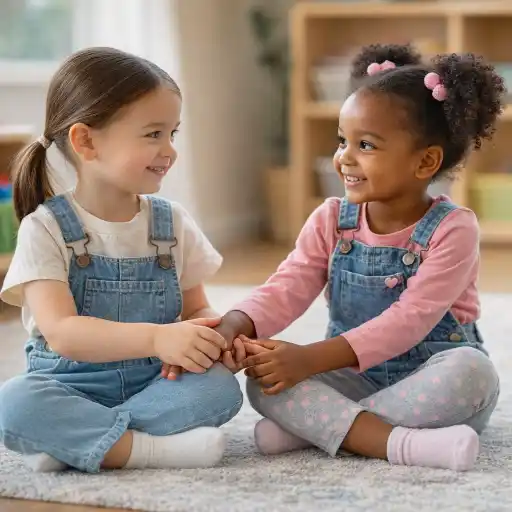
Try the following sequence:
- 🎯 Choose one target, such as joining, listening, or turn-taking.
- Model a short phrase with a puppet or partner.
- Provide three to five brief practice opportunities during centers, outdoor play, or transitions.
- Prompt only as much as needed, then step back.
- Acknowledge the observable effort: “You asked to join, and you waited for an answer.”
Activities should require genuine cooperation rather than simply placing children beside one another. Two children can paint on one large sheet, build a shared roadway with one basket of blocks, complete a puzzle together, or operate a pretend grocery store with rotating roles. A shared goal gives children a reason to communicate, coordinate, and notice one another’s ideas.
Adults should avoid managing every exchange. If a child can solve a small problem safely, allow time for experimentation. When support is needed, offer a concise prompt: “Ask for a turn,” “What could you say?” or “Can you find a way for both ideas?” Guided play becomes most powerful when children gradually assume responsibility for the interaction. The ChildCareEd article on guided play offers additional strategies for communication, empathy, teamwork, and conflict resolution.
How Should Classroom Routines and Environments Support Belonging?
Friendship learning occurs throughout the day, not only during a social-emotional lesson. Arrival, cleanup, snack, transitions, outdoor play, and departure all offer predictable moments for connection. Greet each child by name and provide choices that respect comfort: a wave, smile, verbal greeting, or fist bump. Pair children for accessible jobs such as carrying napkins, checking the book area, or watering plants.
- Use rotating partner jobs so children interact with a wider range of peers.
- Offer cooperative materials such as shared tracks, large puzzles, dramatic-play props, and construction sets.
- Create defined play areas or small “nooks” that support sustained interaction without crowding.
- Post visual friendship phrases near high-interest centers.
- Provide quiet spaces and smaller groups for children who become overwhelmed.
- Use duplicate materials when possible, while still teaching negotiation and turn-taking.
Thoughtful design matters because proximity, materials, and time influence who can enter play. The Hanen Centre notes that defined play areas, adult redirection toward peers, and meaningful roles can increase interaction for children who are often isolated. A child who is hesitant to join might be assigned to demonstrate a new material, deliver a message, or help prepare a center—roles that create authentic reasons to connect without labeling the child as a problem.
Inclusive practice also means expanding what counts as participation. A child may observe first, contribute materials, imitate a peer, use a picture card, or communicate through movement. These entry points can grow into longer exchanges. Directors can support consistency by ensuring staff use shared language, plan social goals, and review whether classroom arrangements provide every child with genuine opportunities to belong.
For ideas on extending this work to empathy, kindness, and cultural awareness across the classroom, see ways to foster harmony and understanding.
How Can Providers Coach Conflict and Repair?
Conflict is a normal part of developing friendship skills. The goal is not to eliminate every disagreement but to help children experience conflict as a manageable problem. During intense emotion, keep language calm, brief, and concrete. First ensure safety, then guide children through a consistent process.
- Stop and regulate: “Hands down. Safe bodies.” Give children space to breathe and settle.
- Name the behavior and feeling: “You are grabbing the truck. You both look frustrated.”
- Explain the impact: “Grabbing can hurt someone. We need a safe way to solve this.”
- Offer language and choices: “You can ask for a turn, use the timer, or choose another truck.”
- Repair: “What can we do to fix the problem?” Children might return an item, rebuild, check on a peer, trade, or practice an apology.
NAEYC’s three-step approach similarly emphasizes stating the behavior, identifying emotions and implications, and addressing the behavior with an appropriate alternative. Avoid assigning character labels such as “mean” or “bad.” Describe what happened and teach what to do next. During calm moments, use puppets to rehearse common conflicts so children are not learning the script for the first time while upset.
When exclusion occurs, respect children’s need for boundaries while teaching inclusive language. A provider might say, “You may finish this part, and then you can offer a role,” or “Tell your friend when there will be room.” If exclusion is repeated or targeted, document patterns, intervene promptly, and partner with families and program leadership. For deeper professional learning, explore You’re Not My Friend Anymore: Learning Conflict Resolution Buy Now $16.00.
How Can Teachers Individualize Support and Partner with Families?
Not every child needs the same pathway into friendship. Observe when and where difficulty occurs: during crowded centers, noisy outdoor play, transitions, language-heavy games, or competition for popular materials. Record brief, objective notes about invitations, responses, sustained play, conflict, and repair. This information can guide a small goal such as, “The child will use a joining phrase with a peer twice during centers.”
- Prime before play: “Ask Leo, ‘Can I build with you?’”
- Use visual scripts, feeling cards, turn markers, and timers.
- Arrange short, supported play with one compatible peer.
- Teach peer buddies to invite and wait, not to take over.
- Offer multiple communication modes, including gestures, visuals, and home languages.
- Share one simple phrase with families for practice at home.
Family partnership should be collaborative and respectful. Share strengths first, describe observable patterns, and ask what works in the child’s home or community. Families may offer important information about cultural expectations, communication styles, preferred activities, and trusted peers. State requirements vary - check your state licensing agency when implementing documentation, referral, or program-wide support procedures.
Directors can help teams by scheduling brief reflection meetings: What skill are we teaching? Where will children practice it? Which children need additional access supports? Are adults prompting consistently? Progress should be measured by increased opportunities and attempts, not by comparing children or expecting constant harmony.
Conclusion: How Can Providers Help Children Build Healthy Friendship Skills?
Children build healthy friendship skills through repeated, respectful practice in real classroom life. Define the skills clearly, model short scripts, use guided play, design environments that invite cooperation, coach conflicts calmly, and celebrate every meaningful attempt. Warm relationships with adults provide the security children need to take social risks, while inclusive routines ensure that every child has a genuine opportunity to participate.
Begin with one joining phrase, one cooperative activity, and one observation goal this week. Over time, these small actions can help children develop #friendship, #empathy, #communication, #cooperation, and #belonging—the capacities that support joyful play, stronger classroom communities, and lifelong relationships.
Additional training options include Social Foundations and Responsive Classrooms Buy Now $24.00, The Best Promotion is Play Buy Now $24.00, and Teach with Respect ONLINE Buy Now $24.00. Each course offers a different way to deepen professional knowledge and translate social-emotional principles into daily practice.
- CDA Home Visitor Subject Area 2 Part 3 Birth to 5
- Opportunity for Growth: Emotional Development
- CDA Bridge Bundle: Family Child Care without Portfolio Review
- Healing Young Hearts: Stress and Grief
- CDA Bridge Bundle: Infant/Toddler without Portfolio Review
- CDA Bridge Bundle: Preschool without Portfolio Review
- Creating Engaging and Meaningful Learning Experiences
- Texas Director Credential
- Wellness in Action: Teaching Healthy Habits to Children
- IEPs and IFSPs in Family Child Care
- Building Social Foundations
- How to Foster Friendship Skills Through Guided Play
- CDA Certification en Español: Recursos y Consejos para Educadores Bilingües
- How can preschool teachers teach friendship skills with activities and role-play?
- Proporciones de Cuidado Infantil y Tamaños de Grupo por Edad en Maryland (Guía Rápida para Centros y Hogares)
- Proporciones de Cuidado Infantil y Tamaños de Grupo por Edad en Virginia (Guía Rápida para Centros y Hogares)
- How can rainy day indoor activities help preschoolers learn kindness and cooperation in Georgia?
- How can indoor creative play encourage teamwork for preschoolers in California?
- How Can We Help Children Make Friends?
- Best Friends Day: Helping Children Learn Kindness and Friendship
- Celebrating Friendship in Child Care on Best Friends Day
- Celebrando la amistad en el cuidado infantil durante el Día de los Mejores Amigos
- Canciones, juegos y preguntas de círculo para niños
- How Child Care Providers Can Promote Safety and Well-Being
- Can a simple friendship bracelet craft strengthen fine motor skills in your daycare?
- How can child care providers help children build friendship skills?
- How Can We Teach the Forgotten Skill of Being a Good Friend to Young Children?
- How Can Child Care Providers Teach Friendship Skills Through Everyday Classroom Activities?
- How Can Child Care Providers Help Children Build Healthy Friendship Skills?
