A pretend restaurant is humming along—until the chef announces that the customers must now pay with leaves, not play money. When the rules shift, children are practicing imagination and learning how to communicate, adapt, and solve problems together. Explore Connections That Count: Building Relationships in Child Care  Buy Now $55.00 for practical strategies to strengthen supportive relationships, encourage cooperation, and guide children through these everyday social learning moments.
For a deeper look at how play supports development, you can also explore The Best Promotion is Play Buy Now $24.00, which focuses on creating engaging play experiences that foster creativity, problem-solving, and cooperation.
Why can a midgame rule change feel so big?
To adults, a sudden change in pretend-play rules may seem like a small adjustment. For a young child who has invested in a role, a plan, or a particular idea of what happens next, it can feel like losing control of the story. One child may want the doctor’s office to become a spaceship; another may be counting on the play staying a clinic. Both are expressing meaningful ideas, even when they disagree.
Shared pretend play asks children to create and maintain a joint story. They need to communicate roles, agree on what is happening, and respond when a peer’s idea takes the play in a new direction. The negotiation itself is part of the learning—not an interruption educators must eliminate. Research on peer relations identifies cooperative play, communication, emotional regulation, and social problem-solving as important skills children practice with one another.
These moments also invite children to consider another person’s perspective. A child may begin to notice, with adult support, that a new rule can be exciting to one friend and confusing or disappointing to another. Warm, trusting relationships make it easier for children to express a preference, hear a peer, and try again after frustration. The goal is not perfect agreement; it is a safe process in which each child can contribute and play can continue.
What should educators do first when the story shifts?
Pause long enough to understand what is happening before stepping in with a solution. Observe the children’s words, gestures, facial expressions, and participation. Are they enjoying the surprise? Is one child being repeatedly overruled? Has the play stopped because no one knows what the new rule means? A brief, calm presence can help you choose the right level of support.
When children seem stuck, describe the situation without blame. For example: “You were playing that this was a grocery store. Now Maya says it is a spaceship, and you both have different ideas.” Naming the change makes the problem easier to think about without labeling either child as difficult or unfair. Reflect feelings as well: “You look disappointed because you wanted to keep being the cashier.”
Then invite the children to share what matters to them. Keep your questions open and simple:
- “What were you pretending before?”
- “What would you like to happen next?”
- “What do you think your friend wants?”
- “How could both ideas fit into the story?”
Listen to each child, including children who communicate through gestures, pictures, or actions rather than full sentences. Avoid deciding too quickly whose version is right. By helping children name the problem and hear one another, you model #communication and create room for a shared solution.
How can children negotiate a new rule together?
Negotiation is a skill children learn through repeated modeling, practice, and supportive coaching; it does not appear automatically when a disagreement begins. Offer a few possible strategies, but keep children involved in choosing what happens. Their solution might preserve the original idea, incorporate the new idea, or create a sequence that gives each child a turn to lead.
Try language that makes options visible:
- “Could the spaceship land at the grocery store?”
- “Would you like to finish this customer’s turn, then change the story?”
- “Can you find a role for both ideas?”
- “What could you say if you want the story to stay the same for a little longer?”
Offer visual supports when spoken discussion is challenging. A simple picture choice, first/then card, or illustrated sequence can help children understand options and anticipate what comes next. Head Start notes that visual supports can make expectations and information easier to understand and can encourage children’s engagement across activities. Such supports should supplement—not replace—adult listening and responsive interaction.
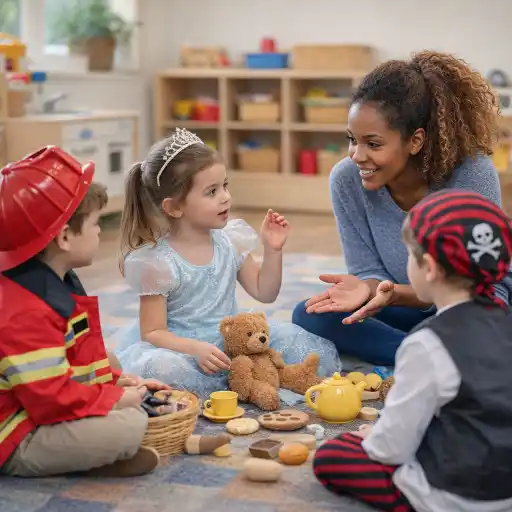
When children agree on a plan, give them room to try it. If it does not work, return to the problem-solving process rather than treating the first attempt as a failure. A brief “You tried the spaceship landing, and now the cashier is unsure what to do. What could you change?” reinforces #problem-solving while keeping the play in the children’s hands.
When should an educator step into the play?
Children benefit from having time to work through manageable differences, but “let them figure it out” should not mean leaving them unsupported. Step in when a child is distressed, excluded, repeatedly ignored, physically unsafe, or unable to communicate a boundary. You might also join when the play has stalled and children are asking for help. Use the least directive support that meets the need.
At first, stay nearby and offer a brief prompt. If that is not enough, model a phrase the children can use: “I want to keep playing the restaurant. Can we make the spaceship a delivery ship?” In some situations, you can take a light role inside the story—perhaps a customer asking how the new rule works—while still allowing children to direct the play. The aim is to help the narrative move forward, not to take over as its author.
Consider each child’s developmental level, language access, culture, and individual communication style. Some children may need more processing time, a visual cue, or adult help entering a group. Do not assume silence means agreement, or that a loud child’s idea represents the whole group. Support #inclusion by making sure each participant has a genuine way to contribute. If the play becomes unsafe, calmly stop the unsafe behavior, set a clear boundary, and help the children return to play when they are ready.
How can educators prepare children before conflicts arise?
Preparation makes in-the-moment coaching more familiar. During group time, use puppets or dolls to act out a pretend-play rule change: one character wants the bus to fly, while another wants it to stay on the road. Ask children what each character might feel and generate more than one possible solution. Practicing through pretend stories gives children a low-pressure way to try words before they need them with a peer.
Establish a few flexible classroom agreements with children. For example: “We listen to each other’s ideas,” “You can say no to a play idea,” and “We keep bodies safe.” Avoid creating so many rigid rules that imaginative play becomes a test of compliance. In pretend play, children may revise the story; classroom safety and respect are the boundaries that remain consistent.
Picture cards can help make options visible. The featured Play Plan Picture Cards can serve as a prompt for planning together: children might choose a setting, decide on roles, and consider what could happen next. Introduce the cards as invitations, not a required script. A child might point to a picture, draw a different idea, or suggest an unexpected twist. The adult can model how to revisit the plan when the story changes while leaving creative ownership with the children.
- Model phrases such as “I have another idea,” “Can we add that?” and “Let’s take turns choosing.”
- Notice and describe cooperation: “You listened to Sam’s idea and found a role for both of you.”
- Keep props open-ended so one object can become something different as the story grows.
- Offer repeated chances to play together; negotiation develops with practice.
These routines support #play without requiring adults to script every exchange.
What common pitfalls should providers avoid?
One common pitfall is stepping in immediately to impose a solution. Although a quick decision may end the disagreement, it can also remove the chance for children to express preferences and practice reaching an agreement. When the situation is safe, try a pause, a reflection, and an open question before offering a solution.
Another mistake is treating the original rule as the only fair rule. Pretend-play rules are often invented and revised by the children; a new direction can be part of the fun. The question is not whether the story stayed consistent, but whether participants have a meaningful voice and are treated respectfully. At the same time, do not pressure a child to accept every new idea. Children may set limits, decline a role, or choose another activity.
Also avoid confusing a child’s emerging skills with unwillingness. Children who have difficulty finding words, shifting plans, waiting, or reading social cues may need a slower pace, a visual support, or help from an adult. Repeatedly asking “Why can’t you just share?” is unlikely to teach a usable strategy. Instead, demonstrate specific language and make time for practice.
Finally, do not praise only the child who compromises. Notice listening, clear boundary-setting, inviting a peer, and creative problem-solving, too. If conflicts recur, observe patterns: Is one child always taking the lead? Are materials limited? Does the play area need clearer spaces or additional props? State requirements vary - check your state licensing agency for applicable supervision and safety expectations.
Conclusion: How can providers turn changing rules into learning?
When pretend-play rules change midgame, educators can help children pause, name the problem, hear one another, and try a solution that keeps the play safe and welcoming. A child’s new idea does not automatically have to win or be rejected; with thoughtful coaching, children can adapt the story, take turns shaping it, or decide to play in different ways.
Stay observant, validate feelings without assigning blame, and offer the least amount of support needed. Practice negotiation before conflicts arise, use visual prompts when they improve access, and make sure every child has a way to participate. These small, repeated interactions nurture relationships and help children build communication, empathy, flexibility, and #negotiation skills—inside the imagined world and beyond it.
Explore related ChildCareEd training:
- Bienvenido! Welcoming All Families
- From Play to Planning: Building Culturally Competent, Child-Centered Curriculum
- Teach with Respect!
- CDA Bridge Bundle: Family Child Care without Portfolio Review
- CDA Bridge Bundle: Infant/Toddler without Portfolio Review
- CDA Bridge Bundle: Preschool without Portfolio Review
- Texas Director Credential
- Access for All: Inclusion and the ADA
- Montessori Cultural Activities: Exploring the World Through Play and Learning
- Families, Communities, and Classrooms: Working Together for Children
- CDA Certification en Español: Recursos y Consejos para Educadores Bilingües
- Cuáles Son las Señales de Alerta en el Desarrollo Infantil que Todo Educador Debe Conocer?
- Recursos en Español sobre el Sueño Seguro del Bebé
- 10 Ejemplos de Cómo la Cultura Influye en el Desarrollo Infantil
- Regulaciones de Licenciamiento de Cuidado Infantil en California para Centros y Hogares de Cuidado Infantil Familiar
- Proporciones de Cuidado Infantil y Tamaños de Grupo por Edad en Nueva Jersey (Guía Rápida para Centros y Hogares)
- Proporciones de Cuidado Infantil y Tamaños de Grupo por Edad en Virginia (Guía Rápida para Centros y Hogares)
- Lista para Abrir una Guardería en Casa en Carolina del Norte: Cómo Empezar
- Por Qué la Supervisión Activa Es Clave para la Seguridad en el Cuidado Infantil
- Retraso del Habla en la Guardería: Cómo Pueden Ayudar los Proveedores
- Cómo Trabajar en el Cuidado Infantil en Carolina del Norte: Requisitos y Pasos
- Celebrando la amistad en el cuidado infantil durante el Día de los Mejores Amigos
- Canciones, juegos y preguntas de círculo para niños
- Rosh Hashanah Sensory Bin Ideas: Apples, Honey, Shofars, and Sweet New Year Play
- How Can Preschool Educators Encourage Learning Through Play?
- How Can Educators Help Children Negotiate When Pretend-Play Rules Change Midgame?
- Why Does a Child Become the Rule Keeper When an Adult Joins Play?
- What Should Child Care Providers Prioritize When Preschool Readiness Goals Compete for Time?
- How Can Pretend Store Play Teach School-Age Children Money Skills?
- How Can Educators Support Fair Membership When Children Invent a Club?
