When a child declares, “That’s not fair!” they are opening the door to meaningful social learning. Use the Building Equity: Inclusionary Practices in Preschool  Buy Now $10.00 course to strengthen your classroom strategies, earn professional development hours where applicable, and turn everyday conflicts into opportunities for belonging and participation. For deeper reflection on bias and culturally responsive practice, explore Diversity, Equity, and Inclusion in Education Buy Now $16.00.
Why Does Teaching Fairness Matter in Early Childhood?
Fairness is not a single rule that means every child receives exactly the same thing. In early childhood settings, fairness often means ensuring that each child has a meaningful opportunity to participate, contribute, and feel respected. This distinction can be difficult for young children because they tend to notice visible differences before they understand the reasons behind them.
Research and professional guidance increasingly recognize that children can reason about fairness in nuanced ways when conversations are connected to authentic classroom experiences. Children may share resources equally, but they can also notice needs, advocate for peers, and support solutions that help a community function well. The goal is not to expect preschoolers to master an adult definition of equity. Rather, it is to give them language and repeated experiences that build empathy, agency, and social reasoning.
Equity also matters because classroom routines communicate values. Who gets attention, whose language appears in books, whose ideas shape activities, and whose needs are treated as legitimate all influence children’s sense of belonging. NAEYC describes equitable learning opportunities as a professional responsibility, not an optional enrichment activity. State requirements vary - check your state licensing agency.
How Are Fairness and Equality Different for Young Children?
A developmentally appropriate explanation begins with concrete examples:
- Equality means everyone receives the same resource, rule, or opportunity.
- Equity means people receive the support they need to participate fully.
- Fairness is the child-friendly question: “What would help make this situation right?”
For example, giving every child the same-size scissors is equal. Providing adaptive scissors to a child who needs them may be equitable because the goal is shared participation. Giving every child the same amount of snack is equal, while responding respectfully to documented dietary or developmental needs may be fair.
Use neutral, brief language: “Equal means the same. Fair means everyone gets what they need to join.” Avoid presenting difference as evidence that one child is receiving a privilege. Instead, emphasize access and shared goals. “Maya has a picture card so she can follow the steps. Everyone is building the same tower.” This approach helps children notice differences without attaching shame or superiority to them.
Visuals make the concept memorable. Show two children trying to look over a fence: identical boxes may represent equality, while different supports allow both children to see. Follow the metaphor with a classroom example so the discussion remains connected to children’s lived experiences.
Which Classroom Activities Make Fairness Concrete?
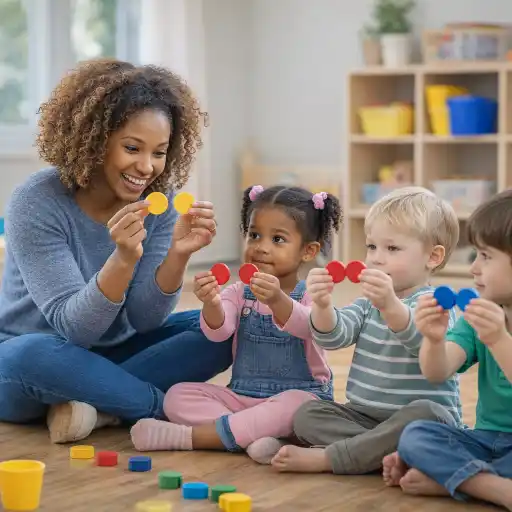
The sellable Fairness Versus Equality Story and Sorting Activity can anchor a short small-group lesson. Read the story, invite children to sort picture cards into “same” and “what someone needs,” and then discuss why a different support can still be fair. Keep the activity brief—approximately 5 to 15 minutes—and revisit it during routines.
- Snack scenarios: Compare two identical servings with a situation in which a child needs a medically appropriate alternative. Ask, “What is the same? What is different? How does each child participate?”
- Turn-taking cards: Use a timer or visual card so children can see how turns are organized. Discuss why transparent procedures help a group experience a decision as fair.
- Access detective: Invite children to notice whether materials are reachable, understandable, and usable. Add a lower basket, picture cue, larger tool, or peer partner when appropriate.
- 😊 Role-play repairs: Use puppets to act out exclusion, then practice language such as “You can join,” “What do you need?” and “Let’s find a way.”
Stories and books should represent diverse cultures, abilities, languages, and family structures in ordinary situations—not only in lessons about difference. Before and after reading, ask open questions: “Who was included?” “What made participation difficult?” and “What could a friend or adult do?” Such conversations develop #empathy without requiring children to solve complex social problems independently.
How Can Educators Use Inclusive Routines and Materials?
Fairness becomes credible when children experience it throughout the day. Begin with access, participation, and supports. An inclusive environment may include visual schedules, reachable materials, flexible seating, calm spaces, multiple ways to communicate, and tools that reflect children’s identities. These are not special favors; they are design choices that reduce unnecessary barriers.
Plan activities with multiple entry points. A child might demonstrate learning by drawing, building, moving, speaking, signing, using a communication device, or pointing to a picture. Offer choices without lowering expectations: “You may show your idea with blocks or a drawing.” This preserves agency while recognizing individual strengths.
- Audit the classroom library and dramatic-play materials for representation.
- Use children’s home languages in labels, greetings, songs, and family communications.
- Duplicate highly desired materials when possible to reduce preventable conflict.
- Break multistep activities into visual or modeled steps.
- Observe who is interrupted, redirected, praised, or invited to lead.
Reflection is essential. NAEYC encourages educators to examine beliefs, set measurable goals, take action, and assess progress. A director might ask staff to track participation during group time for one week: Who speaks? Who receives assistance? Who is waiting? The purpose is not blame. It is to identify patterns and improve the environment. Professional learning such as Planning for Every Child: Responsive Strategies in Action Buy Now $55.00 can help translate observation into differentiated planning.
How Should Providers Respond When Children Say, “That’s Not Fair”?
Children’s complaints often contain important information, even when their proposed solution is not workable. Respond first with curiosity: “Tell me what feels unfair.” Then acknowledge the experience without promising an identical outcome: “You wanted the same turn. I hear that.” Next, clarify the relevant need or agreement: “Jordan is using the communication board to choose first today. You will have the next turn when the timer rings.”
A simple sequence is Connect, Calm, Coach:
- Connect: Move close, name the feeling, and listen briefly.
- Calm: Set one clear limit if safety or respect is at risk.
- Coach: Guide children toward repair, a turn-taking plan, or a support that enables participation.
Avoid long lectures during heightened emotion. Avoid forcing identical outcomes when children have different needs; that may teach compliance rather than justice. Also avoid labeling a child selfish, difficult, or unfair. Focus on the action and its impact: “The blocks were taken before Sam finished. Sam was upset. Let’s make a plan.”
After the conflict, rehearse alternatives through puppets or drawings. Practice “Can I have a turn?” “I need help,” “You can use this tool,” and “I’m sorry; can I try again?” Praise specific acts of advocacy and repair. If conflicts repeat, review the environment, schedule, group size, and communication supports rather than assuming the child lacks empathy.
How Can Programs Partner With Families to Advance Equity?
Families hold essential knowledge about children’s strengths, communication, routines, identities, and experiences of fairness. Ask genuine questions rather than assuming that one family’s preferences represent an entire culture. “What helps your child participate?” and “How does your family talk about fairness?” can guide responsive planning.
Share the classroom language with families: “same” for equality, “what someone needs” for equity, and “make it right” for fairness. Invite families to recommend books, songs, photographs, words, and everyday examples. Translate communications when needed and provide multiple ways to contribute, including brief conversations, questionnaires, or voice messages.
Directors can support consistency by incorporating equity into staff meetings and policies:
- Review behavior guidance data by classroom, age, disability, race, language, and other relevant factors.
- Examine whether enrollment, attendance, field trips, and leadership opportunities are accessible.
- Document accommodations and communicate them respectfully to the team.
- Provide coaching when staff members need support examining bias or changing practice.
- Use strengths-based language in records and family conversations.
Helpful training options include Family Voices Matter: Tools for Meaningful Collaboration Buy Now $55.00, Bridging Cultures: Family Communication & Collaboration Buy Now $55.00, and Inclusive Lessons for Preschoolers Buy Now $16.00. Together, these resources support communication, planning, and classroom application.
Conclusion: What Is the Best Way to Teach Fairness and Equity?
Young children learn fairness through concrete experiences, respectful language, and consistent opportunities to repair harm and include others. The central question is not always, “Did everyone receive the same thing?” It is often, “Did each child receive what was needed to participate and belong?”
- Explain equality as “the same” and equity as “the support someone needs.”
- Use the Fairness Versus Equality Story and Sorting Activity for brief, repeated practice.
- Design routines, materials, and environments for access from the beginning.
- Respond to “That’s not fair” with curiosity, emotional support, and coaching.
- Partner with families and use reflection to identify patterns and improve practice.
Fairness is built in small moments: offering a visual cue, making room for a home language, protecting a child’s turn, or helping peers recognize a needed support. Those moments teach children that difference is normal, participation matters, and communities can work together to make things more just.
Frequently Asked Questions
When should I introduce fairness and equality?
Use the words as early as preschool, pairing them with visible examples and revisiting them over time.
Are equal rules always fair?
No. A shared rule can be useful, but equitable implementation may require different tools, time, communication methods, or supports.
How can I avoid shaming children?
Describe the action and its impact, identify needs, and coach a repair instead of assigning negative labels.
What if a child objects to another child receiving extra support?
Acknowledge the observation and explain the shared goal: “Different tools help each person join. Everyone is working and learning together.” Protect the child’s privacy by sharing only necessary information.
How can directors support staff?
Provide relevant training, schedule reflection time, review participation and discipline patterns, and ensure policies support access, participation, and individualized supports.
- CDA Home Visitor Subject Area 3 Part 3 Birth to 5
- Emergent Learning & Development
- Building Equity: Inclusionary Practices in Preschool
- Equity in Action with Head Start
- CDA Bridge Bundle: Family Child Care without Portfolio Review
- CDA Bridge Bundle: Infant/Toddler without Portfolio Review
- CDA Bridge Bundle: Preschool without Portfolio Review
- Creating Environments that Nurture Growth and Community
- Diversity, Equity, and Inclusion in Education
- Texas Director Credential
- CDA Certification en Español: Recursos y Consejos para Educadores Bilingües
- 🔍 ¿Qué ves cuando observas a un niño aprender?
- Capacitación en Salud y Seguridad Preventiva en Línea para Proveedores de Cuidado Infantil
- Proporciones de Cuidado Infantil y Tamaños de Grupo por Edad en Maryland (Guía Rápida para Centros y Hogares)
- Proporciones de Cuidado Infantil y Tamaños de Grupo por Edad en Nueva Jersey (Guía Rápida para Centros y Hogares)
- Proporciones de Cuidado Infantil y Tamaños de Grupo por Edad en Virginia (Guía Rápida para Centros y Hogares)
- Apoyo en Preescolar para Retrasos del Habla: Estrategias Simples que Ayudan
- Retraso del Habla en la Guardería: Cómo Pueden Ayudar los Proveedores
- Cómo Trabajar en el Cuidado Infantil en California: Requisitos y Pasos
- Cómo Ser Maestra de Preescolar en Maryland
- Capacitación Previa al Servicio para Proveedores de Cuidado Infantil en Virginia
- Capacitación CDA gratuita en Illinois
- Celebrando la amistad en el cuidado infantil durante el Día de los Mejores Amigos
- Canciones, juegos y preguntas de círculo para niños
- How can I teach Black history to young children year-round?
- How Can We Teach Young Children the Difference Between Fair and Equal?
- How Can Child Care Providers Teach Young Children About Fairness and Equity?
- How Can Early Childhood Programs Introduce Juneteenth in Developmentally Appropriate Ways?
- How Can Coloring Pages Spark Meaningful Historical Conversations About Juneteenth?
- How Can Drawing and Dictation Help Children Respond to Juneteenth?
