A child’s “I can’t do it” can be the start of meaningful learning—if an adult leaves room for the child to think. Explore practical ways to coach problem-solving through play, conversation, and just-right support, and deepen your classroom practice with From Play to Planning: Building Culturally Competent, Child-Centered Curriculum  Buy Now $55.00, a course that addresses play, scaffolding, and problem-solving. For peer disagreements, You’re Not My Friend Anymore: Learning Conflict Resolution Buy Now $16.00 offers focused professional learning in developmentally appropriate conflict coaching.
Why does it matter when children solve problems themselves?
Problem-solving is not simply reaching the correct answer. It is a process: noticing a challenge, generating an idea, trying it, considering what happened, and deciding whether to adjust. When children get frequent chances to practice this sequence, they build reasoning, language, flexible thinking, persistence, and confidence. They also learn that mistakes are information—not evidence that they are incapable.
In early childhood settings, problems arise naturally: a block tower tips, a puzzle piece will not fit, a zipper resists, or two children want the same toy. These moments can become manageable learning opportunities when adults support children without immediately taking over. NAEYC’s guidance on questions that stretch children’s thinking highlights how open-ended conversation can invite children to explain, compare, imagine, and create.
This approach does not mean leaving children alone or expecting them to manage every challenge independently. Teachers remain attentive to safety, relationships, and emotional well-being. The goal is to offer enough help for the child to take the next step, while keeping the thinking and decision-making within the child’s reach. That balance strengthens #independence, #resilience, #communication, #curiosity, and #persistence.
What can teachers say instead of giving the answer?
Begin by pausing. A brief moment of observation can reveal whether a child is experimenting, planning, or beginning to feel overwhelmed. Rather than responding to “What do I do?” with instructions, acknowledge the challenge and use one concise, genuine prompt. Then give the child time to think and respond.
- “What are you trying to make happen?”
- “What have you tried so far?”
- “What do you notice?”
- “What else could you try?”
- “How will you know if that works?”
- “Would you like to think of an idea, or would a small hint help?”
Questions should fit the child’s age, language, attention, and emotional state. Too many questions in a row can feel like a quiz. Sometimes a descriptive observation is more useful: “The bridge wobbled when the small block went on top.” This gives the child relevant information without specifying a fix. NAEYC’s article on scaffolding thinking to promote learning emphasizes listening to children’s ideas, making thinking visible, and giving children time to reflect.
For children who communicate through gestures, visuals, home languages, or assistive communication, make space for those responses. A child can point to a possible tool, demonstrate an idea, or select a picture. The aim is not to elicit a polished verbal explanation; it is to support meaningful participation and ownership.
How can teachers scaffold without taking over?
Scaffolding is temporary, responsive support. It begins with the child’s current abilities and changes as the child gains competence. An educator might first wait and observe, then offer a prompt, a visual cue, a limited choice, or a brief model of one small step. Once the child is ready to continue, the educator steps back. This progression helps children experience both support and agency.
A practical sequence is:
- Observe: Notice the child’s strategy, materials, and emotional cues before intervening.
- Reflect: Name the problem neutrally: “The lid is not opening yet.”
- Prompt: Ask, “What could you try?” and allow wait time.
- Offer a small scaffold: Point to a relevant tool, provide two reasonable options, or model a related action with a different object.
- Fade: Reduce prompts as soon as the child resumes acting or planning.
Support should address the actual barrier. A child may understand a task but need a stable surface, a larger tool, a visual sequence, or help regulating emotions. If frustration escalates, connect first: “You wanted the tower to stay up, and it fell. Let’s take a breath. When you’re ready, we can think about what to try.” For peer conflicts, keep everyone safe and help children identify the shared problem, consider perspectives, and suggest fair solutions.
How can play and routines provide daily practice?
Children need repeated practice in real, engaging contexts—not a single lesson on “problem-solving.” Open-ended play materials invite children to test ideas, compare results, and revise plans. Blocks, loose parts, puzzles, dramatic-play props, water tools, and art materials can all present useful challenges without dictating one correct outcome. Karen Worth’s discussion of science in early childhood classrooms describes how curiosity and inquiry can support problem-solving alongside language, collaboration, and early mathematical thinking.
- Invite children to build a bridge that lets a toy vehicle pass underneath.
- Offer a partly completed pattern and ask what might come next.
- Set up a pretend clinic with a limited number of tools and invite children to plan how everyone can participate.
- Ask a group to organize materials so they are easier to find and return.
- 👏 Use puppets to act out a familiar disagreement, then invite children to suggest and rehearse possible solutions.
Make the challenge understandable but not effortless. Materials plus a clear goal and one manageable constraint can provide helpful structure: “Use these five blocks to make a path for the animal.” Provide uninterrupted time for children to change their plans. During transitions or after play, use a brief reflection: “What did you try? What happened? What might you do next time?”
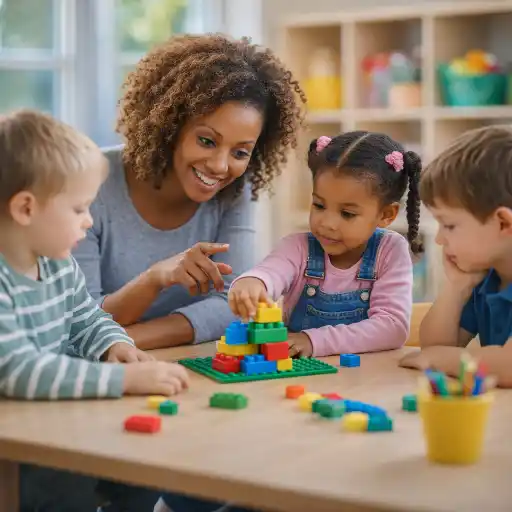
How can adults support productive struggle and avoid common pitfalls?
Productive struggle is focused effort with an achievable path forward; it is not prolonged distress or a test of how long a child can cope without help. Watch for signs of concentration—repeating an action, studying materials, or asking a peer—as well as signs that the child needs more support, such as escalating distress, withdrawing, or becoming unsafe. When necessary, help the child regulate before inviting further reasoning.
Common well-intentioned habits can unintentionally limit practice. Solving the task immediately removes the child’s opportunity to plan. Giving a long series of questions can create pressure. Offering many choices may overwhelm. And praising only a finished product can imply that the process matters less than the outcome.
- Instead of: “Put the big block underneath.” Try: “What do you notice about the bottom of the tower?”
- Instead of: “You’re so smart.” Try: “You changed the base after you saw it wobble.”
- Instead of: “Figure it out yourself.” Try: “I’m here. Would you like a hint, a tool, or a little more time?”
Consistency across the teaching team helps. Directors can model a shared routine, observe one adult move—such as wait time or a strategy-focused comment—and discuss how children responded. Document brief examples of children identifying a challenge, trying a strategy, asking for help, or revising an idea. Keep supervision active even when stepping back from the answer. For policies, documentation, and training obligations, state requirements vary - check your state licensing agency.
How can programs make problem-solving inclusive and track growth?
Children should not need to solve problems in the same way to demonstrate thinking. Offer varied ways to participate: speaking, pointing, drawing, building, using picture cards, communicating in a home language, or collaborating with a peer. Adapt materials and the environment as needed—larger pieces, accessible tools, clear visual steps, a quieter space, or additional time can help a child engage with the same meaningful challenge.
Assess the process rather than whether every attempt produces a successful result. Short, objective notes can capture what the child noticed, which strategy they tried, whether they persisted, how they communicated, and what support was useful. For example: “During block play, Sam noticed the bridge tipped, widened the base, and tested it again.” Photos, work samples, and children’s comments can make progress visible over time.
Use observations to plan what comes next. If children often seek adult help before trying, model a simple “try one idea, then ask” routine. If a challenge repeatedly causes frustration, adjust its complexity or add a visual cue. Share concrete examples with families and invite their observations from home. For further professional learning, providers can explore Supporting Children’s Independence Buy Now $24.00, a three-hour online course focused on independence, self-regulation, and strategies that help children resolve conflicts.
Conclusion: How can teachers encourage problem-solving without giving the answer?
Teachers encourage problem-solving by making space for children to notice, wonder, test, revise, and reflect—while staying close enough to offer safety and timely support. Pause before intervening, ask one open-ended prompt, allow wait time, and add only the smallest scaffold that helps the child move forward. Use play, predictable routines, inclusive materials, and specific feedback to make these skills part of everyday classroom life.
The central question is not whether adults should help, but how to help without taking over. When educators protect children’s ownership of ideas and decisions, everyday challenges become opportunities to develop confidence, persistence, and thoughtful relationships. Start with one routine or one teacher prompt, observe what children do, and adjust support as their skills grow.
Five relevant ChildCareEd courses
- From Play to Planning: Building Culturally Competent, Child-Centered Curriculum Buy Now $55.00
- You’re Not My Friend Anymore: Learning Conflict Resolution Buy Now $16.00
- Supporting Children’s Independence Buy Now $24.00
- Supporting Social Learning: Creating Classrooms that Care Buy Now $24.00
- The Best Promotion is Play Buy Now $24.00
- 45 Hour Child Growth and Development
- 45 Hour Preschool Methods and Materials
- From Play to Planning: Building Culturally Competent, Child-Centered Curriculum
- Children at the Wheel: Emergent Curriculum
- Teach with Respect!
- Pediatric RSV First Aid & CPR/AED
- Mysteries of Challenging Behavior Solved
- Texas Director Credential
- Montessori Cultural Activities: Exploring the World Through Play and Learning
- CDA Certification en Español: Recursos y Consejos para Educadores Bilingües
- Cuáles Son las Señales de Alerta en el Desarrollo Infantil que Todo Educador Debe Conocer?
- Retraso del Habla en la Guardería: Cómo Pueden Ayudar los Proveedores
- Cómo Trabajar en el Cuidado Infantil en Carolina del Norte: Requisitos y Pasos
- Celebrando la amistad en el cuidado infantil durante el Día de los Mejores Amigos
- Cómo simplificar la capacitación para sus empleados de daycare
- How Can Preschool Teachers Help Children Build Problem-Solving Skills?
- How do you build a classroom that encourages independent thinking?
- How can we develop leadership skills in young children?
- Stop Giving the Answer: How Teachers Can Build Independent Thinkers in the Classroom
- How Can You Create Easy Preschool Math Centers with Print, Prep, and Start Learning?
- How Can Everyday Classroom Problems Become Child-Led Investigations?
- How Can “Almost Finished” Activities Encourage Young Children to Problem-Solve?
- How Can Color-Coded Practice Reinforce Early Division Skills?
- How Can You Make Addition Practice More Engaging Without Losing the Learning Goal?
- How Can Open-Ended Summer Art Encourage Planning and Creativity?
- How Can Child Care Providers Build One-to-One Correspondence with Small Objects?
- How Do Dot-to-Dot Activities Support Number Order and Pencil Control?
- How Can Early Childhood Teachers Encourage Problem-Solving Without Giving the Answer?
- How Can Teachers Turn Everyday Classroom Problems Into Learning Opportunities?
