Dear Washington directors and providers — this short guide shares easy steps you can use tomorrow to make your #classroom calmer and more reliable. We focus on simple #routines, calm #transitions, and smart #choices that help children cooperate and lea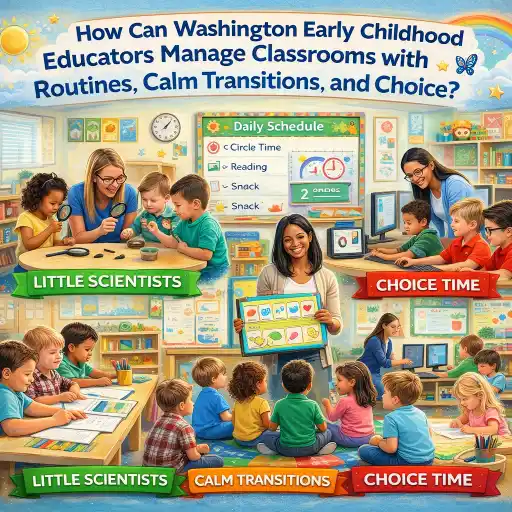 rn. The ideas below come from practical ChildCareEd resources and evidence-based briefs like CSEFEL. When you try changes, remember: state requirements vary - check your state licensing agency.
Why does this matter for children, staff, and families?
1. ✅ Safety and learning: Routines set clear expectations so children can focus on play and learning. See ChildCareEd’s tips on building schedules in How Can I Make Transitions and Daily Routines Easier in My Classroom?.
2. ✅ Fewer power struggles: When adults use consistent cues and give small choices, children cooperate more. For quick ideas that reduce arguing, read How can we build routines that reduce power struggles.
3. ✅ Evidence base: The CSEFEL briefs explain why routines and visual schedules help children understand the day (see What Works Brief #3 and Brief #4).
How can I build simple routines that reduce power struggles?
- 🔔 Make a tiny visual schedule at the child's eye level. Use photos or clip art for arrival, play, snack, outside, rest, and home. See ChildCareEd’s schedule ideas.
- 🙂 Teach the routine as a skill. Model one step, then have children try it. Repeat 3–5 times when children are calm.
- 🕒 Use consistent timing. Keep snack, circle, and outside time around the same clock time so children can predict the day. CSEFEL explains how schedules support children in What Works Brief #3.
- 🎵 Use a short cue: a song, bell, or call-and-response to signal an upcoming routine. Practice until it becomes automatic.
- ✅ Keep rules short (3–5) and positive: “Use walking feet,” “Hands to yourself.” Post with pictures and use the same words each day.
Quick tip: limit new routines to one at a time. When staff teach the same steps and praise small wins, children learn faster.
What quick transition tricks keep everyone calm?
- ⏳ Give warnings: 5 minutes, 2 minutes, then 30 seconds. Use a visual timer so children see time passing. ChildCareEd recommends countdowns in How to Handle Transitions Without Meltdowns.
- 🎶 Use a bridge activity: a cleanup song, a movement cue, or a helper job to let children finish and join the next activity.
- 🤝 Offer a tiny choice during the move: “Do you want the red cup or the blue cup?” Two choices give control without chaos.
- 🔁 Use individualized visuals for children who need more support. The CSEFEL brief on transitions has examples at Brief #4.
- 🧭 After rough transitions, reflect with the team and try one small change next time (e.g., give one more minute before clean-up).
State note: state requirements vary - check your state licensing agency when changing schedules or materials.
How do choices and organized space help independence and staff-family consistency?
Choices and a tidy room let children do more by themselves. When adults organize materials and give controlled choices, children feel trusted and behave better.
- 📚 Put materials at child height and use small baskets or trays so each activity is one kit. See how organizing materials and routines can make my classroom calmer?.
- 🧾 Label shelves with pictures and one short word. Non-readers know where to return toys.
- 🟢 Offer limited choices: two meaningful options (e.g., “Do you want block or puzzle first?”). This reduces power struggles; read more in Routines that reduce power struggles.
- 👥 Share one quick strategy with families at pick-up: one strength and one routine they can try at home. Family partnership boosts consistency.
Common mistakes and fixes:
- ❌ Long lectures when a child is upset → ✅ Use one short sentence and a choice.
- ❌ Different cues across staff → ✅ Pick one cue and practice it in a staff huddle.
- ❌ Using calm corners as punishment → ✅ Teach the calm spot during calm time and show how to use it.
Quick FAQ and next steps
Q1: How long to practice a new routine? A: Try it daily for 1–2 weeks and tweak. Q2: What if one child resists every time? A: Use an individual picture schedule and partner with the family. Q3: Can songs really help? A: Yes — songs and signals make transitions faster and more fun (see Transition Trouble).
Next steps this week:
- 🔎 Post a simple picture schedule and review it in the morning.
- 🎵 Teach one transition song and use it for clean-up.
- ✅ Offer one limited choice each day during a move.
Want more training? Explore ChildCareEd courses like Every Moment Matters: Schedules and Transitions Buy Now $0.00 and other classroom tools. You’re doing important work — small, steady steps lead to calmer days for your #children, your team, and families.
Why it matters: Predictable days help children feel safe. When kids know what comes next, they worry less and can join in learning. Staff also get more teaching time and less time fixing up meltdowns. Families notice calmer drop-offs and happier pick-ups. Routines are habits we teach and practice. Start with 1 routine and practice it every day. Use pictures, short words, and the same steps. Below are numbered steps you can try this week. Transitions are where many meltdowns start. Try this short plan to make shifts smooth and friendly.
- CDA Home Visitor Subject Area 3 Part 3 Birth to 5
- Teacher-Child Interactions for Stronger CLASS® Outcomes
- Guiding School-Aged Children
- Easy Steps to Resume and Interview Success
- Moving About the Classroom: Effective Transitions for Everyday
- Self-Regulation & Change: Helping Children Cope
- Texas Director Credential
- Responding to Emergencies
- Every Moment Matters: Schedules and Transitions
- Early Childhood Education in Washington
- ChildCareEd: Empowering Early Childhood Educators with Quality Training
- Maximizing Efficiency with ChildCareEd's Group Admin Account
- CDA Certification en Español: Recursos y Consejos para Educadores Bilingües
- What Should DC Early Childhood Teachers Know About Pay Equity Right Now?
- How can positive guidance make indoor transitions calm in California early childhood classrooms?
- How can Washington, D.C. child care providers keep children safe during transitions, drop-off, and pick-up?
- Can Washington early childhood educators grow with ChildCareEd’s self-paced courses?
- How can Georgia preschoolers manage big feelings and classroom routines?
- How can Washington early childhood educators manage classrooms with routines, calm transitions, and choice?
- How can Washington classrooms be more inclusive using nature, play, and community?
- Cómo simplificar la capacitación para sus empleados de daycare
- What Should Every Child Care Provider Know About Decision Fatigue?
- Toddler Classroom Management: Routines, Behavior, and Big Feelings
- How Can Child Care Programs Reduce Decision Fatigue for Children and Educators?
- How Can You Create Daily Classroom Schedules That Prevent Behavior Disruptions?
- How Can Child Care Providers Integrate Social-Emotional Learning into Daily Activities?
- How Can Teachers Build Emotional Regulation Into Daily Routines?
- Why Is Social-Emotional Learning at the Heart of 2026 Classrooms?
- How Can “First, Then” Language Reduce Power Struggles in Early Childhood Classrooms?
