Supporting children with special needs starts with noticing how each child communicates and listening closely to the people who know them best. For Nevada educators, that means building family partnerships and making everyday interactions accessible through words, gestures, pictures, or a child’s established communication tools. ChildCareEd’s Supporting Skill Development: Children with Special Needs course explores individualized support, accommodations, and practices that address developmental and language needs.
Why this matters:
- 1) When adults listen and use simple, clear tools, children can show needs in safe ways — that lowers meltdowns and helps learning (CSEFEL).
- 2) Families trust centers that share daily wins and clear plans. That builds better teamwork and better outcomes (ChildCareEd communication tips).
How do I start respectful conversations with families?
- 🗣️ Say one strength first: “I saw Maya help a friend today.”
- 👂 Ask an open question: “What do you notice about her talking at home?”
- 📋 Share a simple observation: one short note about what you saw (time, task, words). Use the WIN format: What we did / Improvement / Next step (ChildCareEd).
- 🔁 Agree on a small trial: “Let’s try a picture at circle time for 5 days and check back.”
- 📎 Offer next steps: referral ideas, hearing check, or speech screening. Keep it collaborative and gentle. See CDC tips on talking with parents (Watch Me! Module 4).
Tip: Use a private space, short notes, and set a follow-up. Keep language simple and avoid jargon. If your center has a policy on referrals, follow it and loop in your director.
How can classroom routines and tools support communication every day?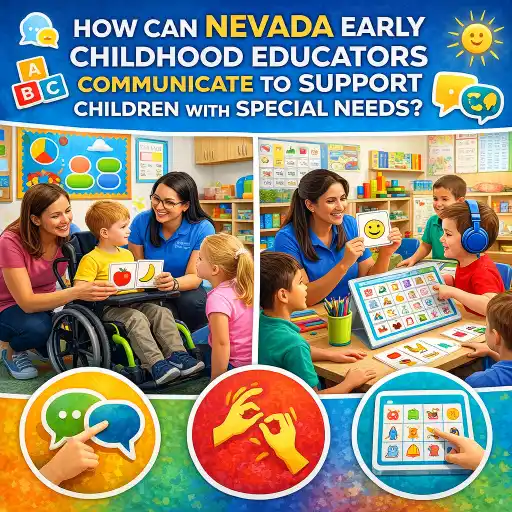
- 📷 Use visuals: picture schedules and first/then boards. Many ChildCareEd articles show simple visuals you can print (How can childcare programs support children with special needs?).
- 🗂️ Offer choices: two quick options reduce frustration and give words to use.
- 🔊 Model language: repeat a child’s word and add one word (child: “ball.” teacher: “red ball!”). See language tips (Language Development
 Buy Now $16.00).
 - 🧰 Use AAC and picture cards: model them yourself; point and press the device as you speak. Helpful guides include Adaptation Station (AAC) and ChildCareEd’s communication PDF (Special Needs: Supporting Communication Buy Now $0.00).
- ⏳ Wait time and cues: pause after a question 5–10 seconds. This gives children space to process and respond (AAC modeling).
Circle time ideas: let one child stand or hold a fidget, give a helper job, or use a picture cue for turn-taking (Inclusive Circle Time).
What do I do when communication links to challenging behavior?
- 🔎 Observe and record triggers: write ABC notes (Antecedent, Behavior, Consequence) for several days. This helps find the function of behavior (IIDC).
- 🧩 Teach a replacement: if a child bangs to get attention, teach “Can you play with me?” or use a picture to ask for help. Functional Communication Training (FCT) steps are practical and evidence-based (FCT guide).
- 🛡️ Safety first: remove hazards, stay close, and use calm language. Use the ChildCareEd behavior support PDF for proactive ideas (Behavior Support Buy Now $0.00).
- 🔁 Team with families and specialists: share notes, try the same cue at home, and ask for strategies from the child’s therapist or Early Intervention.
- 📞 When to get help: repeated major harm to self/others, long meltdowns, or little change after tried supports — bring in mental health consultants or early intervention. For evidence-backed tips, see CDC and CSEFEL (CSEFEL, CDC).
Common mistakes and fixes:
- ❌ Removing the child too fast. ✅ Try one adaptation and stay in the group.
- ❌ Only calling families about problems. ✅ Share small wins daily.
What Nevada rules and teaming steps should center leaders follow?
Directors must know Nevada rules and plan teamwork steps. Start here:
- 📘 Know state law basics: NAC Chapter 388 covers special instruction, IEPs, eligibility, and related services.
- 📝 Document and share: keep clear, dated notes (observations, steps tried, family chats) to use if an IEP/IFSP or referral is needed.
- 🤝 Partner with families: invite them to meetings and respect their insights. Use ChildCareEd’s guides on teaming: How to Support Children with Special Needs.
- 📣 Referral steps: if screening suggests delays, talk with the family and offer a referral to Early Intervention or the school district for evaluation. State requirements vary - check your state licensing agency. If families are unsure where to find an inclusive program nearby, offer to show them local options and resources for finding quality centers near them.
- 🎓 Train staff: use short ChildCareEd courses (e.g., Language Development Buy Now $16.00, Special Needs training, or the 9-Hour Communication Course Buy Now $99.00).
Tip for leaders: set a weekly team huddle to share one child’s wins and one next step. This keeps everyone using the same words and supports consistency.
Conclusion
Try this 3-step plan this week:
- ✨ Pick one child: add a picture support and tell the family you will try it for 5 days.
- 📒 Take short notes each day (ABC or WIN) and share one positive with the family at pick-up.
- 📞 If no change after 2–3 weeks, prepare notes and suggest a referral to Early Intervention or speech. State rules vary - check your state licensing agency.
FAQ
- Q: When should I refer for speech? A: If a child has little vocabulary by 24 months, or unclear speech by 3 years, talk with families and refer. See AAP/AAFP guidance.
- Q: Can we use AAC devices? A: Yes — model them, make messages motivating, and train staff. See Adaptation Station.
- Q: Who pays for adaptations? A: Many small changes cost little. For equipment or therapy, family insurance, early intervention, or local CCR&R supports may help.
- Q: What if a parent is upset? A: Stay calm, listen, name a strength first, and offer a short plan and a follow-up time.
Resources: Start with ChildCareEd’s helpful pages on inclusion and communication (Inclusive Care Strategies, Special Needs: Supporting Communication Buy Now $0.00), the CDC’s family conversation guides (Watch Me!), and Nevada law.
Behavior often says, “I need something.” Follow simple steps to keep children safe and teach new communication skills: Daily routines are the best practice ground. Try these classroom moves (easy, low-cost): Start as a teammate. Use short, warm talk and facts. Try these steps:
- CDA Home Visitor Subject Area 3 Part 3 Birth to 5
- Birth to Five CDA Credential with Portfolio Review
- CDA Bridge Bundle: Family Child Care without Portfolio Review
- CDA Bridge Bundle: Infant/Toddler without Portfolio Review
- CDA Bridge Bundle: Preschool without Portfolio Review
- Early Childhood Education
- Equity in Action with Head Start
- CDA Home Visitor Credential Birth to 5
- Texas Director Credential
- Every Moment Matters: Schedules and Transitions
- Ah-Choo!
- Supporting the Nevada Childcare Workforce
- The Power of International Sign Language in Early Childhood Education
- CDA Certification en Español: Recursos y Consejos para Educadores Bilingües
- 🚌🌄 Engaging Field Trip Ideas in Nevada for Childcare Providers
- Nevada Child Care Required Forms: Enrollment, Emergency Cards, Permissions
- Nevada Child Care Transportation Rules: Field Trip Forms, Car Seats, Supervision
- How can Nevada early childhood educators keep classrooms safe in hot weather?
- How can Nevada early childhood educators communicate to support children with special needs?
- How can Nevada preschool programs help children with special needs feel heard, included, and understood?
- Summer Field Trips for Daycares in Nevada
- Starting an Inclusive Daycare for Children with Speech Delays
- How can Nevada fix its early childhood workforce with better training pathways?
- ADA Training Online in Nevada: Requirements, Access, and Inclusion
- How can child care programs keep children safe during transportation?
- Can Nevada’s Early Childhood Plan Close Funding Gaps and Boost Access and the Workforce?
- Nevada Child Care Ratios and Group Sizes by Age: Home Daycare Guide
- Special Needs Training for Early Childhood Educators: Which Course Should You Take?
- Who Needs Child Abuse and Neglect Training—and How Often Do You Have to Take It?
