You work with busy days and many bright children. This article gives quick, simple ways Georgia early childhood educators and directors can help children with special needs communicate. You will find easy steps, tools you can use today, ideas to work with families, and tips to avoid common mistakes. Use the small changes that help a child join in and feel safe. Remember: state requirements vary - check your 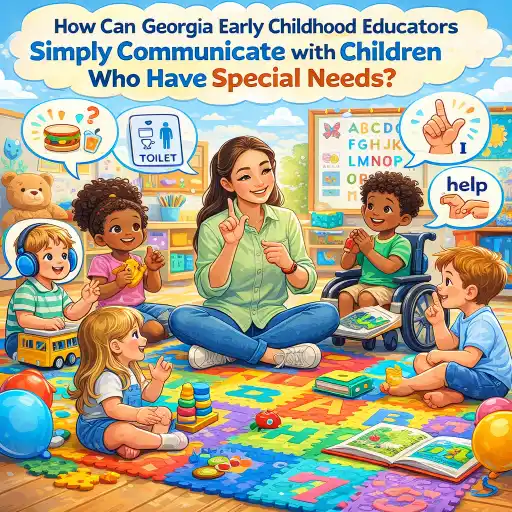 state licensing agency.
How can I make communication easier in my classroom?
Clear communication helps children feel calm and join activities. Try these steps you can start today. Each step is simple and can help many children:
- 🔹 Keep routines predictable
- Post a picture schedule for the day. See example ideas on ChildCareEd’s Georgia inclusion guide.
- Give a 2-minute warning before changes (count down or use a timer).
- 🔸 Use short, clear words and give extra wait time
- Speak at the child’s level and pause so they can respond.
- Try “first/then” language (First snack, then outside).
- 🔹 Add visuals and choices
- Use choice cards (book, blocks, art). Visuals help children who learn faster with pictures — see this ChildCareEd resource Buy Now $0.00 on supporting communication.
- 🔸 Offer calm break spaces
- Make a soft corner with simple rules: “Breaks are for calm bodies.”
- 🔹 Change the activity, not the child
- Shorten tasks, use thicker crayons, or allow standing at circle time.
Small supports like these improve #communication for many children and make your #classroom more welcoming. For more practical examples, check ChildCareEd’s article How to Support Children with Special Needs in Child Care.
What low-tech and high-tech tools can help a child communicate?
Tools can be no-tech (gestures), low-tech (picture cards), or high-tech (voice devices). Pick what fits the child and your program. The important part is how adults use the tools—model, wait, and encourage.
- 🔸 No-tech: gestures and signs
- Teach simple signs (eat, more, all done) and use them often.
- 🔹 Low-tech: picture boards and PECSThe
- Picture Exchange Communication System (PECS) helps children give a picture to ask for something. ChildCareEd explains practical AAC ideas in Special Needs in Daycare: Supporting Communication Buy Now $0.00.
- 🔸 High-tech: speech-generating devices and apps
- Apps or small devices can speak for a child. The AAC spectrum is described well by the Indiana resources and Practical AAC—see AAC Spectrum and Adaptation Station.
- 🔹 How to teach tools: model and wait
- Adults should point to pictures or press device buttons while speaking. Then pause and wait 10–15 seconds. Practicing the prompt hierarchy helps — see Adaptation Station.
Use the daily routine to plan messages on devices and boards. Teach staff to model AAC often — not just leave devices on the shelf. When you help a child use AAC, you build their voice and their confidence. This supports #AAC and #inclusion in real ways.
How do I work with families and Georgia specialists to support communication?
Families are experts on their children. Teamwork with families and local services makes communication plans stronger. Follow these steps to build good partnerships.
- 🔹 Start with listening
- Ask families: “What helps your child at home?” and “What is hard right now?” Use ideas from the CDC’s Watch Me/Act Early training to guide your conversations.
- 🔸 Share small wins and daily notes
- Send one positive note each day. ChildCareEd suggests a Family Communication Note and tools in How to Build Strong Relationships with Families.
- 🔹 Use local Georgia supports for inclusion
- DECAL Inclusion Specialists and the SEEDS program offer coaching and referrals. ChildCareEd’s Georgia inclusion post links to DECAL resources — see Inclusion in Child Care (Georgia Resources).
- For infants, Babies Can’t Wait can help with early intervention referrals; families can be guided to local agencies. If families are seeking inclusive child care nearby, you can help them locate quality local programs by sharing Daycare Near Me: A Parent's Necessity.
- 🔸 Coordinate with therapists and schools
- With family permission, align classroom supports with speech or occupational therapy goals. This helps children use the same cues across places.
Working with families and specialists strengthens your program and helps children reach goals. Always be respectful, private, and clear. State agencies can have rules about referrals and records — state requirements vary - check your state licensing agency. Building trust with families supports long-term success for children and program #Georgia goals.
Why does this matter, and how can we avoid common mistakes?
Why it matters:
1) Every child learns and belongs when we make small changes. Inclusion supports social skills, learning, and friendships. ChildCareEd explains how simple supports help many children in Inclusive Care Strategies.
2) Good communication reduces frustration and behavior challenges. When children can ask for what they need, everyone’s day is calmer.
Common mistakes and how to avoid them:
- 🔸 Mistake: Leaving tools unused
- Fix: Model the tool during routines. Adults must point, press, and pause so children see how to use it.
- 🔹 Mistake: Using too many choices at once
- Fix: Start with 2–3 clear options on a board or device, then add more as the child learns.
- 🔸 Mistake: Not teaming with families
- Fix: Share one daily success and ask what works at home. Use family ideas to shape classroom supports.
- 🔹 Mistake: Expecting quick results
- Fix: Celebrate small steps. Progress may be slow, but steady practice helps a child find their voice. Training like ChildCareEd’s Effective Approaches for Autism and Inclusion
 Buy Now $55.00 or the Play with Purpose Buy Now $55.00 course boosts staff confidence.
- Fix: Celebrate small steps. Progress may be slow, but steady practice helps a child find their voice. Training like ChildCareEd’s Effective Approaches for Autism and Inclusion
Bottom line: Use simple routines, model tools, partner with families, and celebrate small wins. These steps support a child’s #families and help your program grow in #communication and #inclusion.
Conclusion
You do not need fancy gear to make big changes. Start with pictures, short words, calm breaks, and teamwork with families. Georgia has useful supports—link with DECAL and SEEDS, and use ChildCareEd resources to train staff. Try 1–2 small changes this week and watch how children respond. Your work matters. Your patience and steady support give children a better chance to be heard and to belong. #Georgia #AAC
Selected resources: Inclusion in Child Care (Georgia Resources), Special Needs in Daycare: Supporting Communication Buy Now $0.00, Adaptation Station (AAC), AAC Spectrum.
- 45 Hour Child Growth and Development
- 45 Hour Preschool Methods and Materials
- Easy Steps to Resume and Interview Success
- Equity in Action with Head Start
- 45 Hour Infant and Toddler Methods and Materials
- CDA Bridge Bundle: Family Child Care without Portfolio Review
- CDA Bridge Bundle: Infant/Toddler without Portfolio Review
- CDA Bridge Bundle: Preschool without Portfolio Review
- Texas Director Credential
- The Power of International Sign Language in Early Childhood Education
- ChildCareEd: Empowering Early Childhood Educators with Quality Training
- Pediatric First Aid and CPR Training with ChildCareEd - Empower Yourself!!
- CDA Certification en Español: Recursos y Consejos para Educadores Bilingües
- Inclusion in Child Care: Simple Classroom Supports for Children With Disabilities (Georgia Resources)
- How can visuals, routines, and gentle words support Georgia preschoolers with special needs?
- How can Georgia early childhood educators simply communicate with children who have special needs?
- Starting an Inclusive Daycare for Children with Speech Delays
- What Could the SEED Act's New Tax Deduction Mean for Minnesota Early Educators?
- How do Georgia's mini-grants help child care and schools work together to boost early literacy?
- From Training to Career Growth: Exploring Online Early Childhood Education
- Ready to Become a Georgia Child Care Director? Start with the 40-Hour Training
- What Is the Difference Between Early Childhood Education and Child Development?
- Including Every Child: What Child Care Providers Should Know About the ADA
- Are You Ready to Be a Lead Teacher? 7 Signs You’re Prepared to Step Up
- 40 Hour Director Training Georgia: Is the Course All You Need to Become a Director?
- Why Do Bilingual Classroom Activities Matter for Dual Language Learners?
- Early Childhood Administration Certificate Online: Will It Qualify You to Be a Director?
- Special Needs Training for Early Childhood Educators: Which Course Should You Take?
