When circle time turns into a daily struggle with wiggling and repeated reminders, the answer may be a better fit—not more insistence on sitting still. A short, purposeful gathering built around movement, choice, and participation can support learning while helping children feel successful. For practical read-aloud strategies that make stories more interactive, explore ChildCareEd’s Setting the Stage: Story Time Buy Now $25.00; for broader tools to plan active, developmentally appropriate experiences, see Creating Engaging and Meaningful Learning Experiences  Buy Now $55.00.
Why does circle time need to fit children’s attention and development?
Circle time can offer a daily moment for greeting one another, sharing a brief idea, enjoying a song, or introducing materials. It can foster a sense of community and give children opportunities to practice communication and turn-taking. But it is only one teaching format—not a measure of children’s readiness or an activity that must fill a set amount of time.
When children are expected to listen passively for too long, they may begin to wander, talk, or seek movement. These behaviors are useful information. The activity may need a shorter duration, more active participation, a different time of day, or a smaller-group format. NAEYC’s discussion of moving from circle time to small groups emphasizes adapting the approach to children’s needs and using whole-group time for focused purposes.
It also helps to broaden what counts as engagement. A child may be listening while standing, holding a quiet object, watching nearby, or responding with a gesture rather than words. Aim for meaningful involvement and connection, not identical posture or constant eye contact. This strengths-based lens can reduce unnecessary corrections and help educators protect children’s dignity while strengthening #belonging.
How long should circle time last?
There is no universal duration that works for every age, classroom, or day. As a starting point, many groups benefit from a brief gathering—often around five to ten minutes—then educators can adjust based on children’s participation. A more experienced or especially engaged preschool group may manage a little longer, while toddlers or a group new to the routine may need only a song and a closing cue. The practical guidance in Penn State Better Kid Care’s successful circle times recommends beginning briefly and extending only as the group shows readiness.
Watch for group-wide cues instead of treating every movement as a problem. Children may be losing interest if many begin leaving, conversations drift away from the activity, or the educator has to pause repeatedly to regain attention. A child who fidgets, however, may still be following along. Consider whether the session is too long, too passive, or simply not well matched to the group.
- Choose one clear purpose for each gathering: greeting, sharing a short story, or introducing a material.
- End while children can still participate; use a familiar closing song or signal.
- If several topics need attention, distribute them across the day or use small groups.
- 🧭 Treat the clock as a planning aid, not a test children must pass.
Brief whole-group time can be meaningful when it has a focused purpose. Splitting a longer agenda into two short gatherings—or moving a discussion into a small group—can make more space for children to respond and explore.
How can teachers plan an active, predictable routine?
A predictable structure helps children understand what is happening and what comes next. Keep the sequence simple and consistent, while allowing the activity itself to change. For example, begin with a familiar gathering song, focus on one short story or idea, add a movement or response moment, and close with a clear transition cue. The routine becomes a supportive frame rather than a script that must be followed regardless of children’s cues.
Prepare materials before inviting children to gather. A small tub with a puppet, picture cards, or a story prop prevents waiting while adults search. Consider a picture sequence at child height, especially when verbal directions alone are not enough. CSEFEL’s brief on helping children understand routines and classroom schedules describes how predictable schedules and visual supports can clarify expectations and help children anticipate what happens next.
Build participation into each segment. A read-aloud can include a sound effect, a prediction, or a prop for a child to hold. A song can invite actions or let children choose a verse. Ask a concise question and allow time for children to answer in different ways. Repeating a favorite song or story across several days can also help children feel confident and recognize the routine.
Keep the plan intentionally small: one goal and one or two connected activities are often enough. A short gathering that launches a related activity at a center may be more useful than trying to teach every part of a theme at once. This is practical #planning, and it leaves room to notice children’s ideas.
Which activities help children with short attention spans participate?
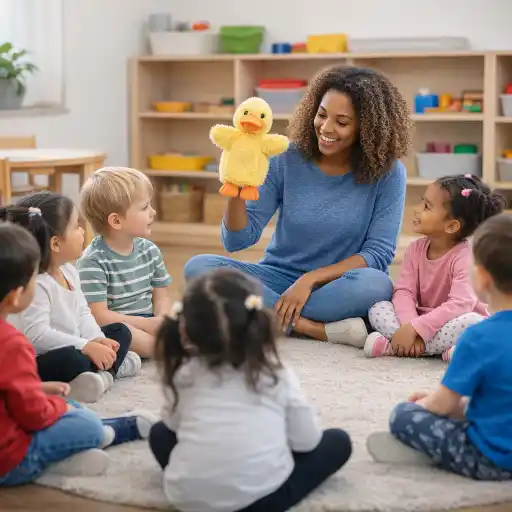
Activities that invite children to move, handle an object, make a choice, or contribute a sound are more active than long stretches of adult talk. They do not need to be elaborate. A scarf, puppet, picture card, or classroom object can turn an ordinary moment into an invitation to notice and respond. The key is a clear connection to the gathering’s purpose.
- Action songs: Sing a familiar song with gestures, clapping, or a simple movement pattern. Children can join through movement even if they do not sing.
- Interactive stories: Pause for a prediction, invite children to make a sound effect, or offer a related prop. See ChildCareEd’s circle time ideas that keep young children engaged for additional examples.
- Mystery object: Place a familiar item in a bag and offer clues. Children can guess by speaking, pointing to a picture, or choosing between two options.
- Movement reset: Stand, stretch, march, or shake out a wiggle before returning to a brief listening activity.
- Helper role: Invite a child to hold a prop, turn a page, choose a song, or place a picture on a board.
Alternate active and quieter moments rather than stacking several listening activities together. A short movement moment between a greeting and a book can help reset the group’s attention. Give children something purposeful to do, but avoid adding so many props or instructions that the activity becomes confusing. Movement and hands-on materials are useful tools for #engagement when they support the learning intention and suit the group.
How can circle time include different learners and participation styles?
Children differ in communication, sensory preferences, mobility, temperament, language, and comfort with groups. An inclusive circle time makes room for those differences from the start, rather than waiting for a child to struggle. Pair spoken directions with pictures, gestures, demonstration, or objects. Offer more than one way to respond: children might speak, point, sign, move, hold a picture, or pass.
Consider flexible seating and positions. A child may participate from a chair, cushion, standing spot, or place near the educator. Some children may prefer to watch at the edge before joining. Invite without pressure: “You can hold the picture, or you can watch.” A picture schedule or song visual can make the sequence more understandable and reassuring, and a quiet handheld object may help some children attend without distracting others.
Choose books, songs, names, and examples that reflect the children’s home languages, families, and communities. Rotate meaningful jobs so children have different ways to contribute over time. If a child repeatedly finds the gathering difficult, reflect with colleagues and families as appropriate: is the timing, noise level, group size, language demand, or transition a barrier? Adaptations should follow the child’s support plan and program procedures when applicable. These choices strengthen #inclusion and communicate that belonging does not depend on one way of sitting or speaking.
How can educators respond to challenges and improve the routine?
When one child leaves the circle or interrupts, respond calmly and briefly. A quiet reminder, a nearby helper role, or a warm invitation to rejoin may be enough. Avoid turning a small disruption into a long public exchange that pauses the activity for everyone. If several children are restless, first consider the experience itself: Is it too long? Are children waiting? Does the group need movement, a clearer cue, or a different format?
Common pitfalls are usually fixable through small adjustments:
- Too much adult talk: Reduce the explanation and invite a response, action, or choice.
- Too many agenda items: Select one main purpose and save other topics for later.
- Expecting stillness: Allow safe, comfortable ways to listen and participate.
- Unclear transitions: Use the same brief song, visual, or cue, and teach children what it means.
- Forcing participation: Offer a low-pressure observer role and welcome gradual joining.
After circle time, jot down one success and one adjustment to try next time. Notice who participated, what captured interest, and when attention shifted. Directors can support consistent practice by planning with staff, preparing shared materials, and discussing observations together. State requirements vary - check your state licensing agency for applicable program rules and training expectations.
Conclusion: What makes circle time work for children with short attention spans?
Circle time is more likely to work when it is brief, purposeful, predictable, and responsive to children’s cues. Start with one clear goal, alternate listening with movement or hands-on participation, prepare materials ahead of time, and offer flexible ways to join. Use whole-group time for a focused shared experience and move longer conversations or individualized learning into smaller groups when that better serves the children.
Most importantly, treat restlessness as information—not proof that children are unwilling to learn or that you have failed. Observe what draws children in, adjust one element at a time, and celebrate small successes: a child joining a song, holding a prop, or staying with the group for one more moment. A joyful, inclusive routine is built through responsive practice, one gathering at a time.
Explore five related ChildCareEd courses
- 45 Hour Child Growth and Development
- Turning Behavior Around for Toddlers and Preschoolers
- Lesson Planning for Preschoolers
- CDA Home Visitor Subject Area 3 Part 3 Birth to 5
- Birth to Five CDA Credential with Portfolio Review
- 45 Hour School Age Methods and Materials
- Texas Director Credential
- Access for All: Inclusion and the ADA
- Ready, Set, Kindergarten!
- How to Celebrate the Fourth of July in Your Center or Daycare
- Father’s Day School Event Ideas for Early Childhood
- How can circle time stay fun and keep children engaged?
- Fall Circle Time Ideas for Preschool and Daycare
- Circle Time Activities That Build Listening and Social Skills
- Circle Time Songs, Games, and Questions for Kids
- Canciones, juegos y preguntas de círculo para niños
- Preschool Circle Time Ideas for Learning and Connection
- How Can I Make Circle Time Activities Work for Preschoolers?
- How can I create meaningful circle-time experiences that engage every child?
- What Does Ms. Rachel Get Right About Talking to Babies and Toddlers?
- How Can Childcare Providers Practice Mindfulness During the Childcare Day?
- Preschool Schedule That Works: When to Plan Centers, Circle Time, and Outdoor Play
- Beyond “How Are You?” Circle Time Questions Kids Actually Want to Answer
- Why Is My Preschool Classroom So Chaotic? 7 Classroom Management Fixes to Try
- How Can You Manage Large-Group Time When Young Children Have Short Attention Spans?
- What Should a 2-Year-Old Be Learning at Daycare?
- How Can Teachers Make Circle Time Work for Children with Short Attention Spans?
