Using photos and work samples strategically turns everyday learning moments into reliable evidence that supports informed teaching decisions. This guide helps child care providers and directors transform candid images, artwork, writing samples, and other classroom artifacts into meaningful #assessment, organized #portfolios, clear #documentation, and stronger partnerships with #families. Child care professionals can expand these skills through ChildCareEd’s Observing & Assessing in Child Care  Buy Now $16.00, which explores observation methods, developmental documentation, individualized learning experiences, and family collaboration. The guide also provides practical steps, ethical and legal safeguards, and classroom-ready workflows for collecting evidence that informs instruction, communicates children’s progress, and supports overall program quality. Because requirements vary, always consult your state licensing agency regarding photography, family consent, confidentiality, recordkeeping, and assessment practices.
How can photos and work samples serve as valid assessment evidence?
1) Photos and samples are authentic, context-rich records of what children actually do and say, not just test scores—see how documentation makes learning visible in Documenting Children’s Learning.
2) When curated over time into a portfolio, they reveal growth trajectories that support instructional planning and referrals—learn portfolio essentials in Creating Effective Child Portfolios and How can we document child progress effectively?.
Use this short framework for validity and trustworthiness:
- Collect multiple kinds of evidence (photo, sample, anecdote) for the same skill over time—this increases reliability (ECRP outcomes-driven assessment).
- Contextualize each item with caption: who, when, where, what the child did or said.
- Triangulate: pair the image/work sample with an observation note and a brief teacher reflection or next step.
- Use standards or learning goals to explain why the artifact matters; link artifacts to goals when possible (see Work Sampling guidance).
What types of photos and work samples should we collect?
- 📸 Photos that document process (not only finished product): play sequences, peer interactions, use of materials. See practical examples in Documenting Children’s Learning.
- 📝 Work samples across domains: drawings, early writing, constructions, math representations, dramatic play props.
- 🎥 Short video clips for communication, physical skills, or language samples (with consent).
- 🖼️ Paired artifacts: photo + work sample + a 1–2 sentence anecdote that records exact words or actions.
- 📅 Time-stamped progress series: e.g., a child’s name writing at multiple points across months (examples from practitioners).
Tip: prioritize items that answer one of three questions: "What can the child do now?", "What pattern do we see over time?", and "What is the next instructional step?" For portfolio structure and templates, see Portfolios in Child Care.
How should we organize, store, and protect photo and sample evidence?
- 📁 Three-place storage:
- Paper: one copy in the child’s secure file.
- Classroom: a binder or panel with selected, dated examples and captions.
- Digital: password-protected folder or secure platform (backed up) for photos and scanned work.
- 🧾 Consent & forms: use clear photo-release forms with checkboxes for specific uses (in-class display, closed family group, public social media). ChildCareEd offers templates and practical language—see photo & privacy consent guidance and general sample forms at SampleForms.
- 🔐 Access control: limit posting/printing rights to designated staff; keep a dated log of who accessed or posted images.
- 🗑️ Retention & deletion: set retention timelines, and honor withdrawal requests promptly; document changes in consent.
- ⚖️ Ethics check: ask—could this photo identify or put the child at risk? If yes, blur faces or avoid public use (CRIN guidance).
Note: state requirements vary - check your state licensing agency. For staff practice, avoid personal-phone posting unless your program policy is explicit and families consent.
How do we use photos and samples to make valid assessment decisions?
Turn artifacts into action with a short cycle that links observation to instruction. Here’s a 6-step process you can use daily or weekly.
- 🔎 Focus: pick 1–2 learning targets per child (language, fine motor, self-regulation).
- 📝 Collect: gather 2–3 pieces of evidence across contexts (photo, work sample, anecdote).
- 📌 Caption & code: note date, context, targeted skill, and any prompts given.
- 🧰 Analyze: ask, "Is this a one-off or pattern?" Use DRDP and observation guidance to interpret non-standard demonstrations (DRAccess on DRDP adaptations and DRDP observation practices).
- 🎯 Plan: write a measurable, time-bound next step (e.g., "Sam will use 3 new words during circle time over 2 weeks") and list teacher moves.
- 🔁 Revisit & rate: collect follow-up evidence and update the portfolio; use multiple measures before changing a rating or making a referral (research on outcomes-driven assessment).
Use short team huddles to compare notes and calibrate observations so ratings stay consistent across staff. For integrating assessment into curriculum planning, see ideas from Work Sampling and AEPS models (Pearson webinar).
How do we involve families and avoid common pitfalls?
Family partnership strengthens the accuracy and usefulness of portfolios. Use straightforward communication, shared goals, and choices.
- 📣 Share early and simply:
- At enrollment: present the photo policy and consent form (one page, checkbox options).
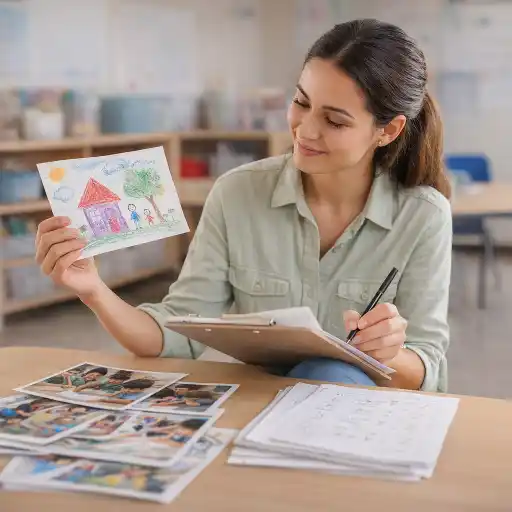
- Ongoing: send single-photo updates with a one-line caption and 1 suggested home activity.
- At enrollment: present the photo policy and consent form (one page, checkbox options).
- 🤝 Invite family artifacts: family photos, home samples, or short notes about milestones add context and balance.
- 📅 Use scheduled portfolio conferences (or short drop-off notes) to co-create goals—see practical communication strategies in Documenting Children’s Learning and ChildCareEd guides (Michigan portfolio start).
- ⚠️ Common mistakes and fixes:
- ❌ Mistake: Random, one-off samples. ✅ Fix: Collect at least one purposeful sample per focus skill each month.
- ❌ Mistake: Subjective language. ✅ Fix: Use factual, objective notes and direct quotes.
- ❌ Mistake: Posting without checking consent. ✅ Fix: Always verify the current consent list before posting.
FAQ (brief):
- Q: How often update a portfolio? A: Small updates weekly; a review with families every 4–8 weeks (ChildCareEd guidance).
- Q: Who can add items? A: Staff who know the child best and family members; log contributors for transparency.
- Q: How long keep records? A: Follow program policy and state rules—state requirements vary - check your state licensing agency.
- Q: What if a family withdraws consent? A: Stop future use, archive/remove public posts when possible, and document the request.
- Q: Can photo evidence be used in staff training? A: Yes, with explicit consent and de-identifying details if needed (consent guidance).
Conclusion
Photos and work samples are powerful assessment evidence when collected with purpose, organized with clear systems, protected ethically, and paired with objective observation. Use the 6-step assessment cycle, keep families at the center, and make documentation part of daily practice rather than an extra task. For templates, training, and example forms, prioritize the practical ChildCareEd resources like Creating Effective Child Portfolios, portfolio start guides (e.g., Michigan guide), and the DRDP observation tutorials (DRDP observation & documentation). Small, consistent steps will make your #documentation and #assessment work both manageable and meaningful. Remember: state requirements vary - check your state licensing agency.
Why it matters:Collect a purposeful mix so portfolios show breadth and depth. Aim for a balanced set of evidence for each child.\Good systems make documentation routine, protect privacy, and reduce staff burden. Use a simple, three-place storage rule and clear consent procedures.
- 45 Hour Child Growth and Development
- Easy Steps to Resume and Interview Success
- Legal & Ethical Essentials in Child Care
- CDA Infants/Toddlers: Benefits to Observing
- The ABCs of Behavior: Turning Challenges into Learning Opportunities
- Tracking Progress, Shaping Futures: Observation & Assessment Skills
- Money Matters in Medicine
- Early Childhood Education
- Texas Director Credential
- CDA Certification en Español: Recursos y Consejos para Educadores Bilingües
- 🔍 ¿Qué ves cuando observas a un niño aprender?
- Cómo Empezar una Guardería en Casa: Requisitos y Pasos
- How do I start portfolio assessment in Michigan early childhood programs?
- How can we assess child progress in simple, helpful ways?
- Celebrando la amistad en el cuidado infantil durante el Día de los Mejores Amigos
- How can I build a simple assessment system for my North Dakota program?
- How do we apply Developmentally Appropriate Practice in mixed-age groups?
- How can child care programs build strong readers before kindergarten?
- How can assessment results be used to plan meaningful activities in early childhood programs?
- How can photos and work samples be used as reliable assessment evidence?
- How Can Developmental Observation Strengthen Early Childhood Practice?
- How Can Child Care Providers Make Individualized Learning Practical and Inclusive?
- How Can Child Care Providers Use Learning Styles Responsibly in Early Childhood Classrooms?
- How Can Child Care Providers Use Observation and Assessment to Support Every Child?
- How Can Child Care Providers Assess Children Through Everyday Activities?
- What Makes a Preschool Curriculum Meaningful, Inclusive, and Effective?
- What Should Be Included in a Preschool Progress Report?
- How Can You Track Children’s Development Without Turning Everything Into a Test?
