Small moments—a new word at snack, a more complex block tower, or an independent attempt to zip a coat—can reveal meaningful growth when teachers capture and revisit them. The right digital workflow can help you organize these observations, plan responsive next steps, and share a clearer picture with families; ChildCareEd’s Tracking Progress, Shaping Futures: Observation & Assessment Skills  Buy Now $55.00 offers deeper practice in objective observation, assessment, and goal setting. Read on for ways to use technology as a practical support—not a substitute—for attentive teaching.
Why does tracking progress over time matter?
Children’s development unfolds unevenly and in context. A single snapshot may capture a skill, but a sequence of observations can show how a child approaches a challenge, communicates with peers, or applies a familiar idea in a new setting. When teachers return to dated records, they can notice patterns and make thoughtful decisions about materials, routines, and interactions.
Progress documentation is not about ranking children or expecting every child to follow the same timetable. It is a way to make learning visible, recognize individual strengths, and identify where additional support or a different teaching approach may help. The National Association for the Education of Young Children describes documentation and portfolios as ways to gather and interpret evidence of children’s thinking and learning. Its resources on portfolios and documentation emphasize the value of authentic, reflective assessment practices.
Digital tools can make those records easier to organize and revisit, but the quality of the observation still depends on educator judgment. Technology is most useful when it helps teachers spend less time searching for information and more time responding to children. A thoughtfully maintained portfolio can also help families see growth that may be hard to describe in a brief daily update.
What can digital tools help teachers notice and preserve?
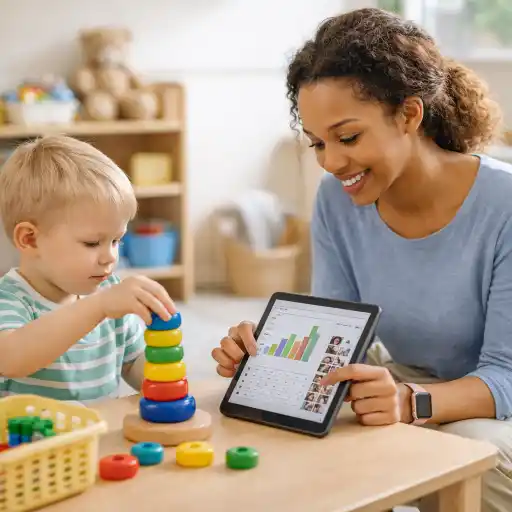
Phones, tablets, and secure documentation platforms can capture evidence in formats that paper records cannot easily hold together. A photograph can show how a child’s drawing changes across a season; a short audio note can preserve a child’s explanation; and a dated anecdotal record can describe the strategies used during play. Together, these records create a richer account of learning than a checklist alone.
Tools may also organize observations by child, date, learning area, or classroom experience. Searchable records can help educators review development across weeks or months and find examples for planning meetings or family conferences. An article on assessment and technology in early childhood classrooms frames assessment as gathering evidence, interpreting it, and acting on what it shows. Digital storage supports that cycle when it makes evidence accessible for reflection and instructional decisions.
- Capture brief, dated observations during natural play and routines.
- Pair images or work samples with context: what was happening, what the child said or did, and what learning might be emerging.
- Organize records by developmental area or program framework, without forcing every observation into a single category.
- Use digital portfolios to assemble selected examples over time rather than accumulating every photo or note.
Choose features that fit the classroom’s real workflow. A simple tool used consistently is often more helpful than a feature-rich platform that staff find difficult to maintain.
How can technology support useful observation and planning?
Technology can help turn everyday noticing into a manageable feedback loop: observe, document, reflect, plan, and observe again. For example, a teacher might record that a child tried several ways to connect train tracks, asked a peer for help, and returned to the task later. Over time, related entries may show persistence, problem-solving, and growing collaboration. These patterns can inform the next invitation—perhaps adding varied construction materials or planning a small-group building experience.
To keep records useful, write what was seen and heard before interpreting it. “Mina stacked five cups, then changed the order after they fell” is more actionable than “Mina is good at problem-solving.” Add a concise reflection or possible next step, while treating it as a teaching hypothesis rather than a fixed label. A digital platform may make tagging and retrieval easier, but it cannot determine what a moment means without professional context.
Try a repeatable process that does not interrupt care:
- Choose one focus, such as expressive language, peer interaction, or fine-motor coordination.
- Record a short, objective note with the date and context; include a child’s exact words when relevant.
- Review several observations together to distinguish a recurring pattern from a one-time event.
- Plan a small, practical teaching response and revisit the focus later.
- 📌 Keep the device secondary: remain present with children and capture only what can be documented safely and appropriately.
How do digital portfolios strengthen family partnerships?
A well-curated portfolio helps families understand the learning behind a classroom moment. Instead of sending a photo without explanation, an educator can add a short description: “During outdoor play, Leo tested three ways to move the wagon over the grass and asked a friend to help.” This communicates effort, language, and collaboration while giving families a concrete starting point for conversation.
Digital sharing can make updates timely and accessible, but the goal is meaningful communication—not a constant stream of notifications. Establish a realistic rhythm for portfolio updates and tell families what kinds of records they will see. Invite family observations as well: a new interest, a word used at home, or a skill practiced with relatives may add context that the classroom team cannot see.
Be mindful that families may have different access to devices, internet service, preferred languages, or comfort with online platforms. Offer alternatives when possible, such as printed summaries or in-person conversations, and make sure digital tools support rather than narrow participation. Use respectful, strengths-based language and describe specific situations instead of applying broad labels. Documentation is most helpful when it opens a two-way conversation about the child’s experiences and possible next steps.
For teachers, these exchanges can sharpen understanding and make planning more responsive. For families, a clear record can show that learning happens through play, relationships, routines, and exploration—not only through finished products or formal milestones.
What safeguards and common pitfalls should programs consider?
Children’s observations, images, and developmental information are sensitive records. Before adopting a platform, directors should review how information is stored, who can access it, how families give or withdraw consent, whether records can be exported, and what happens when a service is discontinued. Use program-managed accounts and devices where possible, limit access to people who need the information for their roles, and avoid sharing identifiable images through personal accounts or unapproved channels.
Clear policies make privacy practical. Explain to families what is collected, how it is used, who will see it, and how long it is kept. Train staff to check permissions before capturing or sharing images and to follow the program’s retention and deletion procedures. Digital tools do not automatically make documentation secure or appropriate; program leaders must evaluate vendors and set consistent expectations. State requirements vary - check your state licensing agency.
Common pitfalls are preventable:
- Collecting too much: Prioritize purposeful records instead of documenting every activity.
- Writing conclusions as facts: Separate direct observation from interpretation and discuss patterns with colleagues.
- Letting technology interrupt interaction: Use brief capture routines and return attention to the children.
- Sharing without sufficient context or consent: Check permissions and add a concise, respectful caption.
- Relying on one measure: Consider observations across settings and times, and invite family perspectives.
These practices help keep technology in its proper role: a tool for careful, ethical teaching.
How can a team begin with a sustainable digital routine?
Start with a classroom need, not a product demonstration. A team might want to reduce time spent assembling conference materials, improve consistency in anecdotal notes, or make progress easier to review. Identify the purpose first, then choose a tool that supports it and can be used securely by the staff who will document learning.
Introduce the workflow in manageable stages. Agree on a brief observation format—date, context, what happened, and a possible next step—then practice it together using a classroom example. Decide how often educators will add records, who reviews them, and how information will be used in planning and family communication. A short weekly review can help staff identify missing perspectives, discuss patterns, and adjust next steps without turning documentation into an additional full-time task.
Leaders can support implementation by providing training, time, and opportunities for staff feedback. If a process is cumbersome, simplify it. If staff have different levels of confidence with technology, pair colleagues and provide clear written guidance. Use periodic checks to ensure that documentation remains objective, inclusive, and useful to instruction. For additional professional learning, the ChildCareEd courses Observing & Assessing in Child Care Buy Now $16.00, Preschool Assessments & Observations Buy Now $24.00, Privacy Matters: Documentation and Observation in Early Learning Buy Now $55.00, and the Tracking Progress, Shaping Futures course Buy Now $55.00 offer focused study in observation, assessment, and responsible record practices.
Conclusion: How can technology help teachers follow progress over time?
Technology can help teachers follow children’s progress by making observations easier to capture, organize, revisit, and share. Its greatest value is not the volume of photos or data collected, but the clearer connections it can support between what educators notice, how they plan, and how children respond. Pair concise, objective notes with selected work samples or media; review evidence across time; and use the patterns to plan responsive experiences.
Keep professional judgment, family partnership, and privacy at the center. A small, consistent documentation routine is more sustainable than an elaborate system that competes with relationships. When thoughtfully chosen and securely managed, digital tools can help teachers recognize growth, communicate it meaningfully, and make each child’s learning journey more visible.
- 45 Hour Child Growth and Development
- Birth to Five CDA Credential with Portfolio Review
- CDA Bridge Bundle: Preschool
- CDA Bridge Bundle: Family Child Care
- CDA Bridge Bundle: Family Child Care without Portfolio Review
- CDA Bridge Bundle: Infant/Toddler without Portfolio Review
- CDA Bridge Bundle: Preschool without Portfolio Review
- CDA Bridge Bundle: Infant/Toddler
- Texas Director Credential
- CDA Certification en Español: Recursos y Consejos para Educadores Bilingües
- 🔍 ¿Qué ves cuando observas a un niño aprender?
- Cómo Trabajar en el Cuidado Infantil en Carolina del Norte: Requisitos y Pasos
- Celebrando la amistad en el cuidado infantil durante el Día de los Mejores Amigos
- Canciones, juegos y preguntas de círculo para niños
- Cómo simplificar la capacitación para sus empleados de daycare
- How to Integrate Technology in the Classroom Effectively
- Integrating Technology in the Classroom: Best Practices for Teachers
- Classroom Management Technology: Tools and Best Practices
- Can technology help preschool classrooms teach better?
- How Can Technology Make Staff Training Faster, Fairer, and More Effective?
- Daycare Teacher Discounts: Deals and Benefits You May Be Missing
- What Should Teachers Know About Screen Time in Child Care?
- How Can AI Give Child Care Teachers More Time Back in Their Day?
- How Can Technology Help Teachers Track Children’s Progress Over Time?
- Can Technology Help Teachers Understand Why Challenging Behaviors Keep Happening?
- How Can Technology Support Dual-Language Learners in Early Childhood Classrooms?
- How Can Child Care Programs Use Technology to Reduce Teacher Burnout?
- Screen Time in Preschool: How Can Teachers Tell Whether Technology Supports Learning?
