Introduction: Why documenting progress matters
Documenting a child’s progress helps teachers plan better lessons and share clear facts with families. Good notes and records show what children can do, where they need help, and how they grow over time. Keep records that focus on strengths and next steps. This supports everyday teaching and larger decisions about screening or referrals.
Why it matters:
- It makes learning visible and fair for each child.
- It helps staff and families work together to support the child.
- It gives proof when you need to refer for more help.
Use short, factual notes and share them kindly. Keep your #documentation clear and your #observation focused so you can track #development and partner with #families to set practical #goals.
1) What is the simplest way to record real moments?
Start with short, clear tools that match your day. A simple plan helps staff keep records without burning time.
- Pick a tool and stick with it: an anecdotal record, a daily report, or a small portfolio. For a full guide to portfolios see Creating Effective Child Portfolios.
- Record the basics each time: who, what, when, where, and what happened next.
- Keep it short: one or two sentences for a moment; save longer notes for big changes.
Practical example: write the date, setting (block area), exact actions ("stacked 6 blocks"), and a next step idea ("offer different block sizes tomorrow"). For templates and ready forms, use ChildCareEd resources like the Preschool Daily Report Form Buy Now $0.00 and the Family Communication Note Buy Now $0.00.
2) How can we observe and record without bias?
Objective observation means writing what you see and hear, not guessing why it happened. Practice and clear rules make notes stronger.
- 🔎 Define the focus before you watch (language, play, self-help).
- 📝 Use concrete language: write quotes and actions (for example: "said 'help me'" or "stacked 6 blocks").
- 👥 Use more than one observer sometimes to compare notes and reduce bias. See how to observe with purpose in How do we observe with purpose and How can teachers observe children's development effectively?.
Common mistakes and how to avoid them:
- 🙂 Mistake: Writing opinions. Fix: Stick to facts and direct quotes.
- 🙂 Mistake: Watching only hard moments. Fix: Observe routines and play to see strengths too.
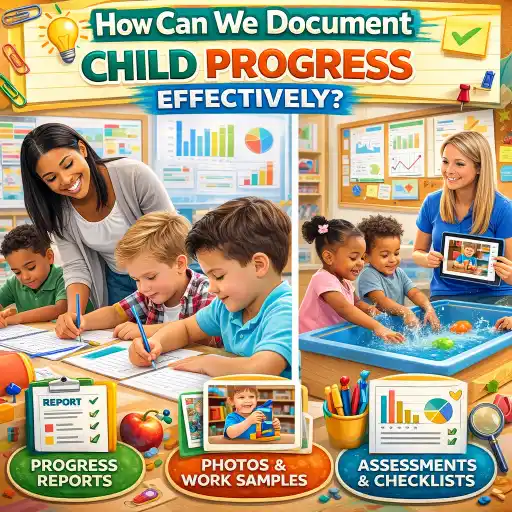
- 🙂 Mistake: Using only one tool. Fix: Combine anecdotal notes, photos (with permission), and work samples.
Supervisors can use a checklist to coach staff. ChildCareEd offers a printable tool for this in Collecting and Using Anecdotal Records Buy Now $0.00.
3) How do we turn notes into clear goals and share them with families?
Notes matter most when they lead to simple, measurable next steps and a shared plan with families.
- 📑 Summarize the observation in one short paragraph with date and setting.
- 🎯 Make 1–3 small, measurable goals (for example: "Will stack 8 blocks in a row in 3 of 5 tries").
- 🛠 List 2–3 teacher supports that fit daily routines (modeling, offering materials, small group practice).
- 🔁 Re-check progress in 2–4 weeks and update goals.
Start family talks with strengths. Use examples and invite the family’s view. For scripts and tools on communicating progress, see How can child care providers communicate a child’s progress clearly and kindly?.
If you suspect a delay, use monitoring and screening steps. The CDC explains monitoring and screening choices and when to refer: Developmental Monitoring and Screening. Remember: state requirements vary - check your state licensing agency.
4) What systems make documentation fast, reliable, and useful?
Good systems save time and keep documentation consistent. Pick forms and routines your team can follow every day.
- 🗂 Use a 3-place system: (1) Child file, (2) Classroom binder, (3) Program file. This is an easy rule from recordkeeping best practices in Recordkeeping and Documentation Tips.
- ⏱ Make mini-notes during the day and finish the form at the next free moment.
- 💻 Consider a simple app or digital folder but check privacy rules and permissions for photos.
- 📆 Review documentation weekly in short team meetings to spot patterns and coach staff.
Try these roles to keep it fair: rotate who writes daily notes, assign a weekly file tidy-up, and have short coaching check-ins. Use ready forms like the Preschool Daily Report Buy Now $0.00 and sample behavior supports for consistency.
Conclusion: Quick steps to start today
- Pick one simple form (anecdotal note or daily report).
- Practice writing objective, short notes (who, what, when, where).
- Turn notes into 1–3 small #goals and share them with #families.
- Set a weekly team time to file and review notes.
Training helps. If you want more depth, courses like Tracking Progress, Shaping Futures  Buy Now $55.00 and Observations And Goal Setting in Childcare Buy Now $24.00 walk you through tools and examples.
FAQ (short)
- Q: How often should we write observations? A: Quick daily notes for some children and deeper observations monthly.
- Q: Who should write them? A: Staff who know the child best; add a second observer sometimes.
- Q: How long keep records? A: Follow your program policy and state rules.
- Q: What if a parent disagrees? A: Listen, show examples, invite their observations, and make a shared plan.
- CDA Infants/Toddlers: Benefits to Observing
- Tracking Progress, Shaping Futures: Observation & Assessment Skills
- Teacher Mentoring in ECE
- CDA Bridge Bundle: Family Child Care
- CDA Bridge Bundle: Family Child Care without Portfolio Review
- CDA Bridge Bundle: Infant/Toddler without Portfolio Review
- CDA Bridge Bundle: Preschool without Portfolio Review
- Privacy Matters: Documentation and Observation in Early Learning
- Texas Director Credential
- Bridging Cultures: Family Communication & Collaboration
- Mathematical Skill Development
- 🔍 ¿Qué ves cuando observas a un niño aprender?
- Proporciones de Cuidado Infantil y Tamaños de Grupo por Edad en Virginia (Guía Rápida para Centros y Hogares)
- How can Georgia early childhood educators build mutual respect with parents through daily communication?
- How can we assess child progress in simple, helpful ways?
- What can DC early childhood educators learn by watching children play?
- How can Florida preschool staff assess children during everyday activities?
- How can Texas child care providers use everyday moments to assess young children?
- How can we make observation and assessment simple and useful in childcare?
- How can I support speech and language development in toddlers?
- How can child care providers handle tough conversations with parents effectively?
- How can we reliably avoid bias during observation and assessment?
- How can child care providers share developmental information with families effectively?
- How can photos and work samples be used as reliable assessment evidence?
- How should child care programs document infant and toddler development?
- How can preschool programs best prepare children for kindergarten?
- How can child care providers track development without comparing children?
- When Is Repetitive Speech Typical—and When Should Teachers Pay Closer Attention?
- How Can Child Care Providers Recognize and Support Developmental Delays?
- How Can Child Care Providers Document Developmental Concerns Without Diagnosing?
