Children reveal remarkable learning when they build, pretend, negotiate, explore, and try again—but busy educators can find it hard to turn those moments into clear year-end reports. Preschool Assessments & Observations  Buy Now $24.00 offers practical learning in objective observation, appropriate assessment, and planning responsive experiences, helping you create reports grounded in what children actually do. Use the ideas below to turn everyday play into a thoughtful account of growth that families can understand and build on.
Why should year-end reports tell the story of learning through play?
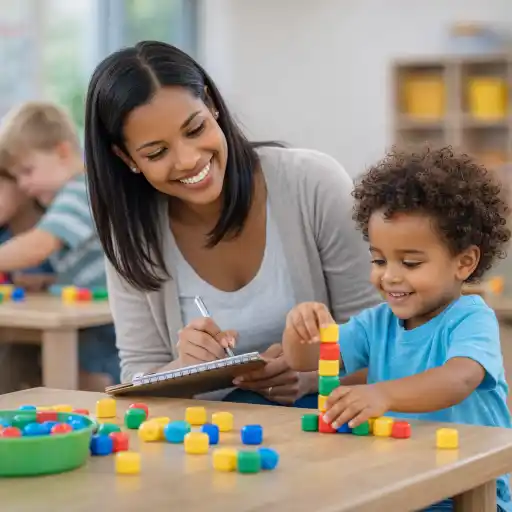
Play is not a break from learning; it is one of the settings where young children make their thinking visible. A child constructing a bridge may compare sizes, test balance, revise a plan, and explain an idea. In dramatic play, children may use language, negotiate roles, represent familiar experiences, and practice cooperation. A meaningful progress report connects these observable moments to developmental learning without reducing the child to a score or a checklist.
Year-end reports matter because they help families see development over time and help educators decide what support, materials, or experiences may be useful next. NAEYC emphasizes that assessment should be ongoing and purposeful, responsive to children’s development, culture, and language, and used to inform teaching and communication with families. A report is strongest when it brings together more than one source of evidence and describes the child’s individual path rather than comparing them with peers.
For directors, a consistent approach to reporting can also strengthen classroom practice. Teams can reflect on whether opportunities to play are inclusive, whether children have enough time to explore, and whether adult interactions extend curiosity without taking over. When a report accurately reflects a child’s interests and capabilities, it becomes a practical bridge between the classroom and home—and a celebration of the year’s learning.
What should educators observe and document during play?
Start by observing with a question in mind. Rather than trying to record everything, choose a focus such as problem-solving, expressive language, peer interaction, persistence, fine-motor coordination, or imaginative thinking. Notice the child across varied experiences and over time: a single moment can offer a useful clue, but it rarely captures a full developmental pattern.
Use concise, factual notes that distinguish what happened from what you think it may mean. Include the date, setting, materials, action, and the child’s words when relevant. For example: “At the water table on May 8, Sam filled two containers, poured water between them, and said, ‘This one is heavier.’” This gives a family and another educator concrete evidence to consider. By contrast, “Sam understands measurement” is an interpretation that needs supporting examples.
- Notice how children begin an activity, make choices, and respond when a plan changes.
- Record interactions with peers and adults, including gestures, home-language communication, and nonverbal contributions.
- Collect selected work samples, children’s words, or photos of a process when consent and program policy permit.
- 🌟 Capture moments of curiosity, persistence, joy, collaboration, and independent problem-solving—not only finished products.
NAEYC’s guidance on using observation to guide teaching underscores the value of watching and listening intentionally, then using what educators learn to adjust teaching and plan experiences. Thoughtful notes gathered throughout the year make year-end writing more accurate and less dependent on memory.
How can evidence become a clear, balanced progress report?
Organize the report around broad areas of development that fit your program’s framework, such as social-emotional development, language and literacy, cognition, physical development, and approaches to learning. These domains overlap in real play: a child negotiating who will be the shopkeeper is using communication, self-regulation, imagination, and social reasoning at once. Describe the connections rather than treating every skill as an isolated box.
For each area, share a specific example, explain the emerging ability in accessible language, and note a possible next step. A useful structure is: “During block play, Ava tested several ways to support a long bridge and asked a friend to hold one end. She is practicing planning, persistence, and collaboration. We will offer varied building materials and invite her to explain how she decides whether a structure is stable.” This gives families a picture of both the learning process and the educator’s plan.
Balance accomplishments with skills still developing. Avoid using a report as a list of deficits, but do not hide a pattern that may call for thoughtful support. Describe growth relative to the child’s own earlier experiences, and recognize that children may demonstrate knowledge differently depending on context, language, relationships, and familiarity. Head Start describes ongoing assessment as a source of information for curriculum planning, teaching, and individualizing support.
- Include strengths, interests, examples, emerging skills, and realistic next steps.
- Use direct quotes or selected artifacts to make the child’s thinking visible.
- Prefer “is beginning to” or “with support, now…” over fixed labels or rankings.
How can reports honor each child’s culture, language, and individual pace?
A fair report reflects how children communicate and learn across their real environments—not only how they respond to one adult or one kind of activity. A child may tell elaborate stories in a home language, observe quietly before joining group play, or show a skill more readily with familiar materials. Educators should consider these contextual differences before drawing conclusions and invite families to share what they see at home.
Assessment methods should be developmentally, culturally, and linguistically responsive. When educators do not speak a child’s language, appropriate language support or a qualified interpreter may help ensure the child’s abilities and family perspectives are understood. Explain observations in plain language, and be careful not to confuse language acquisition, temperament, disability-related access needs, or different experiences with a lack of ability.
Reflect on possible bias as you review the year’s notes. Ask whether some children were observed more often in challenging moments, whether expectations were applied consistently, and whether each child had genuine opportunities to demonstrate skills. Compare evidence across different activities and settings, and consult colleagues or families when an interpretation is uncertain. NAEYC guidance recommends considering multiple sources and recognizing individual variation; a checklist or screening result should not be treated as a diagnosis or as the whole story.
When a concern remains, share factual examples privately and collaborate with the family on appropriate next steps. Screening can identify a reason for further examination, but it does not diagnose. State requirements vary - check your state licensing agency, and follow your program’s procedures for documentation, referrals, and family communication.
How can educators share reports and plan next steps with families?
A year-end report is most useful when it opens a conversation rather than ending one. Give families time to review it, provide translation or interpretation when needed, and invite their knowledge of the child’s interests, routines, languages, and recent changes. A child’s learning at home and in care may look different, and both views contribute to a fuller picture.
Begin conversations with a genuine strength and a concrete example. Then discuss developing skills and ask open questions such as, “What have you noticed lately?” or “What kinds of play does your child return to at home?” Listen carefully before proposing strategies. Families are partners, not recipients of a verdict, and suggested home activities should be optional, simple, and responsive to each family’s circumstances.
Choose one or two next steps that build on the child’s interests and current abilities. If a child is fascinated by ramps, for example, educators might add rolling objects and varied surfaces, observe the child’s predictions, and offer language for comparing speed and distance. Families might choose to explore what rolls at home, but the plan should not require special purchases or formal lessons.
- Share the report in a private setting and protect records and photographs.
- Ask families what goals feel meaningful and realistic for their child.
- Agree on what educators will try, how progress will be noticed, and when you will reconnect.
Resources such as the Child Observation & Progress Toolkit Buy Now $0.00 can help organize observations, family input, and learning updates. The goal is a reciprocal partnership that makes classroom planning more responsive and helps families recognize the learning already happening through everyday play.
What common reporting pitfalls can teams avoid?
Year-end writing can feel like a heavy lift, especially when documentation has accumulated unevenly across a busy year. A shared process can make reports more consistent while keeping the child’s story at the center. Avoid last-minute summaries based mainly on memory; short, regular notes make it easier to identify patterns and select meaningful examples.
Watch for vague judgments such as “good at sharing,” “shy,” or “behind.” These phrases can obscure context and may leave families unsure what the child actually did. Replace them with observable details: “During pretend play, Jordan offered a toy plate to a peer and waited while the peer chose a role.” Similarly, avoid comparing children, treating a single snapshot as a conclusion, or filling the report with technical language that families must decode.
Another common pitfall is documenting only problems or visible academic products. Include creativity, relationships, movement, self-help skills, curiosity, and the approaches children use when something is difficult. Do not let a checklist replace professional judgment or family knowledge. Photos and work samples should be selected for a clear purpose and handled according to permissions and program privacy practices.
- Replace labels with dated examples and relevant context.
- Show progress over time and recognize that development may be uneven.
- Keep the report focused: a few strong examples can be more useful than a long inventory.
- Use team review to align language, notice possible bias, and support consistent interpretation.
Directors can support staff by providing a clear report template, protected time to reflect, and shared expectations for secure recordkeeping and family conversations. These systems reduce unnecessary workload while improving the usefulness of the final report.
Conclusion: How can play-based observation make year-end reports meaningful?
Meaningful year-end reports grow from intentional observation, specific evidence, balanced interpretation, and respectful partnership with families. Play provides rich opportunities to see children’s language, thinking, relationships, movement, creativity, and persistence. When educators record what children actually do and say across contexts, they can describe progress with greater accuracy and plan appropriate next steps.
Keep the report strengths-based without glossing over support needs; consider culture, language, individual variation, and possible bias; and explain learning in clear, family-friendly terms. Most of all, treat the report as one part of an ongoing conversation—not a final judgment. The central question is how to evaluate development through play while honoring each child’s individual journey. The answer is to observe with purpose, share evidence thoughtfully, and use what you learn to support what comes next.
Further learning for child care professionals
- Tracking Progress, Shaping Futures: Observation & Assessment Skills Buy Now $55.00 — objective observation, assessment methods, and goal setting.
- Observing & Assessing in Child Care Buy Now $16.00 — documenting development and using assessment to tailor experiences.
- Culture, Communication, and Collaboration in Assessment Buy Now $55.00 — culturally and linguistically responsive assessment and family engagement.
- Recognize, Respond, Respect: Supporting Diverse Learners Buy Now $55.00 — observation and responsive support for children with diverse learning needs.
- The Best Promotion is Play Buy Now $35.00 — the role of play in development and ways to support it in the classroom.
- 45 Hour Child Growth and Development
- CDA Preschool Credential
- CDA Home Visitor Subject Area 3 Part 3 Birth to 5
- CDA Home Visitor Subject Area 2 Part 3 Birth to 5
- From Tantrums to Triumphs: Equipping Preschoolers with Self-Regulation Skills
- Tracking Progress, Shaping Futures: Observation & Assessment Skills
- Culture, Communication, and Collaboration in Assessment
- Creating Engaging and Meaningful Learning Experiences
- Texas Teacher 24 hours Annual Renewal 2nd Year
- Strategies for Finding Budget-Friendly Deals, Discounts, and Promotions on Back to School Supplies
- 🔍 ¿Qué ves cuando observas a un niño aprender?
- 💛🧩 ¿Cómo puedo hacer que mi enseñanza sea inclusiva para los niños con autismo?
- 10 Ejemplos de Cómo la Cultura Influye en el Desarrollo Infantil
- How can grants and vouchers in Oklahoma help child care providers?
- Canciones, juegos y preguntas de círculo para niños
- Cómo simplificar la capacitación para sus empleados de daycare
- How can I build a simple assessment system for my North Dakota program?
- How to Become a Childcare Worker in Oregon: Requirements and Steps
- How can child care providers track development without comparing children?
- How Do You Look Up a Georgia Daycare’s Inspection History Before Enrolling?
- What Makes a Great Home Daycare? 10 Things Parents Notice First
- More Than ABCs and 123s: The Real Importance of Early Childhood Education
- How Can Child Care Providers Create Effective Daily Reports for Infants and Toddlers?
- How Can Child Care Providers Use Learning Styles Responsibly in Early Childhood Classrooms?
- What Should Be Included in a Preschool Progress Report?
- How Can You Keep a Learning Center Useful After the Novelty Wears Off?
- ¿Faltan Materiales o Falta una Nueva Estrategia? Cómo Revisar los Rincones del Aula
- How Can Play-Based Observation Make Year-End Progress Reports More Meaningful?
