When children look back at a leaf they photographed or a prediction they made weeks ago, they can see how their ideas and questions have changed. Build a thoughtful seasonal reflection into your classroom with the Our Fall Learning Exhibition and Child Reflection Book , and strengthen the observation skills behind it through Preschool Assessments & Observations  Buy Now $24.00. The course explores objective observation and assessment approaches that help you notice children’s learning, plan responsive experiences, and share meaningful evidence with families.
Why revisit the fall inquiry instead of simply moving on?
A seasonal inquiry gives children a shared story to return to: the first chilly morning, a favorite tree, a pile of crunchy leaves, or a question about why some leaves change color. Recalling these events helps children connect earlier experiences with what they notice now. They may recognize that a prediction was confirmed, revise an idea after seeing new evidence, or remember a detail a peer first pointed out.
Reflection is not a test of who remembers the most. It is a way to make learning visible and give children’s ideas a place in the classroom community. Photos and children’s own words can help educators notice reasoning, language, collaboration, persistence, and changing interests—learning that might be missed if attention goes only to finished artwork. Careful observation of children’s goals and strategies can also help teachers plan richer conversations and investigations, as described in Wondering with Children: The Importance of Observation in Early Education.
A fall exhibition or reflection book can serve as a record children help create, rather than a display assembled solely by adults. That shift communicates: your questions matter, your thinking can change, and your discoveries belong here. It also gives families concrete entry points for talking with children about what they explored.
How can teachers gather useful photos, predictions, and discoveries?
Gather a small, varied set of evidence across the inquiry rather than trying to photograph every moment. A useful collection might include an early prediction, a later observation, a child’s drawing, a short quotation, and one or two images showing the process. Photos are particularly helpful when children’s thinking is expressed through building, sorting, pointing, movement, or collaboration, rather than through a written explanation.
Whenever possible, include children in choosing what to revisit. Ask them to select a picture or work sample that reminds them of an important moment. Record their words accurately and add brief context: when and where the moment happened, what materials were involved, and what the child did or said. Head Start’s Collecting and Using Work Samples resource describes ways work samples can document preschool learning and inform teaching.
- 🍂 Photograph an investigation at more than one point, such as the first leaf collection and a later comparison.
- Save predictions as drawings, dictated words, marks on a class chart, or gestures described by an educator.
- Pair images with concise, factual captions and children’s exact words where possible.
- Invite children to choose an artifact and explain—or show—why they want to include it.
Photographs should document authentic participation, not require children to pose or repeat an activity for the camera. Follow program consent and privacy procedures, and keep supervision as the priority. A focused record is more useful than a large collection with little context.
Which questions help children compare predictions with what happened?
Begin with a specific photo, object, or piece of children’s work, then offer one open-ended prompt and wait. Preschoolers may need time to recall an event, find words, or decide how they want to respond. Questions that invite description and comparison make room for different ideas without implying that children must produce a correct answer.
Try prompts such as:
- “What do you remember noticing in this picture?”
- “What did we think might happen to the leaves?”
- “What did we find out when we looked again?”
- “Did anything surprise you or change your idea?”
- “What would you like to investigate next?”
Keep predictions low-pressure. A prediction is a thoughtful possibility based on what a child has noticed; it is not a promise to be right. If a child says, “I thought the leaf would get bigger,” the educator can respond with curiosity: “That was your idea. What do you notice about it now?” The child may point, gesture, speak, draw, or revisit the object rather than provide a long verbal explanation.
Children’s reflections can reveal ideas that adults did not anticipate. In NAEYC’s discussion of Learning Stories, narrative documentation connects observation with interpretation, possibilities for future learning, and family perspectives. For a fall project, this can be as simple as recording a child’s recollection and using it to decide what materials or questions to offer next.
How can a reflection book or exhibition include every child?
Make participation flexible. Some children may enjoy speaking to a group; others may prefer to point to a photo, draw, act out what happened, use a communication aid, or talk with a trusted adult. Invite contributions in children’s home languages and welcome family members’ knowledge of familiar words, seasonal experiences, or nature observations. The aim is not to make every child produce the same kind of reflection, but to make meaningful participation possible.
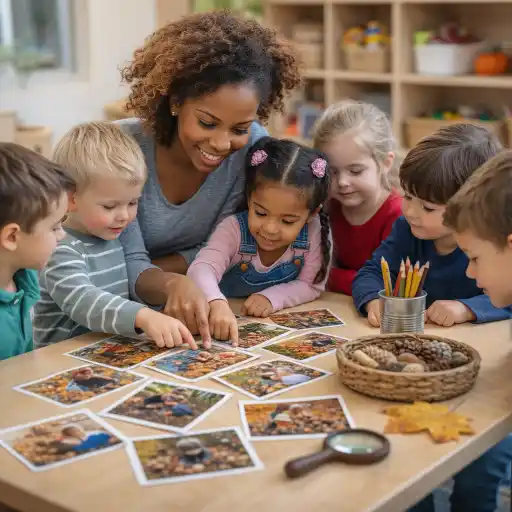
Choose a manageable format. A reflection book might include a few pages organized by the inquiry’s timeline: “What we wondered,” “What we predicted,” “What we noticed,” and “What we want to find out.” An exhibition might display photos and work samples at children’s eye level with short captions. Leave room for children to add a new comment or revisit an earlier page as their ideas develop.
- Offer choices of photos, objects, drawings, and ways to respond.
- Use simple visual sequences to support recall: first, next, and later.
- Include individual and collaborative experiences, not only polished products.
- Ask families for their perspectives and share classroom documentation in ways that respect privacy.
Children’s portfolios and records are strongest when they include varied evidence and make the child’s perspective visible. The NAEYC topic page on portfolios and documentation highlights approaches such as authentic assessment and making learning visible. Keep the display respectful and strengths-based: describe children’s actions and ideas rather than assigning labels or ranking contributions.
How can educators use reflection to plan the next step?
Revisiting a fall inquiry is most valuable when it informs what happens next. After looking through the evidence, educators can ask: What questions remain active? Which materials held children’s attention? What strategies did children use? What new invitation might extend their investigation? One group’s interest in comparing leaves could lead to examining their shapes with magnifiers, sorting them in different ways, drawing patterns, or noticing how the same tree looks over time.
Keep observation and interpretation distinct. First record what a child did or said; then consider what the evidence might suggest. For example, “Mina placed three leaves beside the photo of the maple tree and said, ‘This one is more pointy’” preserves a concrete observation. A teacher may then consider whether to offer opportunities for comparing shapes and describing features. One moment alone is not a complete assessment, so look for patterns across activities, days, and forms of communication.
Common pitfalls are easy to avoid with a little planning:
- Don’t turn reflection into a quiz or correct children before listening to their ideas.
- Don’t assume a child has no thoughts to share because they do not respond verbally.
- Don’t overfill a book or display; a few well-contextualized pieces can tell a clearer story.
- Don’t interpret a single photo as proof of a broad developmental conclusion.
Invite colleagues to review evidence together and consider how different perspectives may enrich interpretation. Share selected examples with families and ask what they notice. State requirements vary - check your state licensing agency, and follow your program’s policies for documentation, permissions, storage, and record sharing.
Conclusion: How can children see how their fall has changed?
Children can revisit their fall by returning to photos, predictions, drawings, work samples, and the words they shared along the way. Educators can make that reflection meaningful by asking open questions, giving children different ways to participate, documenting evidence objectively, and using what they learn to plan a next invitation. An exhibition or reflection book then becomes more than a seasonal display: it is a shared record of children’s curiosity and evolving ideas.
Start small: choose a few moments from the inquiry, invite children to select what matters to them, and ask what they remember or notice now. When children see their earlier ideas beside new discoveries, they can begin to recognize that learning is a process of wondering, trying, revisiting, and changing their minds. That is one powerful way to help them answer the question, “How has our fall changed?”
Further learning: Explore Observing & Assessing in Child Care Buy Now $16.00 for focused guidance on documenting children’s growth; Basic Science in Early Childhood Buy Now $25.00 for inquiry-based experiences; Creating the Natural Outdoor Classroom Buy Now $16.00 for nature-rich settings; and Lesson Planning for Preschoolers Buy Now $24.00 for developmentally appropriate planning.
- 45 Hour Child Growth and Development
- CDA Preschool Credential with Portfolio Review
- 45 Hour Preschool Methods and Materials
- What Makes Me Special: An Overview of Autism and ADHD
- CDA Bridge Bundle: Preschool
- CDA Bridge Bundle: Family Child Care without Portfolio Review
- CDA Bridge Bundle: Infant/Toddler without Portfolio Review
- CDA Bridge Bundle: Preschool without Portfolio Review
- CDA Certification en Español: Recursos y Consejos para Educadores Bilingües
- Proporciones de Cuidado Infantil y Tamaños de Grupo por Edad en Maryland (Guía Rápida para Centros y Hogares)
- Proporciones de Cuidado Infantil y Tamaños de Grupo por Edad en Virginia (Guía Rápida para Centros y Hogares)
- Actividades de Otoño Fáciles para Preescolares esta Temporada
- Celebrando la amistad en el cuidado infantil durante el Día de los Mejores Amigos
- Crunch, Stomp, Scoop! Fall Activities Toddlers Can’t Resist
- Go on a Fall Hunt! Outdoor Learning Challenges for Preschoolers
- Fall Detectives: 10 Questions Pre-K Kids Can Investigate This Season
- How Can Fall Nature STEM Activities Spark Preschoolers’ Scientific Thinking?
- How Can Outdoor Fall Activities Support Children’s Development?
- How Can Teachers Use Fall Classroom Experiences to Document Children’s Development?
- How Can You Turn a Rainy Fall Morning Into a Classroom Sound Investigation?
- How Can You Plan Fall Activities for a Mixed-Age Family Child Care Group?
- What Can Preschoolers Learn by Watching Trees Change Throughout the Fall?
- Why Can Observing the Same Tree Teach Preschoolers More Than a Nature Walk?
- How Can Five Visits to the Same Tree Become a Preschool Investigation?
- How Can Everyday Fall Conversations Build Richer Vocabulary Than “Orange”?
- Where Did the Puddle Go? How Can Children Explore Evaporation After Fall Rain?
- How Can Preschoolers Revisit Fall Through Photos, Predictions, and Discoveries?
- How Can Late-Fall Melting Investigations Turn Ice into Preschool Science?
