What children reveal during play, routines, and relationships can transform teaching—but only when educators observe with purpose and use evidence thoughtfully. For a deeper learning experience, explore Assessing through Observation Buy Now $35.00 to strengthen observation methods, assessment practices, and individualized planning while building relevant professional knowledge. Providers who want a more comprehensive approach may also consider Tracking Progress, Shaping Futures: Observation & Assessment Skills  Buy Now $55.00.
Why does observation and assessment matter in early childhood practice?
Observation and assessment are not merely paperwork or compliance tasks. They are professional processes that help educators understand how each child communicates, explores, relates, moves, solves problems, and participates in daily life. When used well, assessment makes children’s strengths visible and helps teachers decide what to offer next.
NAEYC describes observation, documentation, and assessment as ongoing, purposeful, reflective, and developmentally, culturally, and linguistically responsive. This perspective matters because children demonstrate competence differently across people, settings, languages, and activities. A child who rarely speaks during large-group time may communicate richly during dramatic play; another may solve complex problems outdoors but need additional support during transitions.
Head Start similarly identifies observation as the foundation for individualized care. When educators notice a toddler’s sustained interest in ants, water, music, or movement, they can use that interest to build relationships and design meaningful experiences. Observation therefore connects #relationships, curriculum, environment, and family partnership.
- It identifies interests, emerging skills, and strengths.
- It reveals when materials, routines, or interactions need adjustment.
- It supports formative decisions about what to teach and how to scaffold.
- It provides concrete examples for respectful family conversations.
A strong system benefits both children and adults: children receive more responsive support, while educators develop a clearer professional rationale for their decisions.
How should educators prepare for a purposeful observation?
Effective observation begins with a question rather than a camera, checklist, or blank page. Decide what you want to understand: language during snack, persistence in block play, peer interaction, emotional regulation, fine-motor coordination, or participation in routines. A focused question produces evidence that is easier to interpret and use.
Before observing, identify the child or group, setting, date, approximate duration, and documentation method. Select a context in which the skill is likely to appear naturally. Familiar routines often provide more authentic information than unfamiliar adult-directed tasks. Authentic assessment guidance emphasizes observing children in everyday activities with familiar people, materials, and expectations.
Preparation also includes supervision and ethics. Teachers must not compromise required supervision or ratios to write notes. Use brief embedded observations, scheduled coverage, or a colleague when a longer record is needed. Follow program policy for photographs and recordings, obtain required consent, and store documentation securely.
- 🔎 Define one observable question before beginning.
- Choose a manageable observation period, such as five to ten minutes.
- Observe during both child-initiated and adult-supported experiences.
- Plan to gather information across contexts and over time.
- Invite family knowledge to broaden the picture of the child.
Preparation prevents observation from becoming random data collection. It also helps educators remain present with children instead of becoming so focused on recording that they miss the interaction itself.
Which observation methods provide useful developmental evidence?
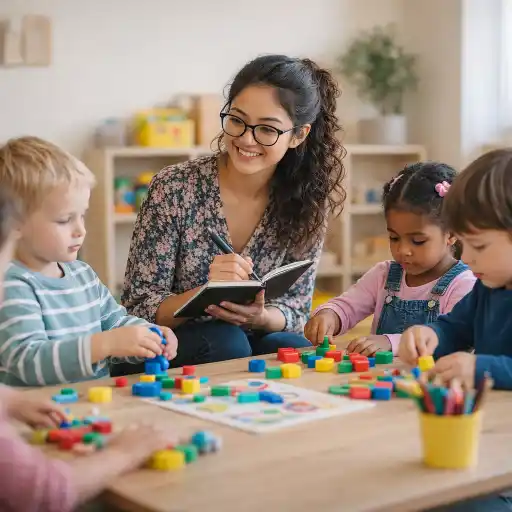
No single method captures the whole child. Running records provide a detailed sequence of actions and language during a defined period. They are useful for studying strategies and interactions but can be time-intensive. Anecdotal records capture brief, significant moments and are often practical for daily use.
Time sampling records whether a behavior occurs during predetermined intervals. It can help identify patterns in engagement, attention, or participation. Event sampling documents each occurrence of a selected behavior and may clarify antecedents, responses, and consequences. Checklists organize information about targeted skills, while work samples and portfolios show growth over time.
Learning stories, photographs, audio recordings, and children’s comments can add context and meaning. However, documentation should serve a professional question or decision rather than become a collection exercise. The goal is not to accumulate the most records; it is to gather useful evidence efficiently.
- Running record: a chronological account of what happened.
- Anecdotal record: a concise description of a meaningful event.
- Time or event sample: information about frequency, timing, or context.
- Work sample or portfolio: visible evidence of learning and growth.
- Checklist: an organized review of selected skills, interpreted cautiously.
Use multiple methods when decisions carry greater significance. ZERO TO THREE recommends combining direct observation, caregiver input, record review, and appropriate formal tools across settings and time. Multiple measures reduce the risk that one unusual day, one observer, or one context will define a child.
How can educators keep assessment objective, inclusive, and ethical?
Objective documentation separates what is observed from what is inferred. Write, “Maya placed four buttons in a row and said, ‘They are a family,’” rather than “Maya is creative.” The first statement provides evidence; the second is an interpretation that requires additional support.
Include context: the materials available, exact words, who was nearby, what happened beforehand, and how the child responded. Avoid unsupported labels such as “defiant,” “lazy,” or “shy.” If an interpretation is important, identify the evidence and consider alternative explanations.
Inclusive assessment recognizes that language, culture, disability, temperament, relationships, and prior experience influence participation. NAEYC recommends methods that are developmentally, culturally, and linguistically responsive. When educators do not speak a child’s home language, family members or qualified interpreters may help provide context, while confidentiality and ethical boundaries remain essential.
Bias can enter through what adults notice, the behaviors they prioritize, and the expectations they apply. Teams can reduce bias by comparing observations, discussing discrepancies, reviewing data regularly, and documenting competence as intentionally as concern. Records should show joy, creativity, persistence, collaboration, and progress—not only difficulties.
- Use exact actions, words, counts, and dates.
- Observe strengths and challenges in more than one context.
- Consider cultural and linguistic explanations before drawing conclusions.
- Protect confidentiality and follow consent procedures.
- Use screening to identify possible concerns, not to diagnose or label.
State requirements vary - check your state licensing agency. Program policies may also establish retention periods, approved tools, and rules for digital documentation.
How do observations become responsive teaching plans?
Observation becomes powerful when it changes what adults do next. After recording an event, separate description from interpretation and ask: What might the child be exploring? Which skills are emerging? What conditions supported participation? What could the adult, environment, or materials offer next?
For example, an educator may observe a child carrying toy animals between dramatic play and blocks, naming habitats and inviting peers to participate. Rather than redirecting the child, the teacher could add habitat photographs, nonfiction books, natural materials, labels, maps, and opportunities for collaborative storytelling. The observation becomes an individualized curriculum decision.
Goals should be specific, achievable, and connected to routines. A useful goal might be: “During small-group storytelling, Jordan will use two sequence words with visual support in three opportunities.” The plan should identify adult supports such as modeling, wait time, visual cues, peer collaboration, adapted materials, or repeated practice.
- Observe a meaningful action or interaction.
- Document factual evidence and relevant context.
- Interpret the evidence with family and team perspectives.
- Plan an experience, environmental adjustment, or interaction strategy.
- Reobserve and revise support based on progress.
This cycle reflects formative assessment: information is continuously used to improve teaching and learning. Directors can support the process by scheduling short reflection meetings, providing shared templates, protecting observation time, and coaching staff to connect evidence to planning.
How should providers communicate assessment information with families?
Families are essential partners and knowledgeable observers of their children. Assessment conversations should be reciprocal rather than a one-way report. Begin with a specific strength or interest, describe what happened without judgment, and invite the family’s interpretation.
For example: “Today, Amira watched water move through the tube, adjusted the angle, and said, ‘It goes faster this way.’ Have you noticed her experimenting with pouring or water at home?” This approach communicates competence while welcoming family expertise.
Use plain language, concrete examples, and culturally respectful questions. Explain the purpose of a screening or assessment, what the information can and cannot show, and what follow-up may be appropriate. Avoid presenting a checklist as a diagnosis or treating a single observation as proof of a delay.
- Share strengths before discussing concerns.
- Use examples rather than vague judgments.
- Ask what the family sees at home and in the community.
- Agree on one or two practical next steps.
- Document family input and revisit the plan together.
When concerns persist, follow program referral procedures and collaborate with qualified specialists. The CDC explains that developmental monitoring and screening work together to identify possible concerns and connect children and families with needed services. Families should remain central to that process.
Summary: What makes observation and assessment effective?
Effective observation and assessment answer the central question: how can educators understand children accurately enough to provide responsive support? The answer is through intentional, ongoing, strengths-based inquiry embedded in ordinary relationships, play, and routines.
Providers can begin with a manageable system:
- Choose one observable question.
- Record factual evidence with date, setting, and context.
- Use more than one method or source when appropriate.
- Reflect with colleagues and families.
- Translate evidence into a small, measurable teaching goal.
- Reobserve, celebrate progress, and adjust support.
When documentation is objective, culturally responsive, ethical, and connected to action, assessment becomes a tool for better care rather than an administrative burden. It helps educators notice children’s capabilities, strengthen #families partnerships, and design experiences in which every child can participate and grow.
For continued professional learning, explore Assessing through Observation Buy Now $35.00, Tracking Progress, Shaping Futures Buy Now $55.00, Preschool Assessments & Observations Buy Now $24.00, Privacy Matters Buy Now $55.00, and Culture, Communication, and Collaboration in Assessment Buy Now $55.00. Confirm course suitability and any applicable training-hour requirements with your licensing agency.
- CDA Home Visitor Subject Area 3 Part 3 Birth to 5
- Planning for Every Child: Responsive Strategies in Action
- Tracking Progress, Shaping Futures: Observation & Assessment Skills
- CDA Bridge Bundle: Family Child Care without Portfolio Review
- CDA Bridge Bundle: Infant/Toddler without Portfolio Review
- CDA Bridge Bundle: Preschool without Portfolio Review
- Privacy Matters: Documentation and Observation in Early Learning
- Culture, Communication, and Collaboration in Assessment
- Play with Purpose: Supporting Children with Autism
- Creating Engaging and Meaningful Learning Experiences
- 🔍 ¿Qué ves cuando observas a un niño aprender?
- How can assessment results be used to plan meaningful activities in early childhood programs?
- How can photos and work samples be used as reliable assessment evidence?
- Building a Better Head Start Lesson Plan: 7 Things Every Teacher Should Include
- First Week of Pre-K Lesson Plans: What Can You Learn About Your New Class?
- How Can Child Care Providers Use Developmental Screening to Support Every Child?
- How Can Child Care Providers Support Individual Differences in Development?
- How Can Child Care Providers Support Preschool Development Across the Whole Child?
- How Can Emergent Readers Support Vocabulary Growth?
- How Can Child Care Providers Use Learning Styles Responsibly in Early Childhood Classrooms?
- How Can Child Care Providers Use Observation and Assessment to Support Every Child?
- How Can Child Care Providers Support Children Who Learn at Different Speeds?
- How Can You Set Up Classroom Learning Centers for Maximum Engagement?
- How Can Child Care Providers Individualize the Curriculum for Every Child?
- How Can Child Care Providers Assess Children Through Everyday Activities?
- What Can Providers Learn From the Toys Children Choose Repeatedly?
- How Can Providers Respond When Children Reject Unfamiliar Materials?
- How Can Child Care Providers Share Small Concerns Before They Become Big Conversations?
- How Can Child Care Providers Document Developmental Concerns Without Diagnosing?
- When Does Taking a Photo Interrupt an Infant’s Interaction—and What Can Providers Do Instead?
