What children reveal during play, routines, and relationships can transform the way adults support them. Purposeful observation helps child care providers recognize strengths, respond to emerging needs, and plan experiences that are genuinely meaningful; for a structured professional learning experience, explore Assessing through Observation Buy Now $35.00 to build practical observation and assessment skills that can strengthen classroom practice and support professional development hours.
Why Does Developmental Observation Matter in Child Care?
Developmental observation is more than watching children; it is disciplined attention directed toward understanding how children learn, communicate, relate, move, and solve problems. When educators observe intentionally, they gather evidence that can inform responsive caregiving, curriculum planning, environmental design, and family conversations.
Observation is especially valuable because young children do not demonstrate their abilities in one uniform way. A child may communicate more confidently outdoors than during a large-group meeting, or show advanced problem-solving with familiar materials while remaining quiet during an adult-directed activity. NAEYC emphasizes that observation, documentation, and assessment should be ongoing, purposeful, reflective, and developmentally, culturally, and linguistically responsive. This approach recognizes the whole child rather than reducing development to a single score or isolated performance.
For providers and directors, strong observation systems also support program quality. Notes can reveal whether classroom materials are accessible, whether routines provide enough time for exploration, and whether adult interactions encourage children’s agency. Observation therefore benefits both individual children and the learning environment itself.
- It identifies interests, strengths, and emerging skills.
- It helps educators individualize activities and interactions.
- It creates concrete evidence for communication with #families.
- It supports reflective teaching and collaborative staff planning.
How Should Educators Prepare for a Purposeful Observation?
Effective observation begins with a clear purpose. Without a focus, educators may collect lengthy notes that are difficult to interpret or use. Before observing, decide what you want to understand: language during meals, persistence in block play, peer interactions, emotional regulation, fine-motor coordination, or participation in routines.
A practical observation plan should identify the child or group, setting, date, approximate duration, and method of documentation. Choose contexts that provide authentic opportunities for the skill or behavior to appear. For example, observe communication during a familiar snack routine rather than relying only on a formal question-and-answer activity.
Preparation also requires attention to supervision and ethics. A teacher must never compromise required supervision or ratios in order to take notes. When possible, use a colleague, scheduled coverage, or brief observations embedded within normal interactions. Photographs and recordings should be used only according to program policy and documented family consent.
Consider gathering information across multiple contexts and over time. A single observation may be informative, but it cannot represent the full complexity of a child’s development. Head Start describes observation as the first step in individualizing care because it helps educators connect children’s interests and actions to responsive experiences.
- 🔎 Define one observable question before beginning.
- 📝 Select a manageable method, such as an anecdotal note or checklist.
- 📅 Observe during both child-initiated and adult-supported experiences.
- 🤝 Invite family knowledge to broaden the context.
Which Observation Methods Provide Useful Developmental Evidence?
Different methods answer different questions. A running record offers a detailed chronological account of what a child says and does during a defined period. It is useful for understanding sequences, strategies, and social exchanges, although it can be time-intensive. An anecdotal record captures a brief, significant incident and is often practical for daily classroom use.
Time sampling records whether a behavior occurs at predetermined intervals. It can help educators identify patterns in attention, engagement, or participation. Event sampling documents each occurrence of a selected behavior, making it useful when examining triggers and responses. Checklists can support systematic review of skills, while work samples and portfolios show development over time.
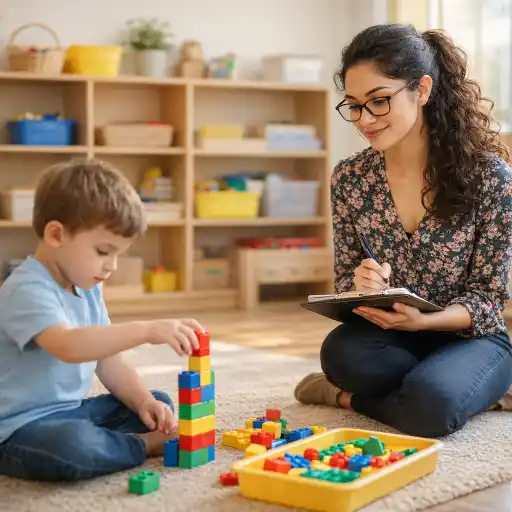
Learning stories and photographs may add narrative and context, especially when they highlight children’s theories, persistence, collaboration, and meaning-making. However, documentation should not become a collection exercise detached from teaching. Each record should contribute to a question, decision, or next step.
Using multiple methods strengthens interpretation. ZERO TO THREE recommends combining direct observation, caregiver input, record review, and appropriate formal tools across settings and over time. This approach produces a more comprehensive picture than relying on one checklist or one adult’s impression.
- Running record: detailed sequence of actions and language.
- Anecdotal record: concise description of a meaningful moment.
- Time or event sample: information about frequency, timing, or context.
- Work sample or portfolio: visible evidence of growth and learning.
- Checklist: organized review of targeted skills, interpreted cautiously.
How Can Educators Keep Developmental Observations Objective and Inclusive?
Objectivity does not mean pretending that observers have no perspectives. It means recognizing personal assumptions and deliberately documenting what can be seen and heard. Write “Maya placed four buttons in a row and said, ‘They are a family,’” rather than “Maya is creative.” The first statement provides evidence; the second is an interpretation that requires support.
Include relevant context: the materials available, the child’s words, who was present, what happened immediately before the action, and how the child responded. Avoid labels such as “defiant,” “lazy,” or “shy” unless they are clearly defined and supported by observable examples.
Inclusion requires more than translating a form. Children’s language, culture, disability, temperament, relationships, and prior experiences influence how they participate. Assessment should occur in familiar contexts and, when needed, in the child’s preferred language with qualified interpretation. The Center of Excellence for Infant and Early Childhood Mental Health Consultation emphasizes that culture and context must be considered when observations are reviewed and interpreted.
Bias can enter through what educators choose to notice, how they describe behavior, and which expectations they apply. Team calibration—comparing independently written observations and discussing differences—can improve consistency. Balance concern-based observations with documentation of competence, joy, creativity, relationships, and progress.
Ethical documentation also protects dignity and confidentiality. Store records securely, share information only with authorized individuals, and obtain consent for photographs or recordings. State requirements vary - check your state licensing agency.
How Do Observations Become Responsive Teaching Plans?
Observation becomes educationally powerful when it changes what adults do next. After collecting a note, separate description from interpretation. Ask: What might the child be exploring? What skills are emerging? What conditions supported participation? What could the environment or adult interaction offer next?
Suppose an educator observes that a child repeatedly carries toy animals between the dramatic-play area and the block center, naming habitats and asking peers to join. Rather than redirecting the child to a predetermined activity, the educator might add habitat photographs, nonfiction books, labels, natural materials, and opportunities for map-making. The observation has become an individualized curriculum decision.
Goals should be specific, achievable, and connected to daily routines. A goal might state: “During small-group storytelling, Jordan will use at least two sequence words with visual support in three opportunities.” Plan the adult supports—modeling, wait time, visual cues, peer collaboration, adapted materials—and identify when progress will be reviewed.
NAEYC describes formative assessment as information used continuously to improve teaching and learning. The cycle is therefore ongoing:
- Observe a meaningful action or interaction.
- Document factual evidence and relevant context.
- Interpret the evidence with family and team perspectives.
- Plan an experience, environmental change, or interaction strategy.
- Revisit the observation to evaluate progress and adjust support.
Directors can strengthen this cycle by scheduling brief team reflection meetings, using shared documentation expectations, and ensuring staff have time and coverage to observe responsibly.
How Should Providers Communicate Observations With Families?
Families are essential partners and valuable observers of children’s development. Sharing observations should be reciprocal rather than a one-way report. Begin with a specific strength or interest, describe what happened without judgment, and invite the family’s interpretation.
For example: “Today, Amira watched the water flow through the tube, adjusted the angle, and said, ‘It goes faster this way.’ Have you noticed her experimenting with water or pouring at home?” This language communicates competence while opening space for family knowledge.
Use accessible language and provide interpretation when necessary. Explain the purpose of documentation, how records are stored, and who may review them. When concerns arise, avoid diagnosing or predicting outcomes. Screening identifies whether further evaluation may be appropriate; it does not diagnose or label a child. NAEYC recommends involving families in significant decisions and using multiple sources of information.
When a pattern warrants additional attention:
- Document several examples across days, settings, and activities.
- Review environmental, relational, linguistic, and cultural factors.
- Discuss strengths and concerns respectfully with the family.
- Collaboratively identify classroom supports and a follow-up date.
- Follow program referral procedures and connect families with qualified professionals when appropriate.
The CDC’s milestone resources can support conversations, but milestone checklists should not replace professional screening or individualized evaluation. Providers document and collaborate; they do not diagnose.
Conclusion: What Is the Central Purpose of Developmental Observation?
Developmental observation answers a practical question: How can we understand each child well enough to provide more responsive care and learning? The answer is through intentional, ethical, culturally responsive attention that is documented objectively and used to guide action.
Start with one focused question, observe in authentic routines, use more than one method over time, and describe evidence rather than labels. Then connect what you learn to a small teaching goal, an environmental adjustment, or a conversation with the family. When directors protect time for observation and reflection, documentation becomes part of a healthy professional culture rather than an added burden.
For deeper training, consider Tracking Progress, Shaping Futures: Observation & Assessment Skills  Buy Now $55.00, which addresses objective documentation, multiple assessment methods, bias reduction, screening distinctions, and goal setting. You may also explore Preschool Assessments & Observations Buy Now $24.00, Developmental Screening in Early Childhood Buy Now $16.00, and Privacy Matters: Documentation and Observation in Early Learning Buy Now $55.00 to extend your team’s practice.
Frequently Asked Questions
How often should educators observe?
Observation should be embedded in daily routines, with more focused observations scheduled regularly so every child is seen across domains and contexts.
What is the best observation method?
It depends on the question. Use anecdotal notes for brief moments, running records for sequences, sampling methods for patterns, and portfolios for growth over time.
Can an observation diagnose a developmental delay?
No. Observations provide information for planning and may support a recommendation for screening or evaluation, but diagnosis belongs to qualified professionals.
How can bias be reduced?
Use observable language, gather information across contexts, include family perspectives, compare notes with colleagues, and examine whether expectations reflect culture and individual differences.
How long should records be kept?
Follow your program’s retention policy and applicable laws. State requirements vary - check your state licensing agency.
- CDA Home Visitor Subject Area 3 Part 3 Birth to 5
- Children at the Wheel: Emergent Curriculum
- 24 Hour Texas Pre-Service
- CDA Bridge Bundle: Family Child Care without Portfolio Review
- CDA Bridge Bundle: Infant/Toddler without Portfolio Review
- CDA Bridge Bundle: Preschool without Portfolio Review
- Early Childhood Education
- Creating Engaging and Meaningful Learning Experiences
- CDA Home Visitor Credential Birth to 5
- Texas Director Credential
- Having a Heart-to-Heart
- Building Quality Early Childhood Education Programs
- CDA Certification en Español: Recursos y Consejos para Educadores Bilingües
- 10 Ejemplos de Cómo la Cultura Influye en el Desarrollo Infantil
- Retraso del Habla en la Guardería: Cómo Pueden Ayudar los Proveedores
- Cómo Trabajar en el Cuidado Infantil en Carolina del Norte: Requisitos y Pasos
- Cómo simplificar la capacitación para sus empleados de daycare
- How Does Play Support Children’s Physical, Cognitive, and Social Growth?
- How do relationships shape early brain development?
- Online Early Childhood Education Courses: Learn, Grow, and Advance Your Career
- What Is the Difference Between Early Childhood Education and Child Development?
- More Than ABCs and 123s: The Real Importance of Early Childhood Education
- Special Needs Training for Early Childhood Educators: Which Course Should You Take?
- How Can Child Care Providers Support Healthy Brain Development in Young Children?
- How Can Child Care Providers Support Memory Development in Young Children?
- How Can Child Care Programs Build Meaningful School Readiness?
- How Can Child Care Providers Recognize and Support Developmental Delays?
- How Can Child Care Providers Support Healthy Child Growth and Development?
- What Is Developmentally Appropriate Practice? Examples by Age
