Children reveal what they know through play, conversation, routines, and relationships—not only through formal tasks. Learn how to gather useful evidence without making children feel evaluated, and strengthen your practice with Tracking Progress, Shaping Futures: Observation & Assessment Skills  Buy Now $55.00, a course on objective observation, multiple assessment methods, and meaningful goal setting. It can help you turn everyday moments into practical next steps while building a fuller learning experience beyond this guide.
Why does tracking development matter when it is not a test?
Assessment is most useful when it helps adults understand a child and improve the experiences they provide—not when it reduces learning to a score. Development in early childhood is uneven and context-dependent: a child may show a skill in familiar play but not in a new or adult-directed situation. A single performance cannot capture that complexity.
Ongoing observation supports responsive teaching. When educators notice how a child approaches a puzzle, negotiates a turn, tells a story, or participates in dressing, they can identify strengths and decide what invitation or support might come next. NAEYC describes observation, documentation, and assessment as ongoing, purposeful processes that inform curriculum and communication with families.
Non-comparative tracking also protects relationships and dignity. Comparing children can turn a difference in timing, language, experience, or temperament into a judgment. Looking at one child’s evidence over time instead allows educators to recognize individual progress, including small steps that might be missed by a checklist alone. This strengths-based approach centers each child’s #development and keeps #assessment connected to better care, not pressure.
What should educators observe in ordinary classroom life?
Begin with a question tied to practice: What does this child do when a peer joins their play? How does the child communicate a choice during snack? What strategies appear when a block structure falls? A clear focus helps you observe closely without trying to document everything at once.
Look across developmental areas and everyday contexts, including:
- Communication: spoken words, gestures, home-language use, listening, and responses.
- Thinking and problem-solving: ideas tried, persistence, sorting, planning, and curiosity.
- Social-emotional learning: approaches to peers, turn-taking, seeking comfort, and expressing needs.
- Physical and self-help skills: movement, grasping tools, feeding, dressing, and participation in routines.
- Interests and agency: choices, questions, preferred materials, and ways the child initiates activity.
Observe children during free play, group experiences, transitions, meals, and outdoor time. Familiar activities often let children demonstrate abilities more naturally than a staged task. Include cultural and linguistic context: a child’s skills may emerge differently across languages or settings. Authentic assessment depends on understanding what children do in real experiences, with information from family members and other familiar caregivers contributing to the picture.
How can you document useful evidence without scoring children?
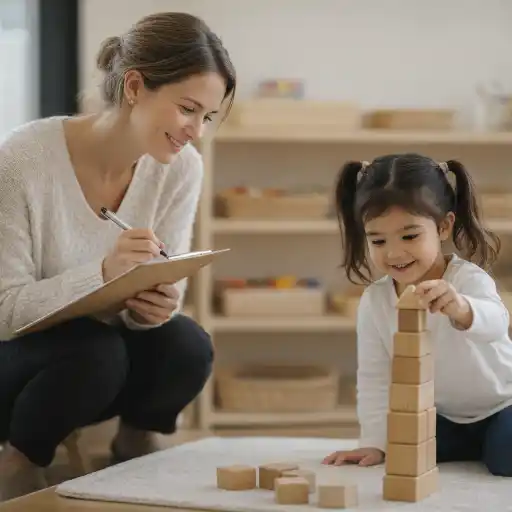
Use concise, factual notes that record what you saw and heard. A brief anecdotal record can include the date, time, setting, activity, focus, and specific actions or direct words. Avoid guessing at motives or applying labels. “Mina placed four shells in a row, then added two after looking at her friend’s pattern” offers more useful evidence than “Mina is advanced at math.”
Choose a documentation method that fits the moment and purpose:
- Jottings capture a quick action or quote to expand later.
- Anecdotal records describe a significant moment in context.
- Work samples and portfolios show change across time when paired with a short explanation.
- Photos or video can preserve a process when program policy and family consent allow.
📝 Record one focused observation, then add a reflection separately: what might this evidence suggest, and what would you like to observe next? Keeping evidence distinct from interpretation makes your thinking transparent. Protect confidentiality, follow your program’s permissions and storage policies, and respect a child’s cues if they do not want to be photographed. A manageable #documentation routine is more valuable than an elaborate system staff cannot sustain.
How do you turn observations into responsive teaching?
Documentation matters when it informs decisions. Review several observations across activities and days, then ask what the child already does, what conditions support that skill, and what would make an appropriate next challenge. A child who uses detailed language in pretend play, for instance, might be invited to dictate a menu, map, or story connected to that play.
Keep next steps flexible and embedded in the classroom day. You might offer new materials, model a phrase, allow additional time, adjust the environment, or create a small-group opportunity. A goal should describe a meaningful skill and the supports educators will provide—not demand that a child perform on command for documentation.
Use checklists or developmental milestones as guides for noticing and planning, not as scorecards or diagnostic tools. If a concern persists, gather information from multiple contexts and consult the appropriate screening or referral process with the family. Screening can indicate whether further evaluation may be helpful; it does not diagnose a child. When requirements apply, state requirements vary - check your state licensing agency. Keep the purpose clear: responsive planning and timely support, not ranking.
How can programs partner with families and reduce bias?
Families know children in contexts educators may not see. Invite their observations about interests, communication, routines, and newly emerging abilities, and share classroom evidence in plain, specific language. A respectful conversation might begin with a strength, offer one or two concrete examples, ask what the family notices at home, and agree on a next step together.
Assessment methods should be appropriate to children’s languages, experiences, and ways of communicating. If a child speaks a language staff do not know, seek suitable interpretation or support from knowledgeable speakers rather than assuming silence indicates limited understanding. NAEYC emphasizes culturally and linguistically responsive methods, awareness of bias, and the use of multiple forms of evidence.
Programs can build consistency through short team reviews. Compare descriptions—not children—and ask whether staff recorded observable facts, considered different settings, and noticed strengths as well as support needs. A colleague’s perspective can reveal assumptions that one observer may miss. Store records securely and share them only with people who have a legitimate role in the child’s care. This collaborative approach strengthens #families partnerships while keeping children’s information respectful and private.
What common pitfalls can teams avoid?
Even well-intentioned documentation can become burdensome or misleading. Avoid trying to capture every moment for every child; that often produces rushed notes and takes educators away from interaction. Set a rotating focus-child schedule and observe a few children deliberately each day, ensuring each child is seen across the week.
- Replace labels such as “shy,” “lazy,” or “behind” with descriptions of observable actions and contexts.
- Do not draw conclusions from one difficult moment; look for patterns across time and routines.
- Do not use a milestone list as a pass/fail test; consider language, culture, opportunity, and individual variation.
- Do not collect photos or videos without following consent, privacy, and storage practices.
- Do not share concerns as a verdict; discuss specific evidence and collaborate with families on possible supports.
Regular reflection helps teams refine their system. Ask whether the records changed a teaching decision, clarified a family conversation, or revealed a question worth exploring. If not, simplify the process and refocus the purpose. Useful tracking is not measured by the number of forms; it is measured by whether evidence helps adults understand and support the child.
Conclusion: What is the practical takeaway?
You can track development without turning childhood into a test by observing intentionally, documenting factual examples, and using evidence to shape responsive experiences. Keep the focus on each child’s progress over time, not comparison with peers. Mix brief notes, work samples, family knowledge, and observations across routines to build a richer and fairer understanding.
Start this week with one child, one question, and one familiar activity. Write what happened, reflect on what it may mean, and choose one supportive next step. Invite family perspectives, protect privacy, and revisit your observations. These small, consistent practices make assessment a tool for connection and planning—and let children remain engaged in the play and discovery where so much learning happens.
Explore relevant professional learning
- CDA Home Visitor Subject Area 3 Part 3 Birth to 5
- CDA Home Visitor Subject Area 2 Part 3 Birth to 5
- CDA Bridge Bundle: Preschool
- Pediatric RSV First Aid & CPR/AED
- CDA Bridge Bundle: Family Child Care
- CDA Bridge Bundle: Family Child Care without Portfolio Review
- CDA Bridge Bundle: Infant/Toddler without Portfolio Review
- CDA Bridge Bundle: Preschool without Portfolio Review
- CDA Bridge Bundle: Infant/Toddler
- Texas Director Credential
- CDA Certification en Español: Recursos y Consejos para Educadores Bilingües
- 🔍 ¿Qué ves cuando observas a un niño aprender?
- 10 Ejemplos de Cómo la Cultura Influye en el Desarrollo Infantil
- Celebrando la amistad en el cuidado infantil durante el Día de los Mejores Amigos
- Cómo simplificar la capacitación para sus empleados de daycare
- How can I support quality improvement without overwhelming staff?
- How Can You Tell If an Activity Is Developmentally Appropriate?
- STEM for Preschoolers: What to Do When the Experiment Doesn’t Work
- How Do Children Learn Through Play?
- How Can Child Care Providers Encourage Independence Without Doing Everything for Children?
- What Makes Task Cards a Teacher’s Time-Saving Favorite?
- How Can Everyday Classroom Problems Become Child-Led Investigations?
- How Can Child Care Providers Document Learning During Ordinary Routines?
- How Can Child Care Providers Introduce Reptiles Through Art, Observation, and Conversation?
- How Can Child Care Providers Question Their First Interpretation of a Child’s Behavior?
- How Can You Track Children’s Development Without Turning Everything Into a Test?
- How Can Educators Help a Child Try One More Strategy Before Asking an Adult to Finish?
- How Can Toddler Classroom Jobs Build Early Math Beyond Counting?
- What Are Simple Ways to Support Memory and Recall in Young Children?
- How Can Pretend Store Play Teach School-Age Children Money Skills?
