Assessment does not have to interrupt play or add another heavy task to an already full day. By observing children during routines, play, conversations, and transitions, providers can gather authentic evidence that improves teaching and strengthens family partnerships; Assessing through Observation Buy Now $35.00 offers focused training on observation methods while helping educators build relevant professional knowledge.
Why does everyday assessment matter?
Young children often demonstrate their abilities most clearly when they are comfortable, engaged, and interacting with familiar people and materials. Everyday assessment captures learning as it naturally occurs rather than relying only on staged tasks. A child who says little during a large-group lesson may use elaborate language in dramatic play; another may reveal persistence while solving a problem at the block area.
The National Association for the Education of Young Children describes observation, documentation, and assessment as ongoing, purposeful, reflective, and developmentally, culturally, and linguistically responsive. These processes help educators understand children’s interests, strengths, emerging skills, and support needs. They also help directors evaluate whether classroom environments and teaching strategies are working effectively.
Authentic assessment matters because it:
- Connects evidence to real classroom experiences.
- Supports individualized curriculum and responsive interactions.
- Shows families specific examples of learning and growth.
- Helps teams notice patterns before making significant decisions.
As NAEYC’s guidance on observing, documenting, and assessing development emphasizes, assessment should improve children’s experiences rather than become an isolated paperwork exercise. State requirements vary - check your state licensing agency.
Which everyday activities provide useful assessment opportunities?
Nearly every part of the day can reveal meaningful information. The key is to select a focus before watching. Consider one skill, one child or small group, and one familiar context. The Head Start guidance on ongoing observations recommends observing across settings, times of day, routines, play experiences, and interactions with adults and peers.
- Arrival and departure: Notice communication, separation, relationships, and independence.
- Meals and snacks: Observe self-help skills, vocabulary, choice-making, fine-motor coordination, and social participation.
- Free play: Look for #language, problem solving, imagination, persistence, cooperation, and flexible thinking.
- Small groups: Watch attention, following directions, early literacy, mathematical thinking, and participation.
- Transitions: Assess self-regulation, memory for routines, independence, and responses to visual or verbal cues.
- Outdoor play: Notice balance, coordination, risk assessment, peer interaction, and physical confidence.
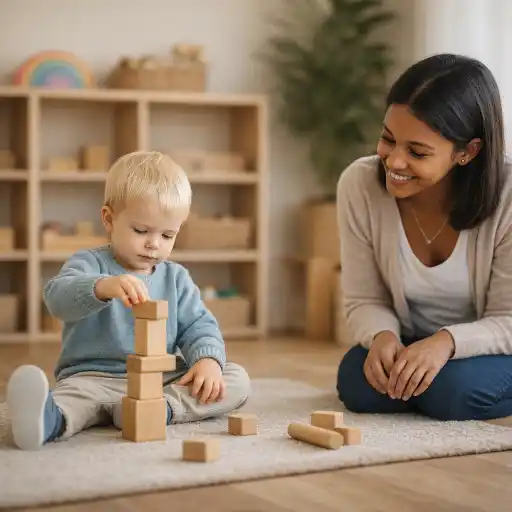
Everyday moments can also reveal “learning in disguise.” Sorting utensils may involve classification; carrying materials may involve planning and motor control; negotiating a turn may involve language and emotional regulation. The goal is not to interpret every action immediately, but to recognize ordinary experiences as possible evidence of development.
How can providers document observations objectively?
Useful documentation describes what happened without labeling the child or guessing about motives. Record the child’s exact actions and words, along with the date, setting, materials, people nearby, and relevant context. A factual note might read: “During outdoor play, Jordan placed three hoops in a row, stepped into each one, and said, ‘This is my path.’” This is more useful than “Jordan enjoyed a creative movement activity.”
Choose a method that fits the question and the available staffing:
- Anecdotal records: Brief descriptions of significant moments.
- Running records: Detailed chronological accounts, best completed with adequate staff coverage.
- Time sampling: Notes about whether a behavior occurs during defined intervals.
- Event sampling: Documentation of each occurrence of a selected behavior.
- Work samples and portfolios: Drawings, constructions, writing, photographs, and child comments collected over time.
📌 A practical routine is to capture one short note during the activity and complete the context or next-step section during planning time. The Head Start resource on documenting observations reinforces that the method should reflect what educators want to learn and remain manageable for the program.
Protect confidentiality, obtain permission for photographs or recordings, and store records securely. Documentation should show strengths as intentionally as concerns.
How can observations remain fair, inclusive, and developmentally appropriate?
A single observation is only a snapshot. Children’s performance may change with hunger, fatigue, illness, schedule changes, unfamiliar adults, language demands, or family circumstances. Repeat observations across several activities and times before drawing conclusions. Multiple sources—teacher notes, family perspectives, work samples, and appropriate screening tools—provide a more balanced picture.
Inclusive assessment also requires attention to language and culture. Children may communicate competence through a home language, gestures, movement, or culturally familiar forms of participation. Invite families to explain what they see at home, and use qualified interpreters when needed. Avoid treating limited English use, quiet participation, or different play styles as evidence of inability.
- Describe observable behavior rather than using labels such as “defiant” or “shy.”
- Observe both strengths and challenges.
- Compare observations with colleagues when possible.
- Consider the environment and adult supports that influenced participation.
- Use screening to identify possible concerns, not to diagnose or label.
The Authentic Child Assessment Practice Guide highlights the value of observing children in familiar activities and identifying the adult behaviors and materials that support participation. This approach is especially helpful when assessing children with disabilities, dual language learners, or children whose skills vary substantially by context.
How do providers turn everyday evidence into teaching plans?
Observation becomes assessment when educators reflect on what the evidence means and decide what to do next. Use a simple cycle: observe, document, interpret, plan, and reobserve. Ask: What skill is emerging? What interests or materials supported participation? What adjustment might make the experience more accessible or challenging?
For example, a teacher notices that Maya repeatedly builds a bridge with large blocks, counts the pieces, and asks peers to test it. The teacher might add photos of bridges, measuring tools, clipboards, books, and varied construction materials. The next goal could be, “During block play, Maya will describe one design change using a position or comparison word in three opportunities.”
- Summarize the evidence in one or two factual sentences.
- Identify one achievable, measurable goal.
- Plan two supports, such as modeling, visuals, peer collaboration, wait time, or adapted materials.
- Embed the goal in an existing routine rather than creating an unrelated worksheet.
- Reobserve in two to four weeks and revise the plan.
The course Tracking Progress, Shaping Futures: Observation & Assessment Skills  Buy Now $55.00 can deepen this process by covering objective documentation, multiple measures, screening tools, and goal setting. Providers seeking more inclusive planning strategies may also explore Planning for Every Child: Responsive Strategies in Action Buy Now $55.00.
How should providers share assessment information with families?
Families are essential partners and valuable observers of their children. Share information as a conversation, not a verdict. Begin with a strength, offer a concrete example, and invite the family’s perspective. For instance: “During snack, Luis used tongs to move five pieces of fruit and told a friend, ‘You can have the red one.’ Have you noticed him using tools or offering choices at home?”
Strengths-first communication builds trust while still allowing concerns to be addressed clearly. When a possible delay or persistent difficulty appears, explain the pattern, describe supports already attempted, and invite collaboration. Do not diagnose. Follow program procedures and appropriate referral pathways when additional evaluation may be needed.
Helpful family communication includes:
- A dated example of what the child said or did.
- The context in which the skill appeared.
- One classroom strategy and one possible home connection.
- An invitation for family observations, questions, and priorities.
Head Start’s guidance on observing to build relationships with families emphasizes regular communication and intentional requests for family input. Directors can support this practice by providing shared templates, translation resources, privacy guidance, and scheduled time for teachers to review documentation together.
What common mistakes should teams avoid?
Even well-intentioned assessment systems can become inaccurate or burdensome. The most common problem is collecting information without a clear purpose. Before documenting, ask what decision the information will support.
- Writing opinions: Replace “good at puzzles” with specific actions, strategies, or quotes.
- Relying on one moment: Gather evidence across contexts and over time.
- Watching only challenging behavior: Include play, routines, relationships, and successful participation.
- Creating too many goals: Prioritize one or two meaningful next steps.
- Ignoring context: Note fatigue, schedule changes, language, materials, and adult support.
- Confusing screening with diagnosis: Use screening to determine whether further evaluation may be appropriate.
Programs should also avoid asking teachers to write lengthy notes while supervising children. Use brief embedded observations, arrange coverage for longer records, and review systems regularly. The Observation and Assessment in Early Childhood Education chapter on observation methods explains that no single method provides a complete view of development; combining appropriate tools produces stronger evidence.
Summary: How can everyday activities become meaningful assessment?
Child care providers can assess children through everyday activities by observing with a focused question, documenting exact actions and words, considering context, and repeating observations over time. Play, meals, transitions, outdoor experiences, and conversations reveal authentic evidence of language, thinking, social-emotional development, motor skills, and independence.
The most effective system is purposeful but manageable: choose one focus, use a simple tool, record a brief factual note, connect the evidence to a small goal, and reobserve. Share strengths and concrete examples with families, invite their knowledge, and follow appropriate screening or referral procedures when concerns persist. When assessment remains connected to relationships and real experiences, it becomes a supportive tool for planning rather than an additional burden.
Frequently asked questions
How often should children be observed?
Short observations can occur throughout the week, with more focused reviews every few weeks. Frequency should reflect program policy, children’s needs, and the purpose of the assessment.
How long should an observation last?
A focused five- to ten-minute observation can provide useful evidence. Longer observations may be appropriate when staffing allows and supervision is maintained.
Can photographs be used as assessment evidence?
Yes, when permitted by family consent, program policy, and applicable privacy requirements. Add a date, context, and brief description of what the image demonstrates.
What if a family disagrees with an observation?
Listen respectfully, share the concrete evidence, ask what the family sees in other settings, and collaborate on additional observations or supports.
When should a provider recommend screening or referral?
If concerns recur across settings or progress remains limited despite appropriate supports, consult program leadership and follow local procedures. State requirements vary - check your state licensing agency.
Which courses can support professional learning?
Relevant options include Assessing through Observation Buy Now $35.00, Tracking Progress, Shaping Futures Buy Now $55.00, Preschool Assessments & Observations Buy Now $24.00, Observations and Goal Setting in Childcare Buy Now $24.00, and Planning for Every Child Buy Now $55.00.
- Moving About the Classroom: Effective Transitions for Everyday
- CDA Infants/Toddlers: Benefits to Observing
- Pediatric RSV First Aid & CPR/AED
- CDA Bridge Bundle: Family Child Care
- Privacy Matters: Documentation and Observation in Early Learning
- Texas Director Credential
- Moving About the Classroom: Effective Transitions for Everyday
- Observing & Assessing in Child Care
- Mathematical Skill Development
- CDA Certification en Español: Recursos y Consejos para Educadores Bilingües
- ¿Cómo puedo usar escenarios de juego de roles de primeros auxilios en mi aula?
- ¿Cómo puedo enseñar habilidades de primeros auxilios con escenarios de juego de roles?
- Proporciones de Cuidado Infantil y Tamaños de Grupo por Edad en Maryland (Guía Rápida para Centros y Hogares)
- Proporciones de Cuidado Infantil y Tamaños de Grupo por Edad en Nueva Jersey (Guía Rápida para Centros y Hogares)
- Proporciones de Cuidado Infantil y Tamaños de Grupo por Edad en Virginia (Guía Rápida para Centros y Hogares)
- How Can Michigan Providers Prevent Summer Learning Loss in Young Children?
- Can simple kitchen activities teach valuable skills to young children in child care settings?
- Dump It, Stack It, Build It! Open-Ended Activities for Curious Toddlers
- How Can Child Care Providers Teach Friendship Skills Through Everyday Classroom Activities?
- How Can Teachers Build Early Literacy Without Screens or Worksheets?
- How Can Early Math Activities Build Young Children’s Mathematical Thinking?
- How Can Child Care Providers Assess Children Through Everyday Activities?
- How Can Child Care Providers Teach Children to Choose Clothing for Weather and Activities?
- How Can Family Child Care Providers Carry Individualized Support Into Everyday Activities?
- How Can You Plan a November Preschool Curriculum Around Gratitude and Community?
- How Can Simple Fall Activities Support Kindergarten Readiness Through Play?
- How Can Playful Dental Health Activities Build Healthy Habits in Young Children?
