What if the materials children reach for most are already in your recycling bin, nature basket, or supply closet? Loose parts play turns ordinary objects into opportunities for imagination, problem-solving, language, collaboration, and motor development. To deepen your classroom practice, explore Beautiful Junk: Using Recycled Materials in the Classroom  Buy Now $16.00, an online course that helps providers use recyclables as engaging learning tools and may provide professional learning hours according to applicable requirements.
Why does loose parts play matter in early childhood settings?
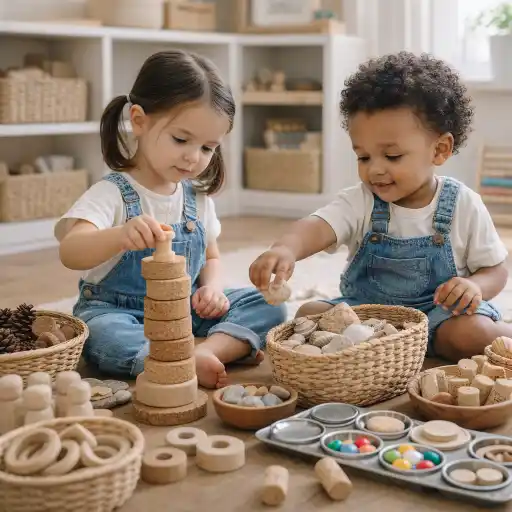
Loose parts are open-ended materials that children can move, combine, redesign, take apart, and use in multiple ways. Unlike many commercial toys with a prescribed function, a cardboard tube might become a telescope, a tunnel, a rocket, or part of a marble run. The child’s idea—not the object’s original purpose—directs the experience.
Simon Nicholson’s theory of loose parts emphasizes that environments rich in variables invite creativity and discovery. Contemporary early childhood guidance similarly describes loose parts as natural, recycled, and repurposed materials that support children’s agency. The Penn State Better Kid Care resource on loose parts highlights how children can carry, classify, line up, redesign, and reconstruct materials while adults provide time, space, and thoughtful invitations.
For providers, the approach is both pedagogically meaningful and practical. It can reduce dependence on expensive materials while creating repeated opportunities to practice #creativity, persistence, communication, and flexible thinking. Children also experience the satisfaction of making decisions and seeing their ideas influence the environment.
How can everyday objects support multiple areas of development?
A carefully selected collection of loose parts can connect several developmental domains within one play episode. When children stack boxes, for example, they are not simply building: they are testing balance, negotiating with peers, using spatial language, coordinating movement, and revising a plan when the structure falls.
- 🧠 Cognitive development: Children predict, compare, classify, test hypotheses, and solve problems through trial and revision.
- Language and literacy: Children explain plans, learn descriptive vocabulary, create narratives, and use objects symbolically.
- Social-emotional growth: Collaborative construction invites turn-taking, negotiation, perspective-taking, and conflict resolution.
- Fine-motor development: Sorting caps, threading fabric, stacking rings, and manipulating tongs strengthen coordination and hand control.
- Gross-motor development: Crates, planks, fabric, and large boxes encourage lifting, carrying, balancing, and spatial awareness.
- Early mathematics and STEM: Children count, measure, pattern, compare weight, explore gravity, and investigate cause and effect.
Research-informed classroom examples show that sustained projects can emerge from a single material. In the Our Wheels Project, children’s interest in wheels developed into investigations of force, motion, design, vocabulary, documentation, and engineering. The lesson is not that every class needs a formal project; rather, attentive observation can reveal valuable curriculum possibilities in children’s spontaneous interests.
How should providers select and organize loose parts?
Begin with a manageable collection instead of filling every shelf. Choose materials that are clean, durable, culturally meaningful when possible, and adaptable across learning areas. Useful categories include natural objects, recyclables, textiles, containers, construction pieces, and household tools.
- Natural: Pinecones, smooth stones, seedpods, leaves, shells, sticks, and wood slices.
- Recycled: Cardboard boxes, paper tubes, clean containers, lids, fabric scraps, and paper packaging.
- Household: Measuring cups, muffin tins, wooden spoons, baskets, pans, funnels, and unbreakable mirrors.
- Construction: Large spools, smooth blocks, crates, planks, tubes, and connectors.
For an open-ended art extension, explore paper mache activities for young children using paper and other reusable materials.
Organize materials in open baskets or labeled bins with photographs and words. Place a small number of choices at children’s level and rotate materials when interest decreases. Pair materials with likely areas of use: tubes near blocks, scarves near dramatic play, and natural objects near science or sensory exploration.
Families and local businesses can become partners in building the collection. Invite donations of safe, clean items and explain how the materials support learning. The New South Wales Department of Education guidance recommends involving families, community organizations, and local businesses in creative reuse while assessing risks collaboratively.
How can loose parts be offered safely and inclusively?
Open-ended play does not mean unplanned play. Before introducing an item, inspect it for sharp edges, splinters, loose components, toxic residues, breakage, pinch points, and entrapment risks. Materials must match children’s ages, abilities, developmental profiles, and supervision conditions. Avoid small choking hazards for infants and toddlers; when uncertain, consult applicable safety guidance and program policy. State requirements vary - check your state licensing agency.
Effective supervision includes positioning yourself so you can see and hear children, reviewing how they are using materials, and intervening when a hazard cannot be managed safely. Children can participate in age-appropriate risk assessment by discussing what feels stable, what could fall, and how materials should be carried.
Inclusion requires more than placing materials within reach. Provide clear pathways for mobility devices, trays for children who benefit from defined workspaces, larger pieces or adapted tools for motor challenges, and visual choice boards for children who need communication support. Offer contrasting colors, varied textures, and alternative sensory experiences. For dual language learners, label materials in home languages and invite children to describe their ideas using all of their linguistic resources.
The NAEYC article on repurposed materials and toddler environments illustrates how following children’s interests, partnering with families, and intentionally arranging loose parts can strengthen belonging, agency, observation, and language development.
What teacher strategies deepen learning without taking over?
The educator’s role is to prepare the environment, observe closely, and extend thinking without replacing children’s ideas. Start by watching. Notice what children repeatedly select, how they use materials, which problems they encounter, and what language emerges. Then decide whether a question, new material, or small environmental change could support deeper exploration.
- Invite prediction: “What do you think will happen if we add another box?”
- Encourage explanation: “How did you decide where that piece belongs?”
- Support revision: “What could you change to make the bridge stronger?”
- Expand vocabulary: Use words such as balance, rotate, heavier, beside, flexible, stable, and compare.
- Protect ownership: Avoid demonstrating a “correct” product when children are exploring their own possibilities.
Document the process rather than judging the final product. A photograph, child quote, brief anecdotal note, or drawing can reveal planning, persistence, collaboration, and emerging concepts. Connect observations to one or two learning goals, then use the evidence to plan the next invitation. For example, if children repeatedly build ramps but struggle to describe changes, add measuring tools, picture vocabulary, and a simple chart.
Common mistakes include offering too many materials, directing every step, overlooking safety checks, and treating cleanup as separate from learning. Fewer materials can reduce overwhelm; open questions preserve agency; routine inspections protect children; and cleanup can involve sorting, counting, categorizing, and caring for shared resources.
How can providers begin a sustainable loose parts program?
Start with one learning area and one clear provocation. A preschool team might place cardboard tubes, wooden blocks, fabric, and toy animals near the construction area with the question, “How can we make a home for an animal?” Another group might offer containers, lids, and water outdoors with the prompt, “Which objects can carry water?” The goal is not to produce identical projects but to create conditions for inquiry.
A simple implementation cycle can help:
- Observe: Identify children’s current interests, strengths, and questions.
- Prepare: Select a limited set of safe, accessible materials.
- Invite: Add one open-ended prompt, image, story, or environmental arrangement.
- Interact: Ask brief questions, model respectful collaboration, and allow wait time.
- Document: Capture a quote, photo, drawing, or work sample.
- Reflect: Decide what to keep, rotate, adapt, or introduce next.
For additional professional learning, providers may explore The Best Promotion is Play Buy Now $24.00, which examines how play supports cognitive, physical, social, and emotional development; Classroom Setup for Child Care Buy Now $24.00, focused on intentional environments and developmentally appropriate materials; Enhancing STEM Education for Infants and Toddlers Buy Now $16.00, which connects early exploration with science and mathematics; and Art from the Heart for Preschoolers Buy Now $35.00, which applies open-ended creativity to confidence and self-expression. Course format, language availability, and training-hour acceptance should be confirmed before enrollment.
Conclusion
Loose parts play turns everyday objects into powerful learning opportunities because children can assign meaning, test ideas, collaborate, and revise their thinking. The most effective approach combines intentional preparation with genuine trust in children’s capabilities: offer varied materials, maintain active supervision, adapt access, ask thoughtful questions, and document the process.
Whether your program begins with a basket of recycled tubes or a larger outdoor collection, small changes can lead to sustained inquiry and richer classroom experiences. The central question—how can ordinary objects become extraordinary learning tools?—is answered through children’s actions: when they move, combine, imagine, explain, and rebuild, everyday materials become a foundation for #problem-solving, #language, #collaboration, #inquiry, and #confidence.
References
- ChildCareEd: Beautiful Junk: Using Recycled Materials in the Classroom Buy Now $16.00
- ChildCareEd: How can I use Loose Parts Play in my early childhood classroom?
- ChildCareEd: Beyond ABCs
- ChildCareEd: From Rags to Riches: Junk Art
- ChildCareEd: “Junk” Art
- ChildCareEd: Everyday Materials for Meaningful STEM Exploration
- Head Start: Let Your Imagination Loose with Loose Parts
- NSW Department of Education: Tips on reimagining waste
- NAEYC: Rocking and Rolling
- Penn State Better Kid Care: Loose parts
- Early Education: Loose parts play in the EYFS
- My Teaching Cupboard: Educators Guide to Loose Parts Play
- Early Impact Learning: Loose Parts Play Ideas
- Fantastic Fun & Learning: Art and Loose Parts Play
- Good2Know: Incorporating Loose Parts
- Early Childhood Research & Practice: Our Wheels Project
- Scholastic: Playing With Recyclables
- ChildCareEd: Beautiful Junk Resources
- ChildCareEd: Classroom Activity Resources
- ChildCareEd: CDA Curriculum Alignment & Materials Buy Now $16.00
- Beautiful Junk: Using Recycled Materials in the Classroom
- The ABCs of Behavior: Turning Challenges into Learning Opportunities
- Birth to Five CDA Credential with Portfolio Review
- The Best Promotion is Play
- Emergent Learning & Development
- 45-Hour Infant and Toddler Curriculum
- Staff Supervision, Observation & Feedback
- Creating Environments that Nurture Growth and Community
- Texas Director Credential
- Supporting Families and Caregivers in Language and Literacy
- CDA Certification en Español: Recursos y Consejos para Educadores Bilingües
- 🤯 ¿Por qué este niño está teniendo un comportamiento difícil de repente?
- Celebrando la amistad en el cuidado infantil durante el Día de los Mejores Amigos
- Canciones, juegos y preguntas de círculo para niños
- What simple early literacy activities really work for preschoolers?
- How can we turn playtime into learning time in North Dakota child care?
- Do Toys Come Alive: How Can Pretend Play Spark Creativity in Your Daycare?
- How can I use simple STEM activities to spark curiosity in preschoolers?
- Why Do Open-Ended Toys Beat Battery-Powered Ones?
- How Can I Use Everyday Materials for Meaningful STEM Exploration in My Preschool Classroom?
- How can I turn everyday materials into meaningful learning experiences?
- How Can You Tell If an Activity Is Developmentally Appropriate?
- Dump It, Stack It, Build It! Open-Ended Activities for Curious Toddlers
- How Can Recycled Materials Create Engaging Learning Centers?
- How Can Child Care Providers Create Low-Cost STEM Activities With Items They Already Have?
- How Can Loose Parts Play Turn Everyday Objects Into Powerful Learning Opportunities?
- How Can Child Care Providers Create Effective Learning Centers in Small Spaces?
- How Do Children Learn Through Play?
- How Can Early Math Activities Build Young Children’s Mathematical Thinking?
- How Do Infants Explore Familiar Objects in Different Places?
