Children do not need to choose between playing and learning—well-designed play makes learning active, meaningful, and memorable. To strengthen your understanding of developmentally appropriate play, explore Role of Play in Learning  Buy Now $16.00, a focused course that can help providers connect everyday play experiences with children’s development and professional practice.
Why Does Learning Through Play Matter?
Play is not an optional break from instruction. It is a primary context in which young children investigate the world, communicate ideas, practice relationships, and develop increasingly complex ways of thinking. NAEYC identifies play—including self-directed, guided, physical, constructive, dramatic, social, and rule-based play—as a central teaching practice across early childhood.
Play also supports the whole child. A block-building episode may involve spatial reasoning, language, fine-motor coordination, planning, persistence, and cooperation at the same time. A pretend restaurant may strengthen vocabulary, memory, symbolic thinking, negotiation, and perspective taking. This integration is one reason play is so efficient and developmentally appropriate.
Research and professional guidance consistently challenge the false dichotomy between play and learning. The goal is not to remove intentional teaching, but to embed it in experiences that preserve children’s agency, curiosity, and delight. Children learn more deeply when they are actively involved and when the experience has meaning in their lives.
- 🧠 Play exercises attention, working memory, self-regulation, and flexible thinking.
- Language-rich play expands vocabulary, storytelling, and conversational competence.
- Movement and manipulation build physical confidence and coordination.
- Social play gives children authentic opportunities to negotiate, repair, and collaborate.
What Happens in the Brain When Children Play?
Play gives children repeated opportunities to form and strengthen connections among perception, movement, language, emotion, and reasoning. Infants learn through responsive “serve-and-return” exchanges, such as babbling and receiving an attentive response. Toddlers test cause and effect by dropping, filling, opening, closing, carrying, and transforming objects. Preschoolers increasingly use symbols, narratives, roles, and rules to represent possibilities beyond what is immediately present.
These experiences support executive function. When a child remembers the rules of a game, waits for a turn, inhibits an impulse, or changes a plan after a tower falls, the child is practicing cognitive control in a meaningful context. Harvard’s Center on the Developing Child describes playful interactions as opportunities to build attention, working memory, and basic self-control.
Emotion matters as well. Enjoyment and concentration help sustain engagement, while manageable challenges encourage persistence. A responsive adult can help children remain within a productive level of challenge by offering encouragement, language, or a small adaptation without solving the problem for them.
For providers, the practical implication is clear: offer varied sensory, movement, social, and symbolic experiences, then observe how children respond. Their choices provide valuable information about interests, strengths, regulation, and emerging skills.
How Do Different Types of Play Support Development?
Children learn through many forms of play, and each form contributes differently to development. Parten’s classic descriptions include solitary, onlooker, parallel, associative, and cooperative play. These categories should not be treated as a rigid ladder: children may move among them depending on temperament, familiarity, language, energy, and the demands of the environment.
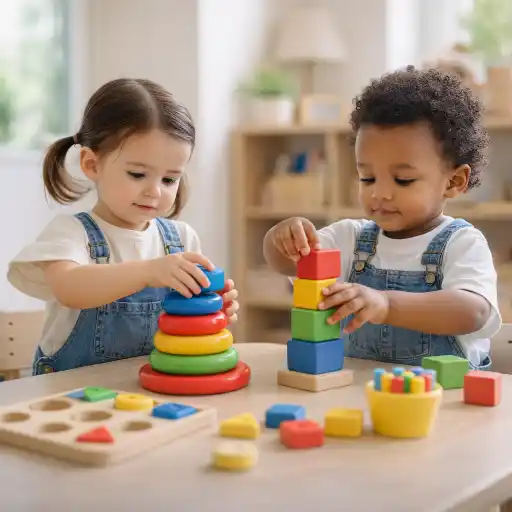
- Constructive play: Blocks, loose parts, clay, and recycled materials support planning, spatial reasoning, creativity, and problem solving.
- Dramatic play: Pretending to be a doctor, caregiver, shopkeeper, or community worker develops symbolic thinking, narrative language, role flexibility, and perspective taking.
- Physical play: Running, climbing, balancing, dancing, and throwing promote motor competence, body awareness, coordination, and confidence.
- Games with rules: Simple games support memory, attention, turn-taking, flexible thinking, and self-regulation.
- Sensory and exploratory play: Water, sand, natural materials, and textured objects invite prediction, comparison, classification, and scientific inquiry.
Pretend play deserves particular attention. Research summarized by the Early Childhood Research and Practice review connects high-quality pretend play with language, social competence, perspective taking, and later abstract thought. Educators can enrich this play by adding culturally familiar props, books, writing materials, photographs, and open-ended questions.
Not every child will enter play in the same way. Some may watch before joining; others may prefer repetitive exploration or parallel play. These behaviors are meaningful starting points rather than problems to eliminate.
How Can Educators Guide Play Without Taking It Over?
Effective educators balance children’s agency with intentional support. Free or self-directed play allows children to choose the activity, materials, roles, and direction. Guided play preserves that agency while the adult thoughtfully arranges the environment, introduces a resource, asks a question, or creates a challenge connected to a learning goal.
Begin by observing. Notice what children are trying to accomplish, what language they use, and where frustration or collaboration emerges. Then choose the lightest support likely to extend learning:
- Join briefly and follow the child’s idea.
- Add precise vocabulary, such as “balanced,” “predict,” “compare,” or “negotiate.”
- Ask open questions: “What could you try next?” or “How might both people fit?”
- Offer one new material or representation, then pause.
- Step back so children can test, revise, and explain their own ideas.
For example, if children build a city, an educator might add maps, signs, clipboards, or photographs of local buildings. The children remain the designers, while the new materials invite literacy, mathematics, spatial reasoning, and community knowledge. Guided play is especially useful when a specific concept may not arise naturally through free play.
Avoid turning every play episode into an assessment interview. Too many questions can interrupt concentration and communicate that adult approval matters more than exploration. Reflective comments—“You tried two ways to make the bridge strong”—often extend thinking while respecting children’s ownership.
How Can Programs Design Environments That Invite Learning?
The environment communicates what children are capable of doing. Accessible materials, clear pathways, predictable routines, and uninterrupted time allow children to make choices and sustain complex play. Head Start emphasizes that attentive adults, meaningful context, appropriate choice, and adaptable materials are essential features of playful learning environments.
Directors and providers can begin with a practical environmental review:
- Provide open-ended materials: blocks, fabric, boxes, natural objects, writing tools, puppets, and loose parts.
- Arrange inviting areas for construction, dramatic play, art, sensory exploration, books, movement, and quiet regulation.
- Include materials that reflect children’s families, languages, cultures, abilities, and community experiences.
- Rotate a few materials intentionally rather than removing everything at once.
- Protect extended, uninterrupted play periods so children can move beyond setup into sustained investigation.
- Adapt tools and spaces with larger handles, visual supports, varied seating, sensory options, or peer access as needed.
Outdoor environments offer additional possibilities for movement, nature inquiry, collaboration, and managed challenge. Ordinary objects can be powerful: containers for filling and pouring, cardboard for building, chalk for mapping, and leaves for sorting. Safety and supervision remain essential, and state requirements vary—check your state licensing agency before changing schedules, equipment, or procedures.
Equity must remain central. A play environment is not inclusive merely because every child may enter it. Children also need genuine access, representation, communication supports, and materials that allow them to influence the play.
What Can Providers Do Next to Strengthen Play-Based Practice?
Meaningful change does not require redesigning the entire program overnight. Begin with one room, one play period, or one learning goal. Invite staff to study a short observation together and ask: What was the child trying to do? What knowledge or skill was developing? What environmental change or adult response might extend it?
Use a simple weekly cycle:
- Observe: Identify children’s interests, strengths, questions, and barriers.
- Prepare: Add materials, books, visual supports, or challenges connected to those observations.
- Interact: Follow children’s lead, use rich language, and scaffold without taking control.
- Document: Capture one concise example of learning.
- Reflect: Adjust the environment and plan the next invitation.
Partnerships with families strengthen this cycle. Ask families what children like to pretend, build, collect, or investigate at home. Use their knowledge to make classroom play more culturally responsive and personally meaningful. Explain that play develops language, executive function, motor skills, social competence, and content knowledge—not simply that children are “having fun.”
For additional professional learning, providers may also explore The Best Promotion is Play Buy Now $24.00, which focuses on types of play, developmental benefits, and strategies for creating stimulating classroom experiences, and From Play to Planning Buy Now $55.00, which connects play, observation, scaffolding, inclusion, and curriculum design.
Conclusion: How Do Children Learn Through Play?
Children learn through play because play invites them to act, choose, imagine, communicate, test ideas, manage emotions, and solve problems in contexts that matter to them. The strongest practice combines sustained child-directed experiences with intentional environments and responsive adult guidance.
Protect time, provide accessible and open-ended materials, observe before intervening, use language that expands thinking, and document the process rather than only the product. When providers treat play as serious curriculum rather than a reward after “real” learning, children gain richer opportunities to develop across physical, cognitive, language, social, and emotional domains.
- Early Mathematics Through Play
- Balancing Physically Active Play in Child Care
- From Play to Planning: Building Culturally Competent, Child-Centered Curriculum
- The Science of Growing Up: Typical and Atypical Development
- The Best Promotion is Play
- Play, Learn, Grow
- Creating Engaging and Meaningful Learning Experiences
- Texas Director Credential
- Balancing Active Play in Child Care
- Montessori Cultural Activities: Exploring the World Through Play and Learning
- Importance of Play for Child Development
- Playful Learning: How Games Help Preschoolers Grow
- CDA Certification en Español: Recursos y Consejos para Educadores Bilingües
- Boosting Language Through Play
- ¿Cómo puedo usar escenarios de juego de roles de primeros auxilios en mi aula?
- Capacitación en Salud y Seguridad Preventiva en Línea para Proveedores de Cuidado Infantil
- Lista para Guardería en Casa en Illinois: Cómo Iniciar una Guardería en el Hogar
- Retraso del Habla en la Guardería: Cómo Pueden Ayudar los Proveedores
- What can DC early childhood educators learn by watching children play?
- Celebrando la amistad en el cuidado infantil durante el Día de los Mejores Amigos
- Canciones, juegos y preguntas de círculo para niños
- Do Toys Come Alive: How Can Pretend Play Spark Creativity in Your Daycare?
- How Can Child Care Providers Support Learning Through Play?
- How Do Children Learn Through Play?
- How Can You Set Up Classroom Learning Centers for Maximum Engagement?
- How Can Early Math Activities Build Young Children’s Mathematical Thinking?
- Why Do Memory Games Support Attention and Working Memory?
- How Can Preschool Educators Encourage Learning Through Play?
- How Can Preschool Teachers Introduce Problem-Solving Skills Through Everyday Play?
- How Can Child Care Providers Use Outdoor Play to Strengthen Problem-Solving Skills?
