What if the most engaging materials in your classroom are already headed for the recycling bin? With intentional planning, everyday objects can strengthen children’s creativity, problem solving, language, and collaboration; ChildCareEd’s Beautiful Junk: Using Recycled Materials in the Classroom  Buy Now $16.00 offers practical ideas and a certificate-based learning experience to help providers build these practices and document professional development.
Why do recycled materials matter in early childhood learning?
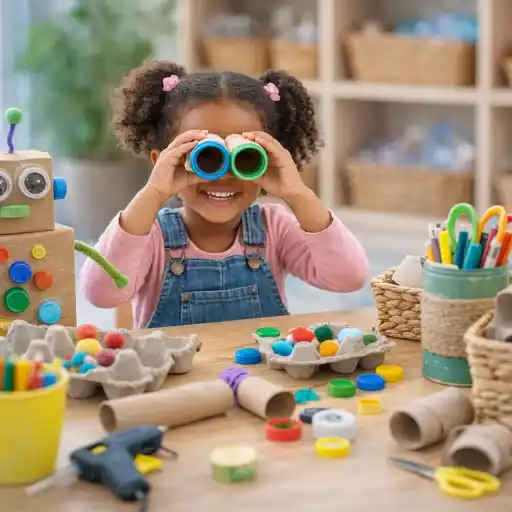
Recycled materials are valuable because they are open-ended. A cardboard box can become a home, a bridge, a store, or a vehicle, depending on children’s intentions. Unlike many commercial toys with one prescribed use, loose parts invite children to make decisions, revise plans, and communicate meaning. Research and professional guidance describe these materials as catalysts for imagination, symbolic play, classification, spatial reasoning, and collaboration. The Pennsylvania State University’s Better Kid Care resource explains that loose parts can be moved, redesigned, combined, and reconstructed in countless ways, with the child directing the experience.
This approach also supports equity. Programs do not need expensive specialty equipment to offer intellectually rich experiences. Clean containers, tubes, fabric, lids, and boxes can provide repeated opportunities for investigation while reducing material costs. Children also encounter an authentic sustainability lesson: objects can have more than one life, and thoughtful choices can reduce waste.
For providers, the instructional value is strongest when materials are connected to observation and curriculum goals. A basket of bottle caps may support counting and sorting; a construction tray may generate engineering language; a collage station may encourage fine-motor control and self-expression. The goal is not simply to make a craft, but to create conditions for meaningful #creativity and inquiry.
How can providers collect and prepare materials safely?
A dependable collection system makes recycled-material centers practical rather than burdensome. Begin with a focused donation list for families and community partners. Useful items may include sturdy cardboard, clean yogurt containers, paper tubes, fabric scraps, magazines, large lids, corks, and plastic containers. Local businesses, reuse centers, thrift shops, and family networks can also provide materials at little or no cost.
- Inspect every item for sharp edges, splinters, cracks, loose components, and toxic residue.
- Wash and dry nonporous materials; launder fabric and discard items that cannot be cleaned effectively.
- Remove small parts, button batteries, magnets, plastic bags, and easily breakable objects from areas used by infants and toddlers.
- Store materials in labeled, accessible bins and rotate selections to prevent clutter.
- Record a brief safety check in the program’s regular maintenance routine.
Safety is contextual. An item appropriate for a supervised preschool construction center may be unsuitable for toddlers. Consider age, developmental ability, sensory needs, and the level of adult supervision required. State requirements vary - check your state licensing agency before introducing unfamiliar materials or changing storage procedures.
Invite children into age-appropriate risk assessment. They can help identify what feels sharp, what needs washing, and how materials should be returned. This turns safety into a meaningful lesson in responsibility rather than a list of restrictions.
How can recycled materials become purposeful learning centers?
Effective centers begin with a learning intention and remain open enough for children to contribute their own ideas. Offer a limited selection of materials, a clear space, and a prompt that stimulates—not dictates—the experience. The following examples can be adapted for preschool classrooms:
- Construction and STEM: Provide boxes, tubes, cardboard strips, lids, and tape. Ask, “How can you build a ramp that helps a car travel farther?” Children can test balance, slope, force, and stability.
- Math and manipulatives: Use large caps, egg cartons, and containers for sorting, counting, matching, and patterning. Add tongs to extend fine-motor and coordination practice when developmentally appropriate.
- Art and design: Offer paper scraps, packaging, fabric, cardboard, and non-toxic adhesive. Emphasize process over a uniform product by asking children to explain their choices.
- Dramatic play: Transform boxes, paper bags, menus, and clean food containers into a market, clinic, post office, or restaurant.
- Literacy: Add labels, signs, clipboards, recycled envelopes, and writing tools so children can create messages, maps, lists, and stories connected to their play.
Centers become more engaging when materials are visible, reachable, and thoughtfully arranged. ChildCareEd’s Spicing Up the Classroom: Learning Centers Buy Now $16.00 can help providers connect center design with lesson planning and developmental objectives.
Which teacher strategies deepen children’s thinking?
The adult’s role is to prepare, observe, and extend learning without taking ownership of the project. Begin by watching what children do with the materials. Their actions reveal interests, theories, social dynamics, and emerging skills. Then use brief, open-ended interactions:
- “What are you noticing?”
- “What could make your structure stronger?”
- “What might happen if we change this part?”
- “How could you show someone else how your design works?”
Allow wait time after asking a question. Children often need several seconds to formulate an idea, especially when they are using a developing language system or communicating nonverbally. Offer vocabulary naturally—balance, flexible, compare, connect, predict, heavier, longer—while accepting children’s home languages, gestures, drawings, and demonstrations as valid forms of communication.
Documentation should capture process, not just finished products. A photograph, a child’s quote, and one concise observation can show planning, persistence, collaboration, or mathematical reasoning. Use these notes to decide whether to add a new challenge, reduce the number of materials, or redesign the center.
Resist correcting every “mistake.” A collapsed tower or unsuccessful ramp is useful evidence. When children test and revise, they develop #problem-solving dispositions and learn that ideas can change through investigation.
How can centers include diverse learners and families?
Open-ended materials naturally support multiple entry points, but inclusion still requires intentional design. Provide larger pieces, adapted grips, pre-cut materials, visual sequences, and stable work surfaces when needed. Keep pathways clear for children using mobility devices, and position materials so children can access them independently or with a peer. For children with sensory sensitivities, offer choices about texture, noise, adhesives, and cleanup.
Dual Language Learners can participate fully when labels, picture cards, and prompts include home languages. Encourage children to explain a design through words, drawing, movement, or demonstration. Families can contribute safe materials that reflect household routines and cultural experiences—such as fabric, containers, packaging, or tools used in everyday life. Ask families what an object means in their home and incorporate that knowledge into dramatic play and conversation.
Family communication is most effective when it makes learning visible. Share a photograph with a short note: “Today, Maya tested three bridges and explained why the cardboard one held more blocks.” Invite families to try a related investigation at home, such as sorting containers or building with boxes. ChildCareEd’s Creating Environments that Nurture Growth and Community Buy Now $55.00 explores materials, learning centers, family involvement, and inclusive classroom design.
Be mindful that sustainability should not become a burden placed on families. Offer multiple ways to participate, including sharing ideas, photographs, cultural knowledge, or time—not only donations.
What common mistakes should providers avoid?
Recycled-material centers are powerful, but several predictable problems can reduce their value. Fortunately, each has a practical solution.
- ❌ Too many choices: Overfilled shelves can overwhelm children and complicate supervision. Rotate a small, purposeful collection.
- ❌ Adult-made projects: When every child follows a template, the experience becomes product-focused. Offer materials and questions instead.
- ❌ Unclear safety expectations: Review materials before use, teach simple care routines, and remove damaged items promptly.
- ❌ Ignoring cleanup: Designate labeled storage and involve children in returning materials so the center remains usable.
- ❌ Documenting only the final product: Capture predictions, revisions, language, and collaboration throughout the process.
Directors can support consistency by creating a shared materials policy, scheduling weekly inspections, and giving staff planning time. A short team reflection can ask: Which materials sustained engagement? Which children accessed the center? What adaptation or challenge should come next? Pennsylvania program leaders may also find it useful to explore how directors and administrators shape quality care and community ties in ECE.
For providers seeking additional preparation, ChildCareEd’s Classroom Setup for Child Care Buy Now $24.00 connects intentional arrangement with safe, welcoming, developmentally appropriate environments. Course certificates and training-hour details should always be reviewed alongside local requirements.
Conclusion
So, how can recycled materials create engaging learning centers? They do so when educators select them thoughtfully, prepare them safely, connect them to children’s interests, and use intentional interactions to extend investigation. Boxes, tubes, caps, fabric, and containers can support #STEM, literacy, mathematics, art, motor development, social learning, and environmental responsibility without prescribing a single answer.
Start with one center and three to six materials. Add one open-ended question, observe before intervening, and document a child’s idea. Then use what you learn to adjust the environment. Recycled materials are not merely inexpensive substitutes for commercial toys; they are invitations for children to imagine, represent, test, collaborate, and make meaning. With careful preparation and reflective teaching, your classroom can turn everyday “waste” into purposeful learning.
Additional ChildCareEd course options: Open Heart, Open Art Buy Now $16.00 and Art from the Heart for Preschoolers Buy Now $35.00.
References
- Beautiful Junk: Using Recycled Materials in the Classroom Buy Now $16.00
- Can recycled materials build real creativity in early childhood classrooms?
- Creating Treasure from Trash
- How can I use Loose Parts Play in my early childhood classroom?
- From Rags to Riches: Junk Art
- How Can I Use Everyday Materials for Meaningful STEM Exploration?
- NAEYC: Rocking and Rolling
- Tips on reimagining waste for loose parts play
- How to Use Everyday Items in ECE Classrooms
- Using Recycled Materials in an Early Learning Environment
- Using recycled materials in Early years settings
- Loose parts: What does this mean?
- Recycling Activity for Preschool
- Sustainable Preschool Crafts
- List recycled materials that can be used in the classroom
- Beautiful Junk: Using Recycled Materials in the Classroom
- CDA Bridge Bundle: Preschool
- CDA Bridge Bundle: Family Child Care without Portfolio Review
- CDA Bridge Bundle: Infant/Toddler without Portfolio Review
- Emergent Learning & Development
- 45-Hour Infant and Toddler Curriculum
- Creating Environments that Nurture Growth and Community
- Texas Director Credential
- CDA: Curriculum Alignment & Materials
- Indoor and Outdoor Activities
- Tiny Tinkerers: How Messy Play Today Could Lead to Tomorrow’s Top Inventors
- Proporciones de Cuidado Infantil y Tamaños de Grupo por Edad en Nueva Jersey (Guía Rápida para Centros y Hogares)
- Canciones, juegos y preguntas de círculo para niños
- Cómo simplificar la capacitación para sus empleados de daycare
- Designing Classroom Spaces That Support Learning and Play
- How Can I Create Engaging Learning Centers for Preschoolers?
- Can You Build a Leaf Bridge? Fall STEM Challenges for Pre-K
- How Can Cut, Sort, and Glue Activities Strengthen Early Learners’ Development?
- Labor Day Crafts for School-Age Kids That Go Beyond Coloring Pages
- How Can Recycled Materials Create Engaging Learning Centers?
- How Can Child Care Providers Create Low-Cost STEM Activities With Items They Already Have?
- How Can Teachers Build Learning Centers on a Tight Budget?
- How Can Child Care Providers Create Effective Learning Centers in Small Spaces?
- Why Are Reusable Printables a Smart Investment for Child Care Providers?
- How Can You Set Up Classroom Learning Centers for Maximum Engagement?
- Which Printable Activities Belong in Every Preschool Classroom?
- How Can Open-Ended Summer Art Encourage Planning and Creativity?
- How Often Should You Rotate Preschool Learning Centers?
- What Are Loose Parts, and How Can Teachers Use Them Safely?
