A harvest basket can be more than a prop for pretend play—it can spark children’s curiosity about which containers hold more, how shape affects capacity, and what makes an object three-dimensional. Explore practical ways to turn seasonal play into meaningful geometry and measurement, and consider Math Foundations in Early Childhood  Buy Now $16.00 for hands-on strategies you can bring into everyday classroom practice. For a broader look at math concepts through play, Early Mathematics Through Play Buy Now $24.00 offers additional professional learning in geometry, measurement, reasoning, and more.
Why bring three-dimensional shape exploration into harvest play?
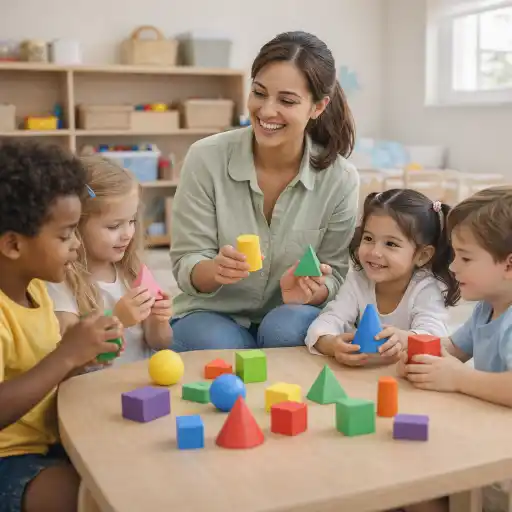
Children encounter solid shapes every day: baskets, boxes, cans, balls, and blocks. In a harvest-themed center, they can handle containers, notice their features, and investigate what happens when they fill, stack, roll, or compare them. This active exploration makes geometry concrete and connected to children’s experiences rather than a set of names to memorize.
Three-dimensional objects have depth, occupy space, and can be examined from different angles. A basket may be tall or short, wide or narrow, open or closed. Children can notice those attributes while using familiar materials and meaningful play roles. Their observations support spatial language and early reasoning: “This one is wider,” “The pumpkin fits inside,” or “The tall container held fewer scoops than I expected.”
Harvest play also naturally combines geometry with capacity, counting, language, collaboration, and pretend play. The investigation is not about teaching formulas or expecting a single correct prediction. It is about helping children wonder, test an idea, observe a result, and explain what they noticed. A rich math invitation can begin with the ordinary question, “Which container do you think will hold more?”
- Connect familiar objects to solid shapes and their visible features.
- Use filling and transferring to make capacity tangible.
- Encourage children to share ideas and revise predictions based on what they observe.
How can you set up a harvest container investigation?
Start with a few stable, clean containers that differ in noticeable ways—perhaps a shallow basket, a tall canister, and a wide box. Add one consistent scoop and large, age-appropriate pretend produce or other safe fillers. A tray can keep materials contained and simplify cleanup. The harvest pretend-play measurement ideas offer a related example of using scoops to compare how much different containers hold.
Invite children to inspect and handle the containers before asking them to predict. Rather than explaining what each object is meant to teach, start with an open question: “Which one might hold more? What makes you think so?” Let children choose roles such as scooper, counter, predictor, or recorder. This gives children with different communication and motor preferences ways to participate.
- Offer two or three containers with contrasting heights, widths, openings, or bases.
- Keep the scoop the same during a comparison so the counts are more meaningful.
- Use picture labels, drawing paper, or simple tally marks to record predictions and results.
- 🍂 Add play produce, market signs, or a pretend harvest story to invite dramatic play and conversation.
Keep the setup flexible. Children may first sort, stack, carry, or explore before they decide to measure. Their play is useful evidence of what interests them and can guide the next prompt. A ready-to-use 2D and 3D shape attributes resource Buy Now $1.99 can also help educators plan language and sorting extensions.
Which geometry and measurement ideas can children investigate?
Capacity—the amount a container can hold—is an accessible starting point, but the investigation can reveal more. Children can compare height, width, base shape, opening size, and whether an object has flat or curved surfaces. These observations help children understand that a container’s appearance alone may not tell them how much it holds. A tall, narrow vessel may hold less than a shorter, wider one.
Use a consistent scoop as a nonstandard unit. Children can predict how many scoops will fill a basket, add one scoop at a time, and count aloud or place a mark after each transfer. They may discover that loose versus heaped scoops affect the result. That variation creates a valuable conversation about keeping a test fair, rather than a reason to label the attempt wrong.
- Notice: “What do you see about the sides, base, and opening?”
- Predict: “Which container might hold more? Why?”
- Test: Fill with the same scoop, counting each transfer.
- Compare: “Which needed more scoops? How could we check?”
- Describe: “How are the tall and wide containers different?”
Children can also explore whether a container stands steadily, whether a round object rolls, or what shapes appear on the faces of boxes and cans. Everyday objects offer approachable examples of solid forms: a ball resembles a sphere, a can a cylinder, and a small box a cube or rectangular prism. Focus on visible features and precise, child-friendly language instead of formal definitions beyond children’s readiness.
How can educators guide children’s thinking without taking over?
Observe first. Some children will begin filling and emptying; others may build a market, sort the produce, or compare containers by sight. Join their play with a brief comment or question, then leave space for them to continue. A pause gives children time to investigate, communicate, and decide what to try next.
Open-ended prompts make thinking visible without turning the center into a quiz. Try “What do you notice?” “How could we find out?” or “What might change if we use the same scoop?” If children disagree about which container holds more, support a fair test rather than settling the question for them. If they lose count, calmly count together or use one visible mark per scoop.
Adapt the challenge to children’s developmental needs and interests:
- For emerging counters, compare just two containers and count a small number of scoops together.
- For children ready to extend the task, invite them to order three containers by capacity or represent results with marks.
- For dual-language learners, pair gestures and pictures with measurement words and welcome home-language explanations.
- For children who prefer not to scoop, offer roles such as predictor, observer, counter, or recorder.
Notice strategies as well as outcomes. A brief note such as “predicted the wide basket would hold more, then checked by transferring scoops” gives you a meaningful next step. The broader investigation of containers illustrates how everyday objects can prompt rich exploration across math, language, art, and science.
How can you keep the activity inclusive, safe, and manageable?
A thoughtful station does not require elaborate materials. Choose washable, sturdy containers, child-sized tools, a tray, and large fillers suitable for the children in your group. Inspect materials for damage, supervise closely, and follow your program’s sanitation and cleanup procedures. Avoid small loose parts when children may mouth objects, and adapt materials to the age and abilities of the group. State requirements vary - check your state licensing agency.
Accessibility includes more than physical access. Make sure containers are stable and easy to reach, provide enough workspace, and offer several ways to participate: speaking, pointing, drawing, using a gesture, or watching a transfer. Children can contribute mathematical thinking without completing every action themselves. If a tool is difficult to grip, consider a larger scoop or a partner-assisted role.
Common pitfalls are easy to prevent:
- Changing scoop sizes mid-test: keep one unit so children can compare counts.
- Correcting predictions too soon: let children test their ideas and reflect on the outcome.
- Focusing only on the final number: ask what children noticed and how they figured it out.
- Offering too many materials at once: begin with a few clear choices and expand in response to play.
These small decisions help keep the activity engaging and attainable for children while making preparation realistic for busy staff. A calm, responsive adult presence lets children take meaningful risks in their thinking while keeping the materials and interaction safe.
How can you extend learning and observe progress over time?
Repeat the invitation with one purposeful change. Use a new set of container shapes, ask whether two baskets can hold the same number of scoops, or invite children to sort containers by features before comparing capacity. Returning to a familiar investigation lets children revisit vocabulary, refine a strategy, and notice how results change when the materials change.
Assessment can happen naturally during play. Notice whether a child makes a prediction, counts one number per scoop, remembers the total, compares two containers, or uses words such as full, empty, wider, and holds more. Document a brief quotation, a child’s marks, or a photo of a completed arrangement, in line with program documentation and family privacy practices. Use the observation to plan one manageable next step, such as introducing a third container or offering a visual tally chart.
Carry these ideas into other parts of the day. Children can compare baskets in dramatic play, explore how blocks fit into bins, or discuss the shapes of familiar objects during a story. Harvest settings also create connections to seasonal materials and community experiences; for more ideas, see fall harvest activities for preschool.
For additional professional learning, explore No Such Thing as Boring Math Buy Now $24.00, CDA Subject Area 2 Buy Now $80.00, and Lesson Planning for Preschoolers Buy Now $24.00. These courses offer related perspectives on play, child development, and intentional planning.
Conclusion: What can a harvest basket teach about three-dimensional shapes?
A harvest basket can invite children to explore three-dimensional forms through handling, filling, comparing, and talking. With a consistent scoop and contrasting containers, providers can connect geometry to capacity, prediction, counting, and evidence-based reasoning. The adult’s role is to offer purposeful materials, ask responsive questions, preserve children’s agency, and notice the strategies behind each discovery.
Keep the experience safe, inclusive, and simple enough to repeat. Let children test their guesses, value multiple ways of participating, and use observations to plan a next challenge. When the question is “Which basket holds more—and how can we find out?”, the answer grows through children’s own play, conversation, and investigation.
References
- How Can Harvest Pretend Play Teach Children to Measure and Compare?
- Investigating Containers
- How Can Preschoolers Learn Geometry Through Building and Play?
- Pumpkin Shape Explorers Guide Buy Now $1.75
- How Can Child Care Providers Move Beyond Shape Names to Attributes and Comparisons?
- 2D & 3D Shape Attributes Buy Now $1.99
- Math Foundations in Early Childhood Buy Now $16.00
- Ideas for Teaching 3D Shapes in Kindergarten
- 3D Shapes Kindergarten Activities with Real World Objects
- Teaching Flat Plane Shapes & Solid Shapes
- Capacity Comparison
- Hands-on Lessons to Teach 3D Shapes
- Harvest Counting Mats Buy Now $0.00
- Comparing & Ordering Capacity Activity
- How Can Early Math Activities Build Young Children’s Mathematical Thinking?
- Investigating Balls
- Shapes Chart Buy Now $0.00
- Fall Harvest Activities for Preschool
- Math Foundations in Early Childhood course information Buy Now $16.00
- How Does Counting Shapes Build Early Number Sense Through Play?
- 45 Hour Child Growth and Development
- Early Mathematics Through Play
- From Play to Planning: Building Culturally Competent, Child-Centered Curriculum
- Roots & Resilience: Understanding What Shapes a Child
- What Makes Me Special: An Overview of Autism and ADHD
- Tracking Progress, Shaping Futures: Observation & Assessment Skills
- Lesson Planning for Preschoolers
- Montessori Cultural Activities: Exploring the World Through Play and Learning
- Every Moment Matters: Schedules and Transitions
- Thanksgiving Booklet Activity
- Nature’s Classroom: Why Fall Is the Best Season for Sensory Learning Outdoors
- CDA Certification en Español: Recursos y Consejos para Educadores Bilingües
- 10 Ejemplos de Cómo la Cultura Influye en el Desarrollo Infantil
- Cómo Trabajar en el Cuidado Infantil en Carolina del Norte: Requisitos y Pasos
- Celebrando la amistad en el cuidado infantil durante el Día de los Mejores Amigos
- Canciones, juegos y preguntas de círculo para niños
- Fall Challenge Accepted! Hands-On Learning Games for Pre-K
- Should I Teach My Blind Child Colors? Why Do Color Words Still Matter?
- Why Can a Child Match a Shape but Struggle to Rebuild It with Pieces?
- How Can Fall Harvest Activities Teach Young Children Healthy Eating Habits?
- How Can November STEM Activities Encourage Curiosity and Discovery?
- How Can Thanksgiving Classroom Activities Teach Nutrition and Healthy Eating?
- How Can Responsive Teaching Make Fall Classroom Activities More Effective?
- How Can November Activities Help Children Learn to Work Together Inclusively?
- What Simple November Activities Build Cooperation and Social Skills?
- How Can Harvest Pretend Play Teach Children to Measure and Compare?
- How Can One Cardboard Box Become Four Fall Dramatic-Play Settings?
- How Can Fall Clubs Engage School-Age Children Who Have Outgrown Preschool Crafts?
- How Can Harvest Play Help Children Explore Three-Dimensional Shapes?
