Children’s play is already full of questions, discoveries, and practice—teachers can help those moments become even richer without taking over. The ChildCareEd course Role of Play in Learning  Buy Now $16.00 explores how play supports development and learning, offering a focused next step for strengthening your classroom practice. Read on for practical ways to notice children’s ideas, extend their thinking, and keep play joyful and child-centered.
Why is everyday play such a powerful place for learning?
Play is not a break from learning; it is one of the ways young children actively make sense of their world. When children build, pretend, move, explore materials, or play games, they bring prior experiences to new situations and test ideas through action. A block tower, for example, can invite spatial reasoning, planning, vocabulary, fine-motor practice, persistence, and collaboration at once.
Playful learning draws on children’s curiosity and motivation while allowing educators to connect experiences to meaningful goals. Research describes play as a spectrum, from child-directed exploration to guided play and structured games. Each form has value: children need autonomy to follow their interests, and sometimes a thoughtful adult prompt or resource can help them explore a concept more deeply. A systematic review found that guided play supported some learning outcomes, including early mathematics and shape knowledge compared with direct instruction, while effects differed across other outcomes.
This perspective can also ease the pressure to choose between “academic” learning and joyful classroom life. Literacy, math, science, social skills, and self-regulation can emerge in authentic play when educators observe carefully and respond with intention. The key is to protect children’s ownership of the experience while recognizing the learning already taking place.
- Building can bring out counting, comparing, balance, and design ideas.
- Pretend play can support language, storytelling, perspective-taking, and social negotiation.
- Outdoor exploration can invite movement, observation, prediction, and questions about nature.
How can teachers notice learning without interrupting play?
Start with a brief pause. Watch what children choose, repeat, talk about, and try to solve. Notice who is involved, what materials they use, and whether the play is changing. These small observations help you decide whether to stay nearby, add a resource, offer a comment, or simply let the play continue.
Try recording a few objective details instead of rushing to label what a child “knows.” For example: “Maya placed three long blocks across two crates, tested the ramp with a car, and moved one block after the car slid off.” This description captures planning, experimentation, and revision without making assumptions. Later, you can connect the observation to a possible next step, such as offering different surfaces or introducing words like steep, smooth, and slope.
Observation is especially useful when children approach play differently. One child may enter a group immediately; another may watch for several minutes before joining. A child may repeat an action to explore cause and effect, or choose solitary play to concentrate. These are meaningful ways of engaging, not automatic signs that something is wrong. Responsive teaching begins by valuing the child’s current approach.
- 📝 Notice the child’s focus, language, strategies, and interactions before stepping in.
- Capture a brief quote or action that may help with planning.
- Consider the child’s interests, strengths, culture, communication, and access needs.
How can teachers extend play without taking it over?
When you see a chance to deepen thinking, use the lightest support that may help. Join the play by following the child’s idea, describe what you notice, or offer one open-ended question. “What are you working on?” and “What could you try next?” invite children to explain and plan, while “You need to build it this way” can shift control to the adult.
New vocabulary can extend learning without interrupting the child’s purpose. If children are building a bridge, you might say, “That beam is balancing across the gap,” or “You made the base wider.” If a child is making pretend soup, you might wonder aloud what ingredients are needed or add a notepad for taking orders. Allow time for children to respond, revise, or ignore your suggestion; their direction remains central.
Guided play works best when there is a clear learning intention alongside child choice. The goal might be to explore spatial language, compare quantities, or practice taking turns, but the exact pathway can remain flexible. The NAEYC discussion of playful learning frames the educator as a guide who connects goals to play while preserving children’s agency and enthusiasm.
- Use open prompts: “How could we make the tower steadier?”
- Offer one relevant material, such as a ramp, measuring tape, map, or story prop.
- Model a strategy only when it supports the child’s current effort, then step back.
How can familiar activities invite language, math, and inquiry?
Everyday play materials are rich with learning possibilities. Blocks and loose parts can support sorting, counting, patterns, measurement, and spatial thinking. Add a few photographs of structures or simple design pictures, and children may compare shapes or work together on a shared plan. In dramatic play, signs, menus, clipboards, and writing tools invite children to create messages and stories as they take on roles.
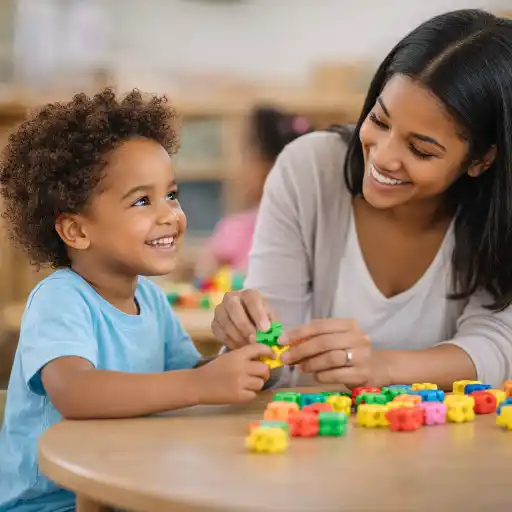
Inquiry grows when children can make predictions and test them. Offer containers and water to explore which objects float, or provide different surfaces for toy cars and ask what changes how far they travel. Avoid giving the answer too soon; listen to children’s theories and let them repeat or adjust their tests. Ordinary classroom experiences can support this same thinking when educators make room for children to notice, compare, and explain.
Language-rich interaction can be woven into play through descriptive comments, expansions, and conversation between peers. If a child says, “It’s big,” you might respond, “Yes, that is the biggest box, and it can fit two smaller boxes inside.” The aim is not to quiz children continually, but to give them useful words and reasons to communicate.
- Blocks: compare height, shape, balance, and the number of pieces used.
- Pretend shop: make lists, sort pretend food, count items, and negotiate roles.
- Nature play: collect, classify, draw, and describe leaves, stones, or seedpods.
What classroom conditions help play become meaningful and inclusive?
Children need time to become absorbed in play. Frequent interruptions and rushed transitions can prevent them from moving beyond choosing materials into sustained planning and problem-solving. Whenever possible, protect extended play periods and arrange the schedule so children have time to return to ideas and develop them.
The environment matters, too. Accessible, open-ended materials support more than one kind of play, while clear pathways and predictable storage help children make choices and participate with growing independence. Include books, props, images, and materials that reflect children’s families, languages, cultures, abilities, and communities. Consider whether each child can reach, understand, communicate about, and meaningfully use what is offered.
Inclusion is not achieved by inviting every child into an activity that was designed for only one way of participating. Adapt materials, provide visual or communication supports, offer varied sensory options, and allow children different ways to engage. Maintain safe supervision as you do so; state requirements vary - check your state licensing agency when considering changes to schedules, equipment, or supervision practices.
- Keep a small selection of versatile materials visible and within children’s reach.
- Plan for different communication, mobility, sensory, and developmental needs.
- Ask families about children’s interests and familiar play experiences at home.
How can teachers reflect and plan from children’s play?
Use a simple cycle: observe, interpret, respond, and reflect. After play, ask yourself what children were exploring, what strategies or language emerged, and what might help them continue. You do not need to turn every observation into a formal assessment. A concise note, photograph, child quote, or work sample may be enough to inform your next decision.
For example, if children repeatedly create roads for toy vehicles, you could add a simple map, signs, measuring tools, or photographs of neighborhood streets. If they are interested in caring for dolls, offer blankets, family photographs, or a small notebook for recording pretend appointments. Let children’s questions shape the next invitation, and avoid planning so tightly that there is no room for unexpected discoveries.
Teams can make reflection practical by sharing one observation during a brief planning conversation. Directors can support staff by protecting play time, discussing examples of guided interaction, and ensuring materials are accessible and relevant. Professional learning can also help educators build a stronger foundation; in addition to the course linked above, ChildCareEd offers The Best Promotion is Play Buy Now $24.00, Teacher & Me Playtime Buy Now $24.00$19.00, Playful Spaces for Infants & Toddlers Buy Now $24.00, and Early Mathematics Through Play Buy Now $24.00. Review each course’s format and details to choose what best fits your goals.
- Observe one play episode and identify a skill, question, or interest.
- Plan one small adjustment to materials, environment, or adult interaction.
- Revisit the play and consider what children did with the opportunity.
Conclusion: How can teachers turn everyday play into learning?
Teachers turn everyday play into learning opportunities by noticing children’s ideas, preparing engaging and inclusive environments, and offering responsive guidance without taking control. Building, storytelling, movement, exploration, and pretend play can support many areas of development at once. The educator’s task is not to make every moment a lesson, but to recognize when a small question, new word, useful material, or protected stretch of time can help children think further.
Keep children’s curiosity and agency at the center. Observe first, connect play to meaningful goals, and reflect on what children show you. With thoughtful preparation and warm, flexible interactions, ordinary play can become a powerful context for children to explore, communicate, collaborate, and grow.
- Moving About the Classroom: Effective Transitions for Everyday
- The ABCs of Behavior: Turning Challenges into Learning Opportunities
- Pediatric RSV First Aid & CPR/AED
- CDA Bridge Bundle: Family Child Care without Portfolio Review
- CDA Bridge Bundle: Infant/Toddler without Portfolio Review
- The Best Promotion is Play
- CDA Bridge Bundle: Preschool without Portfolio Review
- Creating Environments that Nurture Growth and Community
- Role of Play in Learning
- Texas Director Credential
- CDA Certification en Español: Recursos y Consejos para Educadores Bilingües
- 🎈 Better Together: Why Little Friends Make a Big Difference in Early Childhood
- Celebrando la amistad en el cuidado infantil durante el Día de los Mejores Amigos
- Canciones, juegos y preguntas de círculo para niños
- How Can Child Care Providers Recognize "Learning in Disguise" During Everyday Activities?
- How Can Child Care Providers Teach Friendship Skills Through Everyday Classroom Activities?
- Teacher-Directed or Child-Directed? Finding the Right Classroom Balance
- What Toddler Activities Encourage Language and Communication?
- How Can Teachers Build Emotional Regulation Into Daily Routines?
- What Should a 2-Year-Old Be Learning at Daycare?
- How Can Teachers Turn Everyday Play Into Learning Opportunities?
- How Can You Help a Preschool Group Include the Child Who Is Often Left Out?
- What Are the Best Ways to Support Cooperative Play in Preschool?
- How Can Teachers Turn Everyday Classroom Problems Into Learning Opportunities?
- How Can Preschool Teachers Introduce Problem-Solving Skills Through Everyday Play?
- How Can Teachers Balance Alphabet Worksheets with Preschool Conversation?
- How Can Preschool Teachers Balance Alphabet Worksheets with Conversation?
- How Can a Familiar Sound Help Infants Anticipate What Comes Next?
- What Common Kindergarten Readiness Mistakes Should Preschool Teachers Avoid?
- How Can Playful Dental Health Activities Build Healthy Habits in Young Children?
