Supporting toddler development requires more than knowing what children should be able to do; it involves creating responsive relationships, purposeful environments, and meaningful opportunities to practice emerging skills. Strengthen your foundation with Baby Steps to Milestones ONLINE  Buy Now $24.00, which can help you recognize developmental domains, plan appropriate experiences, and notice possible concerns while earning professional training hours.
Toddlers are wonderfully active learners. Between approximately 12 and 36 months, children may move from tentative steps to running, from single words to short conversations, and from parallel play toward early cooperation. These changes can feel rapid and uneven, especially in a busy child care room. A child may demonstrate advanced language while still needing support with self-regulation, or confidently climb while communicating mostly through gestures.
Development is multidimensional, relational, and individualized. The goal is not to make every child perform on a rigid schedule. Instead, providers observe patterns, offer accessible challenges, respond warmly, and partner with families. The CDC describes milestones as skills that most children—at least 75%—can do by a certain age; these tools support conversation and monitoring, not diagnosis. Zero to Three’s developmental milestones guide likewise emphasizes that checklists are guides rather than scorecards.
Why does understanding toddler development matter in child care?
Developmental knowledge helps providers interpret behavior with greater accuracy and compassion. A toddler who throws materials may be exploring cause and effect, communicating frustration, or seeking sensory input. A child who clings during arrival may need predictable attachment support rather than pressure to “be independent.” When adults understand the developmental task beneath the behavior, guidance becomes more effective and less punitive.
Knowledge also improves curriculum decisions. A developmentally appropriate room includes opportunities to move, manipulate, communicate, pretend, rest, and connect. NAEYC explains that toddlers learn through caring relationships, hands-on play, exploration, and connections between new experiences and what they already know. These principles position daily routines—meals, diapering, transitions, and cleanup—as valuable learning contexts.
- Observe strengths before identifying needs.
- Plan experiences with several ways to participate.
- Use routines to build language, self-help, and social skills.
- Share specific observations with families regularly.
Professional learning can deepen this work. The Early Learning with Infants and Toddlers Buy Now $24.00 course focuses on individualized needs, developmental milestones, responsive interaction, and individual planning—skills that can translate directly into classroom practice.
What developmental domains should providers observe in toddlers?
Toddler development is commonly considered across four connected domains: social-emotional, language and communication, cognitive, and physical development. These categories organize observation, but they should not be treated as separate compartments. For example, a child solving a puzzle may use fine-motor coordination, attention, language, persistence, and emotional regulation simultaneously.
Social-emotional development includes attachment, emotional expression, awareness of others, emerging empathy, and increasing independence. Toddlers may play beside peers before they can consistently share or negotiate. They often need adults to model simple scripts such as “my turn,” “help please,” or “are you okay?”
Language and communication include understanding language, using words, gestures, facial expressions, and other communication methods. At two years, the CDC lists pointing to objects in books, combining at least two words, identifying body parts, and using gestures beyond pointing and waving among common milestones.
Cognitive development involves memory, imitation, problem-solving, cause-and-effect exploration, categorization, and pretend play. Open-ended materials invite toddlers to test ideas without requiring one correct result.
Physical development includes gross-motor skills such as walking, running, kicking, climbing, and jumping, as well as fine-motor and self-help skills such as scribbling, using utensils, turning pages, and manipulating containers.
Use developmental information to guide responsive planning—not to label children. The CDA Infants/Toddlers: Stages of Development Buy Now $24.00 course offers focused training on developmental stages, milestones, and age-appropriate activities.
How can play and routines strengthen toddler learning?
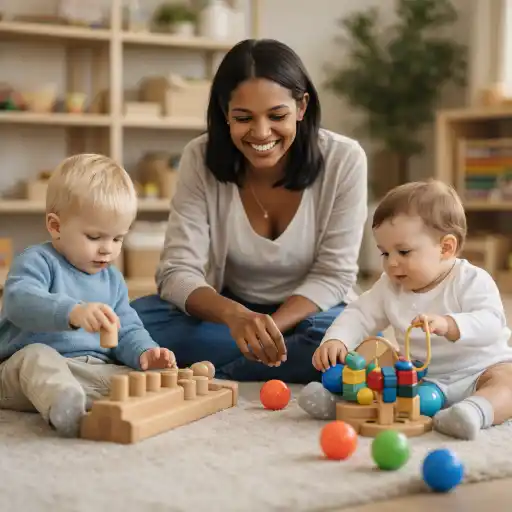
For toddlers, play is a primary mode of inquiry. Children learn by touching, moving, repeating, imitating, and experimenting. NAEYC’s developmentally appropriate practice guidance recommends a balance of self-directed play, guided play, and intentional instruction. The adult’s role is not to control every action, but to notice interests and add just enough support to extend thinking. For additional ideas on play experiences that support children’s natural development and fine-motor skills, see ways to support children’s natural development through play.
- 🧱 Construction play: Offer large blocks, boxes, and tubes. Describe balance, size, position, and effort without taking over.
- 📚 Shared reading: Pause for pointing, name pictures, repeat favorite phrases, and connect the story to children’s experiences.
- 🎭 Pretend play: Add dolls, dishes, fabric, phones, or familiar household objects. Model nurturing and problem-solving scripts.
- 🏃 Movement play: Provide balls, push toys, low climbing opportunities, and safe pathways for walking, running, and stopping.
- 🧺 Sorting and filling: Use containers, scoops, large objects, and simple matching activities to support coordination and early reasoning.
Routines offer equally rich opportunities. During handwashing, narrate sequence and body parts. At meals, encourage children to carry napkins, choose between two foods, and practice utensils safely. During transitions, use songs, visual cues, and brief warnings. Predictable routines support security while also developing memory and independence.
To build more intentional activity planning, explore Playing with a Purpose: Infant/Toddler Lesson Planning Buy Now $24.00. The course addresses lesson-plan components and developmentally appropriate activities for children from birth through age three.
How can responsive relationships support social-emotional development?
Relationships are the context in which toddlers feel safe enough to explore and learn. Responsive caregiving means noticing cues, interpreting behavior thoughtfully, and responding with warmth and consistency. When a child looks toward an adult after a new experience, the adult’s facial expression and words help the child decide whether the situation is safe. When a toddler cries at separation, a predictable goodbye routine and trusted caregiver can support emotional regulation.
Providers can strengthen social-emotional learning through everyday interactions:
- Get physically close and use a calm, respectful tone.
- Name emotions without shaming: “You are angry that the truck is being used.”
- Set clear limits and describe the acceptable alternative: “I won’t let you hit. You can stomp or ask for help.”
- Model repair after conflict, including returning materials and checking on peers.
- Offer small choices to build agency: “Do you want the blue cup or the green cup?”
- Create a quiet, safe space where children can calm with an adult nearby.
Tantrums are common because toddlers’ emotional intensity often exceeds their language and self-regulation capacities. Ignoring unsafe behavior is not the same as ignoring the child. Stay present, protect children, reduce language during peak distress, and reconnect once the child is calmer. Consistency across adults matters; directors can support staff through shared scripts, coaching, and reflective discussion.
Family partnerships are equally important. Ask families how the child communicates needs, what comforts them, and which routines are familiar. Respect home languages and cultural approaches to emotion, independence, sleep, and caregiving. Strong continuity between home and child care can reduce stress and promote belonging.
How should providers document progress and respond to concerns?
Observation is most useful when it is specific, repeated, and connected to planning. Rather than writing “has poor language,” record what happened: “During snack, Maya pointed to the banana and said ‘more’ twice after the teacher modeled the word.” Include the date, context, people present, the child’s exact actions or words, and the support that helped.
A practical documentation cycle is:
- Notice: Observe during play, routines, transitions, and peer interactions.
- Record: Write brief, objective examples and note strengths.
- Interpret cautiously: Look for patterns across days and settings.
- Plan: Offer a small, measurable opportunity for practice.
- Review: Discuss progress with colleagues and families.
Developmental checklists can help organize observations, but they are not standardized screening tools and should not be used to diagnose. The CDC recommends developmental screening at 9, 18, and 30 months, with autism-specific screening at 18 and 24 months, or whenever a parent or provider has a concern. Providers should encourage families to consult the child’s health care professional and ask about screening.
Pay particular attention to loss of previously acquired skills, persistent concerns across settings, or multiple areas of difficulty. A concern does not establish a diagnosis; it signals that further conversation may be valuable. For children under three, families may contact their local early intervention system directly. State requirements vary - check your state licensing agency.
Staff who want deeper training in observation and documentation may explore CDA Infants/Toddlers: Benefits to Observing Buy Now $16.00, which focuses on assessment techniques for tracking development and individual needs.
How can directors create an inclusive toddler program?
Inclusion begins with the assumption that every child belongs and can participate meaningfully. A toddler may need adapted materials, additional time, visual cues, movement options, peer modeling, or communication supports. These adaptations are not lowered expectations; they are access points that allow children to demonstrate competence.
- Provide large-handled utensils, thick crayons, stable seating, and accessible containers.
- Use photographs, objects, gestures, and simple sign language alongside spoken directions.
- Offer quiet spaces and sensory choices for children who become overwhelmed.
- Break routines into short steps and demonstrate each step.
- Plan activities with easy, moderate, and more challenging entry points.
- Include children’s home languages, families, cultures, and varied abilities in materials and dramatic play.
Directors can make inclusion sustainable by reviewing enrollment information, consulting families and specialists, and building time for staff collaboration. Individual goals should be integrated into ordinary play and routines rather than isolating a child from the group whenever possible. Universal Design for Learning principles—multiple means of engagement, representation, and expression—can help teams anticipate differences before barriers appear.
Common mistakes include relying on age labels alone, comparing children publicly, overcorrecting emerging speech, and treating milestones as pass-fail requirements. Avoid these pitfalls by emphasizing growth, documenting context, and asking what support makes participation possible. When concerns arise, communicate privately, begin with strengths, use factual examples, and invite the family’s perspective.
For a broader professional foundation, the The Science of Growing Up: Typical and Atypical Development Buy Now $55.00 course explores developmental theories, milestones, individual differences, and developmentally appropriate practice through age five.
Conclusion: What is the central goal of supporting toddler development?
The central goal is not to accelerate children toward a uniform checklist. It is to create relationships and environments in which toddlers feel secure, curious, capable, and included. Providers support development by observing across four connected domains, offering playful and practical learning opportunities, embedding teaching in routines, and responding to emotions with empathy and clear limits.
Use milestone resources as conversation tools, not diagnostic instruments. Document concrete examples, look for patterns, celebrate strengths, and communicate early when concerns persist or skills are lost. Partner with families and health professionals, and follow local guidance—state requirements vary - check your state licensing agency.
When directors invest in staff training, reflective coaching, inclusive materials, and consistent caregiving practices, everyday moments become powerful developmental opportunities. A block tower, a shared book, a difficult goodbye, or a toddler’s attempt to use a spoon can all reveal growth. Your attentive presence helps children build the confidence and skills they will carry into the next stage of learning.
Frequently asked questions
Are developmental milestones strict deadlines?
No. They describe skills most children demonstrate by particular ages and should guide observation and conversation, not function as a pass-fail test.
What should I do if a toddler is not meeting a milestone?
Document specific examples across settings, speak privately with the family, and encourage consultation with the child’s health care provider about developmental screening.
Why is play so important for toddlers?
Play integrates movement, language, problem-solving, imagination, social negotiation, and emotional regulation in a meaningful context.
How can I support a toddler who has frequent tantrums?
Maintain safety, stay calm, use few words during peak distress, name feelings afterward, and teach acceptable ways to request help or express frustration.
Can toddlers develop at different rates in different domains?
Yes. Uneven development is common. Observe the whole child, build on strengths, and provide targeted support without making comparisons.
- 45 Hour Child Growth and Development
- CDA Home Visitor Subject Area 3 Part 3 Birth to 5
- CDA Home Visitor Subject Area 2 Part 3 Birth to 5
- 45 Hour Preschool Methods and Materials
- Pediatric RSV First Aid & CPR/AED
- 45 Hour School Age Methods and Materials
- CDA Bridge Bundle: Infant/Toddler without Portfolio Review
- CDA Bridge Bundle: Infant/Toddler
- Texas Director Credential
- Healthy Cooking for Picky Kids
- Why do I need a CDA Credential?
- Bye Bye Winter: The Role of Outdoor Play in Early Childhood Development
- Empowering Early Childhood Education: NYAEYC
- Invest in Your Skills, Invest in Children: ChildCareEd Training for Michigan Providers
- CDA Certification en Español: Recursos y Consejos para Educadores Bilingües
- 🔍 ¿Qué ves cuando observas a un niño aprender?
- Cómo usar tu certificación de 90 horas en Maryland para completar tu CDA
- ¿Cuáles son los pasos, requisitos y opciones en línea para la certificación de 90 horas en cuidado de Infantes/Toddlers en Maryland?
- Proporciones de Cuidado Infantil y Tamaños de Grupo por Edad en Maryland (Guía Rápida para Centros y Hogares)
- Proporciones de Cuidado Infantil y Tamaños de Grupo por Edad en Virginia (Guía Rápida para Centros y Hogares)
- How Can Child Care Providers Support Infant Brain Development?
- How is California's TK expansion reshaping private preschool and family child care — and how can providers adapt?
- Online CDA Classes: A Flexible Path Toward Your CDA Credential
- Where Can You Get Your CDA Online? Start Your Credential with ChildCareEd
- How Do You Explain Ego to a Child Without Making It Sound Like a Bad Thing?
- How Can Child Care Providers Support Healthy Brain Development in Young Children?
- Why Is Outdoor Play Essential for Healthy Child Development?
