Introduction
Setting simple #rules that young children can follow helps your day go smoother. When rules are short, visual, and taught with practice, children feel safe and ready to learn. This article is for child care providers and directors. It gives steps, ideas, and real tips you can use tomorrow. Remember: state requirements vary - check your state licensing agency.
Why does this matter?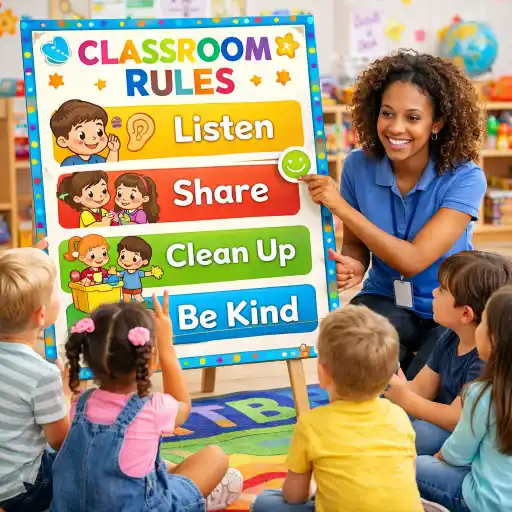
Children who know what to expect worry less, join activities more, and act kinder with friends. Clear expectations protect everyone and build trust. The ChildCareEd guide on creating a positive learning environment explains how rules fit into a calm, learning space.
What makes rules clear and easy for #preschoolers to understand?
Short, positive rules work best. Aim for 3–5 simple statements. Use words kids hear often. For example:
- Use walking feet.
- Hands are for helping.
- Use kind words.
Why these work:
- They are short (1–7 words) and positive. See ChildCareEd's tips on clear rules.
- They are the same for everyone. This helps kids remember and feel treated fairly.
- Pair each rule with a picture, a gesture, or a simple song so non-readers can learn it. Visual cues are powerful; see photos and ideas at Rainbows Within Reach.
Quick steps to make a rule poster:
- 🖍️ Write the rule in big letters.
- 📷 Add a photo of children doing the rule (real kids in your room works best).
- 🔁 Post it at child height and review daily.
Citations: Use the ChildCareEd poster ideas Buy Now $0.00 and the CDC family tips on rules (CDC) for wording and consistency.
How can I teach rules so children remember and practice them?
Teaching rules takes practice, not just one talk. Use this simple teach-then-practice plan. It is based on positive guidance principles shared by ChildCareEd and by CSEFEL's strategies (CSEFEL).
- Say it: Say the rule with a short phrase, e.g., "Our rule: walking feet."
- Show it: Model the rule. Use a puppet or teacher volunteer to act it out.
- Try it: Let children practice right away (a short role-play or a game).
- Praise it: Give specific praise. Say, "I see Sofia using walking feet — thank you!"
Extra ideas that help memory:
- 🎵 Make a tiny chant or song for each rule. Music sticks in memory.
- 👉 Add gestures: a hand for helping, walking motion for walking feet. Down Under Teacher shows how gestures help recall (Down Under Teacher).
- 📅 Practice rules at transitions. Use "first–then" language like "First clean up, then playground" — a tip from ChildCareEd and visual schedules resources.
Keep teaching short and repeated. Children need many chances to try a rule before it becomes routine. If a child needs extra support, a small one-page plan helps staff respond the same way each time — see ChildCareEd's mini plans and courses (Staying Positive  Buy Now $24.00).
How can the #classroom layout and daily #routines help rules succeed?
Many rule problems start because the room or schedule makes them hard to follow. The Manitoba best practices and ChildCareEd both say to look at the environment first (Manitoba guide, ChildCareEd).
Use these steps to set up the space and day:
- Define clear centers: blocks here, books there. Label bins with pictures so kids know where things go.
- Provide enough materials so children do not fight over one toy. ChildCareEd recommends extra favorites in group rooms.
- Plan longer play blocks so children can get deeply involved. This lowers behavior that comes from boredom.
- Post a visual daily schedule and an individual "first–then" card for children who need it. Rainbows Within Reach shows many visual schedule examples (visual supports).
Simple signals for the group help transitions: a ringing bell, a clap pattern, or raising your hand. Teach the signal like a rule: say it, show it, try it. Add small classroom jobs so children feel ownership (see ChildCareEd's Classroom Jobs Buy Now $0.00 resource).
Why this matters: when the space and times match children's needs, following rules is easier and less stressful for everyone. For more design ideas, review ChildCareEd strategies.
What can I do when rules are broken without yelling?
Yelling can scare children and stops learning. Use calm, short phrases and consistent follow-through. ChildCareEd outlines calm scripts and quiet choices (How to set clear rules without yelling).
Try a 3-step calm script each time:
- Name the rule: "Hands are for helping."
- Tell the action: "Put your hands in your lap."
- Give next step: "When you're ready, you may join the block table."
If a child keeps testing, offer two choices that are both okay to you. For example:
- 😊 "You can put your shoes on now, or in one minute."
- ✋ "You can sit on the carpet or at the table."
Important follow-through examples (fair and safe):
- If a child throws toys: remove the toy for a short time and offer a safe alternative.
- If a child runs indoors: walk back together and practice walking feet.
- If a child hurts another: support the injured child, then help the child who hurt repair the relationship.
After things calm, have a brief repair chat: "What happened? How did it feel? What can we do next time?" This helps children learn cause and effect and builds social skills (see CSEFEL for scripts and role play ideas: CSEFEL).
Common mistakes — how to avoid pitfalls?
- 🚫 Setting too many rules. Keep 3–5 main rules so children can remember them.
- 🚫 Posting rules but never teaching them. Teach with role-play, gestures, and praise.
- 🚫 Inconsistent adult responses. Make a simple team plan so all staff follow the same steps.
- 🚫 Blaming environment. Check if space, materials, or schedule are the true cause of the problem.
FAQ
- How many rules should I have? Aim for 3–5 main room rules. Short is better. (See Study.com.)
- Should kids help make the rules? Yes. When children help create rules they understand them better. See ideas at Eastern CT's guide on creating rules with children (Eastern).
- What if one child keeps breaking the same rule? Collect data: when, where, and what leads up to the behavior. Use a mini support plan and involve families. ChildCareEd offers helpful templates and courses.
- Can visuals help children who don't speak English well? Yes. Visuals and gestures help all learners, especially English learners and children with special needs (see visual prompts).
- Where can I learn more? ChildCareEd has courses like Classroom Management is Collaboration Buy Now $16.00 and Staying Positive Buy Now $24.00 for deeper skill-building.
Conclusion
Setting rules preschoolers understand is simple when you:
- Keep them short and positive,
- Teach with modeling, gestures, and practice,
- Design the room and day to support the rules, and
- Respond calmly and consistently when rules are broken.
Try one small change tomorrow: post one rule with a picture and teach it by showing and practicing. For more ready-to-use posters and job charts, check ChildCareEd's resources like Classroom Dos and Don'ts Buy Now $0.00 and Classroom Jobs Buy Now $0.00. You are doing important work — small steady steps make big changes for children and staff. #rules #preschoolers #classroom #routines #safety
- 45 Hour Child Growth and Development
- 45 Hour Preschool Methods and Materials
- Teach with Respect!
- Super Special School Agers
- 24 Hour Texas Pre-Service
- CDA Bridge Bundle: Family Child Care without Portfolio Review
- CDA Bridge Bundle: Infant/Toddler without Portfolio Review
- CDA Bridge Bundle: Preschool without Portfolio Review
- Texas Director Credential
- Cómo Empezar una Guardería en Casa: Requisitos y Pasos
- Proporciones de Cuidado Infantil y Tamaños de Grupo por Edad en Nueva Jersey (Guía Rápida para Centros y Hogares)
- How can indoor creative play encourage teamwork for preschoolers in California?
- How can preschool teachers use simple classroom management techniques that really work?
- Celebrando la amistad en el cuidado infantil durante el Día de los Mejores Amigos
- Cómo simplificar la capacitación para sus empleados de daycare
- How can I manage mixed-age groups in my Michigan family child care home?
- How can childcare programs talk to parents about screens and AI without starting a fight?
- What's the Secret to Making Classroom Rules Stick?
- Preschool Classroom Rules: How to Teach Expectations Without Constant Reminders
- Made by Me! Labor Day Crafts for Preschoolers That Celebrate Hard Work
- How Can Child Care Providers Help Children Understand Classroom Expectations?
- How Can Child Care Providers Set Clear Classroom Rules and Expectations?
- How Can Child Care Providers Create Classroom Rules That Children Understand and Use?
- How Should Child Care Providers Respond When Preschoolers Lie?
- Keep It Simple: Introducing Classroom Rules Preschoolers Can Remember
- When a Preschool Rule Expects More Self-Control Than Children Can Manage, What Should Educators Do?
- Why Doesn’t Knowing a Safety Rule Mean a Preschooler Can Follow It?
- What Should You Do When a Child Changes Their Vote on the Classroom Graph?
