Fall words like pumpkin, scarecrow, and sunflower invite children to listen, move, and discover the beats inside spoken language. Try the Science of Reading Foundations in the Pre-K Classroom Buy Now $16.00 course to deepen your understanding of early literacy and gain practical ways to connect sound play with classroom learning; then use the ideas below to make syllable practice joyful and developmentally appropriate.
With a few familiar words, simple props, and repeated opportunities to listen, you can help children build foundational literacy skills without turning play into a test.
Why do fall-themed syllable activities matter?
Syllables are the spoken beats or parts within words. When children clap pump-kin or tap sun-flow-er, they are practicing how to notice the sound structure of language. This skill is one component of phonological awareness, which includes listening for rhyme, syllables, and other sound patterns. It is not the same as phonics: children can explore syllables orally before they connect speech sounds to printed letters.
That distinction matters in a preschool classroom. The goal is not to ask children to read or spell scarecrow; it is to invite them to say the word, listen closely, represent its parts, and blend those parts back into the whole. Research and professional guidance describe playful sound experiences as a meaningful foundation for later literacy learning. NAEYC’s examples of word play include using movement and instruments to represent syllables, while research on phonological awareness emphasizes intentional, appropriately supported practice.
Seasonal vocabulary gives the listening task a vivid context. A child who has seen a pumpkin or helped make a scarecrow is more likely to know the word and stay interested. Short, social activities also fit naturally into busy routines: a quick name-clapping game at arrival or a word-beat chant before snack can make practice frequent without requiring a lengthy lesson.
- Children learn that spoken words can be noticed as smaller sound parts.
- Movement makes an abstract listening task concrete and memorable.
- Shared play creates opportunities to hear adult models and learn alongside peers.
How can you model syllables in pumpkin, scarecrow, and sunflower?
Begin by saying each word naturally, then repeat it clearly without exaggerating or separating sounds unnaturally. Invite children to listen for the beats and represent each one with a clap, tap, stomp, or block. For this activity, the common spoken pronunciations are pump-kin (two syllables), scare-crow (two), and sun-flow-er (three). Pronunciation can vary by accent, dialect, and individual speech patterns, so treat the activity as collaborative listening rather than a contest over one “correct” way to say a word.
Try a simple sequence:
- Show a picture or real object and make sure children can name it.
- Say the word together once at a natural pace.
- Say it again and mark one movement for each spoken beat.
- Count the movements, then blend the parts to say the whole word again.
- Invite children to show or explain how they heard the word.
For example, hold up a sunflower picture and say, “Sunflower. Let’s listen: sun-flow-er. I hear three beats, so I’ll tap three times.” Children can use fingers, rhythm sticks, a drum, or a line of three blocks. If someone claps twice, model the word again and invite another try with warmth: “Let’s listen together.” Guidance from NAEYC’s discussion of word play throughout the day supports blending movement, songs, and authentic routines into phonological awareness experiences.
Keep attention on listening, not on cutting, gluing, or producing a perfect response. Hands-on materials can help children participate, but the sound pattern is the learning focus.
Which playful fall activities make word parts easier to hear?
Children do not need a worksheet to explore word beats. Use fall objects, photographs, pretend-play props, and story vocabulary to make the activity active and social. Start with a small set of words children recognize, then add new vocabulary as interest grows. The ChildCareEd overview of teaching syllables through play also recommends familiar words, clear modeling, and movement-based ways for children to represent each beat.
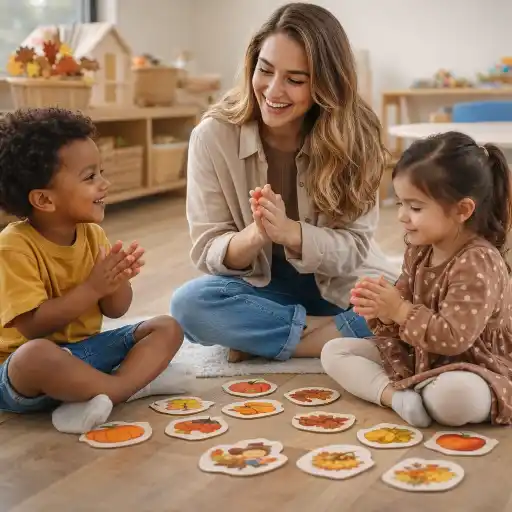
- Make a fall word path: place picture cards on the floor and invite children to tap one spot for each syllable before moving to the next card.
- Build a beat tower: children add one block for each beat they hear in words such as leaf, apple, or sunflower.
- Try a puppet’s “slow talk”: the puppet says “scare…crow,” and children blend the parts to say the whole word.
- Clap names and classroom words during arrival, cleanup, or snack. Familiar names are often an engaging starting point.
- 🎵 Create a short fall chant, such as “Pumpkin, pumpkin, two beats!” and let children choose the next word and movement.
Children can also sort picture cards into one-, two-, and three-beat groups. Before asking them to count, make sure they know what each picture represents. If a word is new, pause to name and describe it first; otherwise, the challenge may be vocabulary, not sound awareness. For a related example of fall vocabulary in syllable sorting, see this fall syllable clip-card activity.
Use short rounds and repeat favorites over several days. Playful repetition gives children another chance to listen without making the activity feel like a drill.
How can you include children with different communication and sensory needs?
Children come to fall word play with different vocabularies, home languages, speech patterns, sensory preferences, and motor abilities. Those differences are not barriers to participation; they are reasons to offer more than one way to join in. A child may speak, point to a picture, sign, tap a surface, place a block, use a communication device, or watch a demonstration before trying. Each can be a meaningful response.
Use clear photos, real objects, gestures, and extra wait time. Offer seated movements as well as standing ones, and provide quiet alternatives to loud clapping, such as finger taps or placing counters. Children who benefit from observing first can join with a partner or take a turn after watching a model. For a child learning English, invite familiar words from the home language when appropriate and recognize that syllable patterns and pronunciation vary across languages. Family language knowledge is an asset, not something to set aside during classroom learning.
- Use a small group or partner format when a whole-group response feels overwhelming.
- Offer choices: clap, tap, point, move a counter, or listen and respond in another way.
- Check that fall pictures and words are familiar before asking children to count their parts.
- Notice participation and growth over time rather than judging a child from one attempt.
Supportive language helps protect curiosity: “Let’s listen together,” “You found another way to show it,” or “Would you like to try it with blocks?” If concerns about communication or listening persist across activities, follow program procedures for partnering with families and seeking appropriate support. State requirements vary - check your state licensing agency when aligning professional learning and classroom documentation with local expectations.
How can educators plan, observe, and avoid common pitfalls?
A clear learning intention keeps the activity purposeful without making it formal or rigid. For example: “Children will listen to familiar words and represent each syllable with one movement.” Choose a few recognizable words, decide how you will model, and prepare more than one response option. The ChildCareEd resource, Teaching Syllables Through Play, describes how providers can use simple sequences and observation to extend this kind of experience.
Observe what each child can do: name or identify the picture, repeat the word, mark its beats, count the movements, or blend the parts back together. A brief note can inform your next step. If a child is unsure, use a more familiar word, model again, reduce the number of choices, or invite a response through pointing or movement. Avoid treating a single answer as a measure of overall ability.
Common pitfalls are manageable with small adjustments:
- Too many words at once: Begin with a few familiar choices and expand gradually.
- Unfamiliar pictures: Name and discuss the object before asking children to listen for syllables.
- Overcorrecting pronunciation or counting: Model the word naturally, then invite children to listen again without pressure.
- Making the printable the lesson: Keep listening, movement, and conversation at the center; use cards or craft materials as optional supports.
For a ready-to-use way to organize syllable practice, explore ChildCareEd’s literacy resources, including syllable-counting materials. Extend the seasonal word play into books, dramatic play, walks, and conversations so children hear useful words in more than one setting.
Conclusion: What should preschoolers discover about fall word parts?
Through fall-themed play, preschoolers can discover that spoken words have beats or parts that they can hear, represent with movement, count, and blend back into a whole word. The purpose is attentive listening and joyful experimentation—not reading a word, giving a flawless response, or completing a worksheet independently.
Choose familiar words such as pumpkin, scarecrow, and sunflower; model one movement for each spoken beat; and offer flexible ways to participate. Revisit the skill in brief moments across the day, observe children’s strategies, and adjust the words or supports when needed. This playful approach helps make phonological awareness part of children’s real classroom experiences while honoring their different strengths and communication styles.
For a broader foundation in preschool literacy—including phonological awareness, vocabulary, print knowledge, and read-aloud practices—consider the Science of Reading Foundations in the Pre-K Classroom Buy Now $16.00 course. For a practical classroom resource focused on syllable counting, explore the ChildCareEd syllable-counting materials and adapt the activity to the children in your care.
- Understanding Print Knowledge in Preschool
- Science of Reading Foundations in the Pre-K Classroom
- Language and Literacy Foundations in Pre-K
- Setting the Stage: Story Time
- Working Together: Teachers & Preschoolers
- Creating Environments that Nurture Growth and Community
- Texas Director Credential
- Building Vocabulary
- Montessori Cultural Activities: Exploring the World Through Play and Learning
- IEPs and IFSPs in Family Child Care
- Phonological Awareness
- CDA Certification en Español: Recursos y Consejos para Educadores Bilingües
- Actividades de Motricidad Gruesa que Desarrollan el Equilibrio, la Coordinación y la Fuerza
- 10 Ejemplos de Cómo la Cultura Influye en el Desarrollo Infantil
- Actividades de Otoño Fáciles para Preescolares esta Temporada
- Cómo Trabajar en el Cuidado Infantil en Carolina del Norte: Requisitos y Pasos
- Celebrando la amistad en el cuidado infantil durante el Día de los Mejores Amigos
- Canciones, juegos y preguntas de círculo para niños
- How Can Sound Bingo Sharpen Listening Skills in Preschoolers?
- Why Is Beginning-Sound Bingo a Smart Step Toward Reading?
- How Can Songs and Rhymes Build Young Children’s Language Skills?
- How Can Printable Books Help Preschoolers Fall in Love With Reading?
- How Can Familiar Summer Vocabulary Make Syllable Instruction More Meaningful?
- How Can Seasonal Picture Sorting Build Phonemic Awareness in Early Childhood?
- How Can Transportation Interests Motivate Beginning Readers?
- Why Is Hearing Syllables Different from Naming Letters?
- Teaching Syllables Through Play: What Should Preschoolers Notice?
- Teaching Syllables Through Play: What Should Preschoolers Notice?
- How Do Rhyming Games Help Preschoolers Prepare for Reading?
- How Can Fall Word Play Help Preschoolers Hear Syllables?
