Printable books can turn a few sheets of paper into a child’s first experience of authorship, choice, and reading success. To strengthen these experiences with intentional print and read-aloud practices, explore Science of Reading Foundations in the Pre-K Classroom Buy Now $16.00, which offers practical professional learning on print knowledge, vocabulary, comprehension, emergent writing, reading aloud, and storytelling.
For an additional focus on engaging shared reading, Reading Aloud and Storytelling  Buy Now $16.00 can help providers refine classroom practices while strengthening their professional knowledge.
Why do printable books matter in preschool?
Printable books are more than inexpensive classroom materials. When thoughtfully selected and introduced, they give preschoolers repeated opportunities to handle books, interpret pictures, hear language, notice print, and contribute ideas. A child who helps assemble a mini-book or illustrates a class story experiences literacy as something they can actively create—not merely something adults deliver.
This sense of agency matters because early reading development is both cognitive and relational. Research and professional guidance describe shared books as contexts where children build vocabulary, comprehension, concepts of print, and positive identities as readers. The NAEYC guidance on reading together emphasizes that children learn that pictures and words are symbols, encounter new vocabulary, and become familiar with print conventions through shared reading.
- Printable books are easy to repeat, adapt, and send home.
- Children can connect text to their artwork, experiences, and interests.
- Providers can adjust language, pictures, and page length for individual needs.
- Families can revisit the same book in flexible and familiar ways.
These benefits are strongest when printables supplement—not replace—high-quality trade books, teacher storytelling, informational texts, poetry, and child-selected reading. The goal is to build a lively literacy ecosystem in which children experience #books as useful, enjoyable, and personally meaningful.
How do printable books build early literacy skills?
A well-designed printable book can support several areas of emergent literacy at once. As children look at a cover, turn pages, listen to a repeated sentence, and discuss illustrations, they learn how books work and how meaning is represented. Printable texts also offer a manageable context for connecting spoken language with written words.
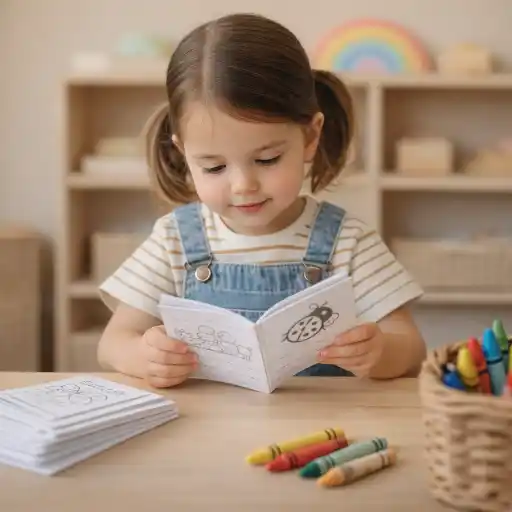 The Head Start language and literacy guidance identifies preschool literacy domains such as phonological awareness, print and alphabet knowledge, comprehension and text structure, and writing. Printable books can be intentionally planned around these domains without turning reading into a worksheet exercise.
- Print knowledge: Children notice the cover, title, page order, spaces, punctuation, and direction of print.
- Vocabulary: Repeated words are heard in meaningful contexts and can be connected to objects, gestures, or actions.
- Phonological awareness: Rhymes, alliteration, syllables, and repeated sounds can be explored playfully.
- Comprehension: Pictures and predictable structures support prediction, sequencing, retelling, and inference.
- Emergent writing: Children can dictate sentences, copy meaningful words, draw, scribble, or attempt letter forms.
Use printables to reinforce learning that children have encountered through authentic experiences. After investigating leaves, for example, create a class book titled “We Found Leaves.” Each page might include a child’s drawing, dictated observation, and a repeated sentence frame. This approach makes literacy connected to #play, inquiry, and memory.
How can providers design printable books children want to read?
Engagement begins with relevance. Select or create books that reflect children’s questions, cultures, families, languages, abilities, and current play themes. A printable about familiar classroom routines may be especially motivating for a child who is still learning how the program works; a book about dinosaurs, cooking, buses, or pets may invite another child to participate more fully.
Predictable language is useful because it lowers the cognitive demand of joining the reading. Repeated questions, refrains, rhymes, and sentence patterns allow children to anticipate what comes next. As explained in Why Do Predictable Books Help Preschoolers Feel Like Readers?, children may fill in a missing word, chant a refrain, or turn pages before an adult does. These are meaningful signs of participation and emergent literacy.
When preparing a printable, consider:
- Use one clear idea or short sequence per page.
- Pair simple text with illustrations that genuinely support meaning.
- Repeat a sentence while changing one meaningful word or image.
- Include children’s names, dictated language, photographs, or artwork when appropriate.
- Offer bilingual text or home-language versions with family collaboration.
- Use large, uncluttered print and strong visual contrast.
Remember that a book does not need to be perfect to be valuable. Children’s invented spellings, uneven drawings, and dictated sentences show that communication has purpose. Preserve their ideas while modeling conventional writing in a respectful way.
How should printable books be used during read-alouds and rereading?
The most effective use of a printable book is interactive. Rather than distributing pages and expecting children to work independently, introduce the book with warmth and curiosity. Preview the cover, invite predictions, read expressively, and pause for children’s observations. A short book may be revisited several times across a week, with a different purpose each time.
- First reading—enjoyment: Read the book naturally and observe which images, words, or ideas capture attention.
- Second reading—participation: Pause before repeated phrases, invite gestures, and allow children to complete familiar lines.
- Third reading—meaning: Ask children to sequence events, explain vocabulary, or connect the story to their experiences.
- Extension—creation: Invite children to add a page, act out the story, draw a new ending, or make a related class book.
Keep questions brief and responsive. Try “What do you notice?”, “What might happen next?”, or “Which page shows that?” Offer wait time and accept answers through speech, pointing, signing, movement, drawing, or an augmentative communication system. A child who cannot yet recite the text may still demonstrate deep understanding through actions or choices.
📚 Place favorite printables in the library, dramatic-play area, or writing center. Children often reread familiar books independently, retell them to peers, or use them as scripts for pretend play. These experiences strengthen #confidence and help children see reading as something they can do.
How can printable books include every preschooler?
Inclusion begins with the belief that every child is a capable meaning-maker. Printable books can be adapted more readily than many commercial texts, but adaptation should be guided by observation rather than assumptions. Notice how children access information, communicate ideas, and sustain attention.
For dual language learners, repetition provides valuable exposure without requiring immediate English responses. Introduce key vocabulary with objects, photographs, gestures, and home-language equivalents. Families may help translate a sentence, record a reading, or suggest a familiar song or story pattern. Head Start notes that language and literacy skills develop in any language and that supporting the home language helps prepare children for additional language learning.
- Use photographs, tactile symbols, props, and real objects alongside pictures.
- Offer large-print, high-contrast, or simplified versions when needed.
- Provide options for listening, pointing, acting, signing, drawing, and speaking.
- Invite children to choose between topics, page formats, or participation roles.
- Represent varied families, cultures, abilities, neighborhoods, and experiences.
Directors can support inclusion by creating a shared process for reviewing classroom materials. Ask whether children recognize themselves, whether the language is accessible, and whether the book invites meaningful participation rather than passive completion. State requirements vary - check your state licensing agency when selecting curriculum materials or documenting literacy instruction.
What common mistakes should providers avoid?
Printable books are powerful, but their impact depends on how adults use them. One common mistake is treating them as busywork. If children simply color predetermined pages or trace letters without conversation, the activity may offer limited literacy value. Instead, connect the book to children’s ideas, oral language, play, and authentic communication.
Another pitfall is relying on printable books exclusively. Children need varied genres and levels of complexity, including rich picture books, nonfiction, poetry, wordless books, songs, and stories read aloud by adults. Printables are especially useful for personalization and repetition, while published literature expands language, imagination, background knowledge, and artistic experience. The National Institute for Early Education Research highlights the importance of reading and rereading picture books, discussing illustrations, and allowing children to make personal connections.
- Do not require every child to respond aloud or complete the same product.
- Do not confuse memorizing a pattern with decoding unfamiliar words.
- Do not introduce too many instructional targets in one short book.
- Do not choose texts solely because they are easy to print.
- Do not use cultural or family representation as decoration without context.
Instead, select one or two goals, such as sequencing a familiar event or learning three topic words. Document small changes: a child joins a refrain, chooses a book, uses a new word in play, retells an event, or creates a new page. These observations provide more useful information than high-pressure testing.
Conclusion: How can printable books help preschoolers fall in love with reading?
Printable books help preschoolers fall in love with reading when they make literacy personal, participatory, and joyful. They give children opportunities to handle books, revisit familiar language, connect pictures with print, express ideas, and see their own experiences represented on the page. A celebration such as National Book Lovers Day can also offer a timely reason to make shared reading special through playful, child-centered activities.
The strongest practice combines printable books with responsive read-alouds, diverse published literature, meaningful play, and family partnership. Create books from children’s questions, reread them with changing purposes, adapt them for communication and access, and celebrate every form of participation. When a child proudly turns the pages of a book they helped make, literacy becomes more than a skill to practice—it becomes a way to belong, communicate, imagine, and discover.
For continued professional learning, providers may also explore Classroom Tools for Emergent Literacy Buy Now $16.00, Understanding Print Knowledge in Preschool Buy Now $16.00, and Setting the Stage: Story Time Buy Now $25.00.
- Understanding Print Knowledge in Preschool
- Science of Reading Foundations in the Pre-K Classroom
- Language Development in School Age
- Reading Aloud and Storytelling
- Language and Literacy Foundations in Pre-K
- Setting the Stage: Story Time
- 45-Hour Infant and Toddler Curriculum
- Texas Director Credential
- Classroom Tools for Emergent Literacy
- Celebrate the Joy of Reading on National Book Lovers Day
- CDA Certification en Español: Recursos y Consejos para Educadores Bilingües
- Proporciones de Cuidado Infantil y Tamaños de Grupo por Edad en Maryland (Guía Rápida para Centros y Hogares)
- Cómo Trabajar en el Cuidado Infantil en Carolina del Norte: Requisitos y Pasos
- Cute Fall Picture Ideas Teachers Can Try in the Classroom
- What fun literacy activities do Florida VPK classrooms need now?
- Celebrating Mother's Day in Child Care: Simple Ideas for Providers
- Father’s Day Keepsake Ideas for Preschool and Child Care
- How can I plan peach-themed summer activities for preschoolers in Georgia?
- Fall Sensory Activities for Toddlers and Preschoolers
- Pumpkin, Leaves, and Apples: Fall Activities for Preschoolers
- Celebrando la amistad en el cuidado infantil durante el Día de los Mejores Amigos
- Canciones, juegos y preguntas de círculo para niños
- Cultural Activities for Preschoolers: Fun Ways to Learn About the World
- How can preschool programs build early literacy every day?
- How can seasonal activities (spring, summer, fall, winter) combine fun with clear educational goals?
- How can pumpkin science create meaningful, hands-on fall learning for preschool classrooms?
- How Can Child Care Providers Support Language Development in Young Children?
- How Can Printable Books Help Preschoolers Fall in Love With Reading?
