Playful sound activities can turn a song, story, or trip to the snack table into meaningful early-literacy practice. Explore Science of Reading Foundations in the Pre-K Classroom Buy Now $16.00 to deepen your understanding of sound awareness and other early reading foundations, and Language and Literacy Foundations in Pre-K  Buy Now $16.00 for practical ways to strengthen everyday listening and communication. These courses can help you plan more intentional classroom experiences; read on for ideas you can begin using with children right away.
Why does sound play matter in preschool?
Phonological awareness is the ability to notice and work with the sounds in spoken language. Children can practice it by listening, speaking, singing, and moving; they do not need to read letters. The broad skill includes noticing rhymes and syllables, hearing repeated beginning sounds, and gradually attending to smaller sound units.
These experiences support later literacy because children begin to understand that spoken words have sound structures. That understanding can help them make sense of how print represents speech when they encounter formal reading and writing instruction. Phonological awareness is related to phonics, but the two are not the same: phonics explicitly connects sounds with letters, while phonological awareness focuses on spoken sounds.
Play gives children a natural reason to listen closely. A rhyme during cleanup or a syllable chant using children’s names can make an abstract idea social, memorable, and enjoyable. As NAEYC’s examples of word play throughout the day illustrate, small moments in familiar routines can become useful learning opportunities. A warm, responsive approach lets children participate at different levels without turning sound play into a test.
Which sound skills can teachers explore through play?
Preschool educators can offer varied experiences across a continuum of sound awareness. Children may develop multiple skills at once, so there is no need to wait for perfect mastery of one activity before introducing another. Start with familiar words and adjust prompts to children’s interest and responses.
- Rhyme: Notice that “cat” and “hat” sound alike at the end; invite children to match or invent playful rhymes.
- Alliteration: Hear repeated beginning sounds in phrases such as “Silly Sam sings.”
- Sentence segmentation: Count the separate words in a short, familiar sentence as you say it.
- Syllables: Clap, tap, or step once for each spoken part in a name or object word.
- Onset and rime: Blend the beginning sound with the rest of a word, such as /m/ and /ap/ to make “map.”
- Emerging phonemic awareness: Notice or blend individual sounds in short, familiar words when children are ready.
Keep the sound task distinct from letter instruction at first. A child can listen for the first sound in “sun” without identifying the printed letter S. Massachusetts early literacy guidance describes sound awareness as a foundation for blending and decoding; in preschool, the emphasis can remain playful and oral.
How can everyday routines become playful sound lessons?
Short, frequent invitations are practical in a busy classroom and give children repeated chances to listen. Use routines that are already part of the day rather than adding a lengthy, isolated lesson. Model the sound idea, invite children to try, and accept movement, pointing, or verbal responses.
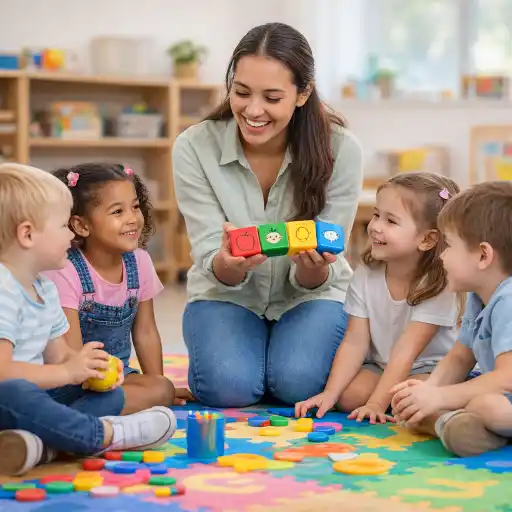
- 🎵 During transitions: Chant a familiar rhyme as children line up, wash hands, or put materials away.
- At snack: Name a utensil or food and ask whether anyone can think of a word that rhymes with it.
- At arrival: Clap the syllables in children’s names or tap them on a drum.
- In dramatic play: Give pretend characters alliterative names, such as “Baking Bella” or “Doctor Dan.”
- In block play: Invite children to find an object that starts with the same sound as “block.”
- With manipulatives: Move two blocks together as you blend an onset and rime into a whole word.
Use clear, natural speech and familiar vocabulary. If a child does not know the name of an object, introduce it before asking them to listen for its sounds. Avoid correcting every response; model the word again and invite another listen. The aim is to make sound patterns noticeable while keeping children’s play and curiosity at the center.
How can books, music, and home languages enrich sound play?
Books, songs, fingerplays, and chants provide rhythm and repetition, helping children hear sound patterns in meaningful contexts. During a read-aloud, emphasize one rhyme or repeated sound, invite children to finish a predictable phrase, or revisit a favorite line. There is no need to stop on every page; a few focused moments can preserve the story’s flow and children’s enjoyment.
Music and movement make listening physical. Children can clap a syllable, sway to a rhyme, or use rhythm sticks to mark the parts of a word. Research reviews have described connections between musical activities and emergent literacy, while also noting that research findings should be interpreted carefully. In practice, songs offer an engaging way to repeat language and invite participation.
Include children’s home languages as valuable sources of words, songs, and rhymes. Invite families to share a familiar fingerplay or phrase, and use words children know well. Sound patterns differ across languages, so a rhyme or pronunciation that works in one language may not transfer directly to another. Head Start’s guidance on phonological awareness highlights the importance of supporting children who are learning more than one language, including those with disabilities or suspected delays. Treat multilingual knowledge as an asset and provide clear, patient models in the classroom language.
How can teachers observe progress and adapt activities?
Observation helps teachers decide what to model or offer next; it is not a reason to label a child based on one response. During play, notice whether a child attends to a rhyme, claps parts of a familiar word, identifies a repeated beginning sound, or benefits from a picture or model. Brief notes can help you plan responsive next steps and share concrete examples with colleagues and families.
- Choose one sound skill to notice during a familiar game or routine.
- Record the words used, the child’s response, and any supports that helped.
- Repeat the activity in a relaxed context before drawing conclusions from a single attempt.
- Model the target: “Listen again—cat, hat. They sound alike at the end.”
- Adjust the number of choices, use more familiar words, or offer a pointing or movement response.
Common pitfalls are manageable. Avoid relying only on worksheets, using vocabulary children do not know, or expecting every child to participate in the same way. Do not confuse difficulty naming a picture with difficulty hearing its sounds. If concerns persist across settings, follow program procedures to discuss observations with the family and seek appropriate support. State requirements vary - check your state licensing agency.
How can a program make sound play consistent and inclusive?
A simple plan can help a teaching team make phonological awareness part of the everyday environment. Choose a weekly sound-play focus, such as rhyme or syllables, and identify familiar words, a book or song, and one routine where children can revisit it. Keep activities flexible: children’s interests may lead to a spontaneous rhyme game or sound hunt that is just as worthwhile as a planned moment.
Directors can support staff by sharing examples of short prompts, building time for collaborative planning, and encouraging observation rather than drill. Families can extend the fun with songs, name clapping, or word games in whichever language feels most comfortable at home. These simple connections affirm children’s experiences and help sound play travel between home and classroom.
For additional professional learning, explore Reading Aloud and Storytelling Buy Now $16.00, Classroom Tools for Emergent Literacy Buy Now $25.00, and Assessment of Language and Literacy Skills Buy Now $24.00. These English-language courses address interactive reading, literacy-rich classroom practices, and observation approaches that can complement playful sound activities.
Conclusion: How can preschool teachers build phonological awareness through play?
Preschool teachers can build phonological awareness by making sound play brief, intentional, inclusive, and joyful. Use familiar words in songs, stories, movement, routines, and child-led play to explore rhyme, alliteration, syllables, and other sound patterns. Model clearly, offer different ways to respond, and adapt activities to children’s language knowledge and interests.
Above all, treat each game as an opportunity to listen and connect—not as a high-stakes test. Consistent playful practice helps children notice how spoken language works and gives teachers practical ways to nurture early literacy throughout the day.
- Science of Reading Foundations in the Pre-K Classroom
- Language and Literacy Foundations in Pre-K
- What Makes Me Special: An Overview of Autism and ADHD
- Setting the Stage: Story Time
- Building Equity: Inclusionary Practices in Preschool
- Reading Aloud and Storytelling
- Classroom Tools for Emergent Literacy
- Building Early Science Foundations
- Classroom Tools for Emergent Literacy
- Montessori Cultural Activities: Exploring the World Through Play and Learning
- Phonological Awareness
- Language and Literacy Preschool Curriculum
- How can we prepare preschoolers for kindergarten success?
- How can we teach letters, numbers, and early literacy to young children?
- Celebrando la amistad en el cuidado infantil durante el Día de los Mejores Amigos
- Canciones, juegos y preguntas de círculo para niños
- How can preschool programs build early literacy every day?
- What simple early literacy activities really help children learn?
- Can we build early literacy skills through play in high-quality child care?
- How can child care providers support name recognition and letter awareness effectively?
- How can child care programs build strong readers before kindergarten?
- How can child care providers build early literacy skills through play?
- How can child care providers build early literacy skills through play?
- How Can Child Care Programs Build Meaningful School Readiness?
- How Can Child Care Providers Build Phonological Awareness in Preschool?
- How Can Simple Music and Movement Activities Build Early Literacy Skills?
- How Can Teachers Build Early Literacy Without Screens or Worksheets?
- How Can Fall Word Play Help Preschoolers Hear Syllables?
- What Does the Science of Reading Mean for Preschool Teachers?
- How Can Preschool Teachers Build Phonological Awareness Through Play?
