When children are eager to talk about buses, bikes, boats, or trains, that enthusiasm can become a welcoming route into early reading. Explore practical ways to turn transportation play into meaningful print, sound, vocabulary, and comprehension experiences, and consider Science of Reading Foundations in the Pre-K Classroom Buy Now $16.00 for a broader foundation in early literacy instruction. The course connects key reading-readiness skills with classroom practice, while the strategies below help you put children’s interests to work right away.
For focused next steps, providers may also explore Reading Aloud and Storytelling  Buy Now $16.00, Classroom Tools for Emergent Literacy Buy Now $25.00, Building Vocabulary Buy Now $16.00, and Understanding Print Knowledge in Preschool Buy Now $16.00.
For a ready-to-use activity, see ChildCareEd’s I see: Transportation Buy Now $1.75, a short printable that pairs simple sentence patterns with transportation pictures and coloring pages.
Why can transportation capture beginning readers’ attention?
Transportation is already part of many children’s everyday worlds. A child may arrive by car, hear a bus outside, watch a plane overhead, or push a toy train across the floor. These familiar experiences offer strong starting points for conversation because children bring observations, questions, and personal stories to the topic. When literacy activities begin with what children care about, participation often feels purposeful rather than imposed.
Start by noticing what children talk about, draw, build, or repeatedly choose in play. A passing airplane or a favorite family trip may spark more sustained discussion than a preselected theme. Follow that interest with a few relevant books, pictures, toy vehicles, and opportunities to use the words in play. The aim is not to turn every conversation into a lesson, but to make literacy visible within engaging experiences.
How can providers connect transportation play to early reading skills?
Beginning readers need a constellation of foundational experiences, not simply practice with letter names. Transportation play can connect oral language and vocabulary with sound awareness, print knowledge, alphabet learning, comprehension, and early writing. Keep activities brief and playful, and model the skill before inviting children to try.
- Vocabulary: Introduce useful words such as vehicle, passenger, tracks, wheels, and destination. Show an object or picture, say the word naturally, and revisit it during play.
- Sound awareness: Clap syllables in words such as “airplane” or “bicycle,” listen for rhymes in a vehicle song, or notice the first sound in “bus.”
- Alphabet knowledge: Link a meaningful letter to a vehicle name, such as B for bus, while remembering that children may be at different stages of learning letter names and sounds.
- Print awareness: Point out the title of a transportation book, track a repeated line, or notice that labels and signs carry messages.
- Comprehension: Ask what a character is doing, what might happen next, or how the character gets from one place to another.
The printable I see: Transportation Buy Now $1.75 uses a simple repeated sentence pattern and pictures of a boat, bus, car, train, and bike. Read it together, point to the words as you say them, and let children identify or color a vehicle. Treat a child’s memorized participation as meaningful engagement, while making clear that repeating a familiar line is different from decoding unfamiliar text. The Science of Reading Foundations course covers the broader relationships among these foundational skills.
How can a transportation activity become an intentional literacy routine?
A useful routine does not require a long lesson or elaborate supplies. Choose one target skill, one or two words, and a short experience children can revisit. The same vocabulary can appear in a read-aloud, block play, a drawing, and a conversation across the day. Repeated, meaningful exposure helps children connect a spoken word with an object, action, image, or idea.
Try this sequence with the I see: Transportation Buy Now $1.75 resource or a favorite picture book:
- Invite noticing: Ask, “What kinds of things go?” Give children time to name, gesture toward, or point to vehicles.
- Read and model: Read the repeated sentence clearly. Point to the words as you read, and pause to invite children to say or indicate the pictured vehicle.
- Focus on one skill: Choose one target, such as the /b/ sound in “bus,” the syllables in “bicycle,” or the word “passenger.” Demonstrate first, then invite a response.
- Extend through play: Add toy vehicles, a simple road, and a few signs or labels to blocks or dramatic play. Use the target word in natural conversation.
- Notice learning: Record a brief observation—for example, whether a child used the word independently or recognized the first sound with support.
Keep the interaction responsive. If the group is captivated by boats, follow that interest rather than insisting on a bus activity. A child may participate by speaking, pointing, making a sound, moving a toy, signing, or using an augmentative communication system. Those varied responses can show comprehension and engagement.
How can providers make transportation literacy inclusive and accessible?
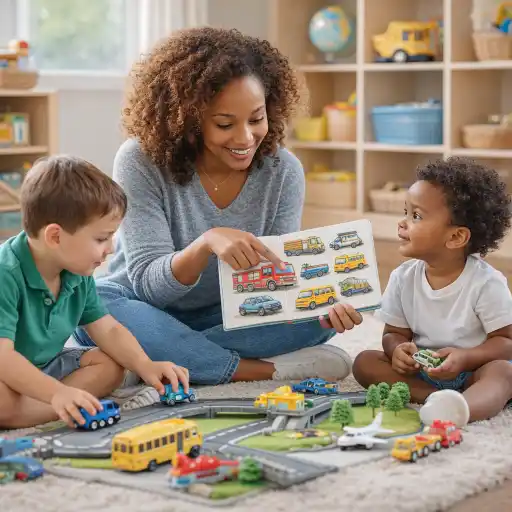
Children’s experiences with transportation differ. Some ride a school bus every day; others may be more familiar with walking, bicycles, trains, boats, or vehicles seen in books and the neighborhood. Invite children to share what they know without assuming that every family uses the same forms of transportation. Images and stories should reflect varied communities, caregivers, abilities, and ways of traveling.
Participation should not depend on a child being ready to answer aloud. Offer choices and multiple ways to communicate: point to a picture, match a toy to a word card, act out “stop” and “go,” draw a vehicle, or select an image using AAC. For children learning English, pair new words with objects, gestures, photographs, and home-language equivalents when available. Family contributions—such as a familiar vehicle word, song, or travel story—can help connect classroom learning with home knowledge.
- Use clear, high-contrast pictures and uncluttered pages when these support access.
- Provide sturdy, easy-to-hold books, cards, or toy vehicles, and adapt materials to children’s motor needs.
- Offer tactile objects or movement cues alongside spoken words.
- Allow extra processing time and accept gestures, sounds, signs, or communication devices as responses.
- Include a range of transportation modes and avoid treating one family’s experience as universal.
Preschool literacy guidance notes that expectations should account for the language and writing systems children encounter at home; alphabet-sound expectations do not apply identically across languages. Observe each child’s strengths and provide access without pressure. If an activity is not engaging a child, adjust the materials, communication options, or level of support rather than interpreting silence as lack of understanding.
What common pitfalls should educators avoid?
Transportation themes are motivating, but an activity can lose its literacy purpose if adults focus only on crafts or naming vehicles. A colorful train project may be enjoyable; to connect it with reading readiness, add a meaningful opportunity to notice print, hear sounds, use vocabulary, tell an idea, or connect speech with a written word. Keep the literacy goal developmentally appropriate and explicit without making play feel like a test.
- Teaching too many skills at once: Choose one or two targets per experience, such as a new word and a beginning sound.
- Relying only on worksheets: Pair printables with conversation, books, movement, play, and real objects or pictures.
- Confusing recitation with decoding: A child may remember a repeated sentence. Continue to model how print works and offer sound and letter experiences as appropriate.
- Requiring spoken answers: Accept pointing, gestures, actions, signs, and communication devices as meaningful participation.
- Overcorrecting children: Respond warmly to approximations, model the word or sound clearly, and keep the interaction positive.
Use brief observations to decide what to offer next. Note whether children join a repeated phrase, use a target word during play, recognize a familiar letter, or respond to a story question. These notes need not become a high-pressure assessment; they can help teachers adjust scaffolding and share specific examples with families. If you are using literacy activities to meet program or professional requirements, state requirements vary - check your state licensing agency.
Conclusion: How can transportation interests help beginning readers?
Transportation interests can motivate beginning readers by making early literacy relevant, observable, and enjoyable. Familiar vehicles give children something concrete to discuss while providers intentionally support vocabulary, sound awareness, alphabet and print knowledge, comprehension, and early writing. The strongest experiences connect a child-led interest to a clear learning target, then revisit that target through books, conversation, movement, and play.
Begin simply: notice what children are curious about, select one word or reading-readiness skill, model it during a short shared activity, and observe how children respond. Make participation flexible so every child can contribute in a way that works for them. A resource such as I see: Transportation Buy Now $1.75 offers a practical starting point, while Science of Reading Foundations in the Pre-K Classroom Buy Now $16.00 provides a wider professional-learning context for planning language- and print-rich experiences. The goal is not to hurry children into conventional reading; it is to help them build the foundations and confidence that support their next steps.
- 45 Hour Child Growth and Development
- Moving About the Classroom: Effective Transitions for Everyday
- Science of Reading Foundations in the Pre-K Classroom
- CDA Home Visitor Subject Area 3 Part 3 Birth to 5
- Reading Aloud and Storytelling
- Building Equity: Inclusionary Practices in Preschool
- Setting the Stage: Story Time
- Creating Engaging and Meaningful Learning Experiences
- Classroom Tools for Emergent Literacy
- CDA Certification en Español: Recursos y Consejos para Educadores Bilingües
- 💛🧩 ¿Cómo puedo hacer que mi enseñanza sea inclusiva para los niños con autismo?
- 🤔 ¿Cómo hablo con los padres cuando un niño no está avanzando en el entrenamiento para ir al baño?
- 🚌 ¿Qué Significan las Regulaciones de Transporte de Illinois para las Excursiones Infantiles? 🚦
- 👶 ¿Cuáles son las proporciones y grupos requeridos en Dakota del Norte? 🏫
- Qué capacitación se requiere para ser director de cuidado infantil en Texas?
- Recursos en Español sobre el Sueño Seguro del Bebé
- 10 Ejemplos de Cómo la Cultura Influye en el Desarrollo Infantil
- Cómo Empezar una Guardería en Casa: Requisitos y Pasos
- Proporciones de Cuidado Infantil y Tamaños de Grupo por Edad en Maryland (Guía Rápida para Centros y Hogares)
- Proporciones de Cuidado Infantil y Tamaños de Grupo por Edad en Nueva Jersey (Guía Rápida para Centros y Hogares)
- Proporciones de Cuidado Infantil y Tamaños de Grupo por Edad en Virginia (Guía Rápida para Centros y Hogares)
- Cómo Trabajar en el Cuidado Infantil en Carolina del Norte: Requisitos y Pasos
- Las Mejores Ideas de Excursiones para Guarderías en Dakota del Norte
- Las Mejores Ideas de Excursiones para Guarderías en Texas
- Las Mejores Ideas de Excursiones para Guarderías en Georgia
- Celebrando la amistad en el cuidado infantil durante el Día de los Mejores Amigos
- Canciones, juegos y preguntas de círculo para niños
- Cómo simplificar la capacitación para sus empleados de daycare
- How Can Transportation Interests Motivate Beginning Readers?
