When children clap for ice cream, watermelon, or sunshine, they are doing more than enjoying summer talk—they are noticing the sound structure of spoken language. The Science of Reading Foundations in the Pre-K Classroom Buy Now $16.00 course can help you connect playful syllable work to broader early literacy instruction while earning a certificate after completing the course requirements.
Why does familiar summer vocabulary support syllable learning?
Syllable awareness is a form of phonological awareness: the ability to hear and work with parts of spoken language. Before children decode printed words, they can listen for the beats in words, combine those beats, and separate them through clapping, tapping, movement, or conversation. ChildCareEd explains that syllable awareness is one component of phonological awareness and provides a foundation for later phonics, word recognition, spelling, and comprehension in its article on phonological awareness.
Summer vocabulary is especially useful because it is concrete and emotionally meaningful. Children may have seen a beach, eaten a popsicle, worn sandals, or watched a butterfly. When a word is connected to a real experience, educators can focus attention on the sound task without first spending extensive time explaining the word.
Familiar words also invite participation from children with different language, communication, and developmental profiles. A child can point to a picture, tap a drum, show fingers, use a communication device, or say the word aloud. The objective is not performance; it is purposeful listening and responding.
- One syllable: sun, beach, shell, sand.
- Two syllables: summer, sandal, picnic, sunset.
- Three syllables: watermelon, butterfly, lemonade.
How should providers introduce the Ice Cream Syllable Sort?
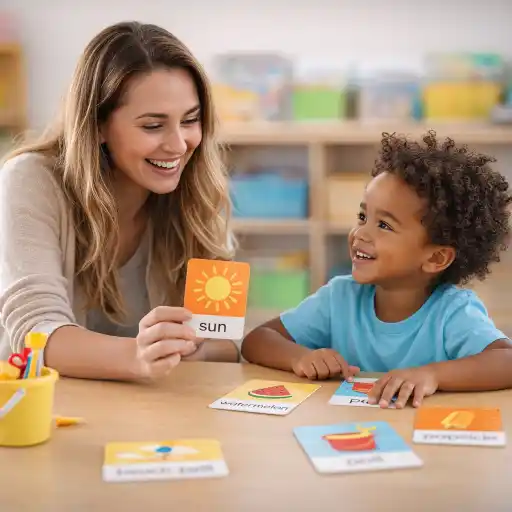
Begin with a small set of picture cards and sorting mats labeled with one, two, and three syllables. The sellable Ice Cream Syllable Sort can serve as a playful center: children choose a familiar summer picture, name it, stretch the word naturally, and place it beside the matching number of ice cream scoops or cones.
Model the thinking process explicitly. Hold up a picture of a popsicle and say, “Popsicle. Let’s listen: pop-si-cle.” Clap once for each spoken part, then count the claps. Invite children to repeat the word and verify the placement. Use the same routine repeatedly so children can concentrate on listening rather than learning new directions.
- Show the picture and name the object.
- Check that children understand the vocabulary.
- Say the word naturally, then slowly enough to hear its parts.
- Clap, tap, or move once for each syllable.
- Place the card on the correct mat and explain why.
Keep the first round brief—perhaps four to six cards. As children gain confidence, add cards with one through four syllables, invite children to explain their choices, or let a child lead the clapping. ChildCareEd’s overview of preschool phonological awareness similarly recommends short, frequent, multisensory practice rather than relying on lengthy lessons.
How can movement and music deepen syllable awareness?
Movement makes an abstract auditory concept visible and memorable. Invite children to hop for each syllable, tap rhythm sticks, pat their knees, or place one scoop of pretend ice cream into a bowl for every beat. The action should correspond directly to the spoken syllable, not simply accompany the word.
Try a “summer sound walk.” Show a card, say the word, and ask children to move to the one-, two-, or three-scoop station. For children who cannot or do not want to travel, offer seated choices such as tapping, pointing, or raising fingers. Multiple response modes allow every child to participate meaningfully.
Songs and chants add repetition and rhythm. A simple chant might be: “Wa-ter-mel-on—three!” Pause before the number so children can supply it. Use children’s names, classroom objects, and seasonal words during transitions. Research published by the Early Childhood Research & Practice journal describes how structured musical activities can support preschool vocabulary development; music is most useful when the educator connects rhythm and repetition to intentional language goals.
- 🎵 Clap the syllables in children’s names before outdoor play.
- Tap a drum for “sun,” “sand-al,” and “wa-ter-mel-on.”
- March to the correct sorting mat after hearing a word.
- Use a quiet finger-tap option for children sensitive to noise.
Remember that music and movement should clarify the target, not create sensory overload. Adjust tempo, volume, and group size according to children’s needs.
How can directors differentiate the activity for diverse learners?
Effective differentiation begins with the words, materials, and response options. Use real objects, photographs, gestures, and picture symbols when possible. Before sorting, introduce unfamiliar terms such as lighthouse or seahorse through conversation or dramatic play. Otherwise, a child may appear to struggle with syllables when the real difficulty is vocabulary.
For dual language learners, invite families to share summer words in the home language. Syllable patterns may differ across languages, but children’s existing awareness is an asset. Start with words that are meaningful and, when appropriate, compare how the same idea sounds in two languages. Massachusetts guidance notes that phonological awareness developed in one language can support learning in another, while also emphasizing the need for explicit support with unfamiliar English sounds.
- Offer picture-only cards for children who are not yet reading.
- Use larger cards, tactile scoops, or adapted grips for motor access.
- Allow pointing, signing, tapping, speech, or a communication device.
- Practice in pairs or groups of four to six when children need more opportunities to respond.
- Provide one-, two-, and three-syllable choices before introducing longer words.
Use strengths-based language: “Let’s listen again,” rather than “That is wrong.” Model the word naturally, invite another attempt, and celebrate careful listening. State requirements vary - check your state licensing agency when documenting professional development or aligning activities with local expectations.
How should providers assess progress and avoid common mistakes?
Assessment can be brief, embedded, and supportive. During the Ice Cream Syllable Sort, record whether a child can name the picture, repeat the word, produce the beats, and select the correct category. These observations help you decide whether the next step is vocabulary development, modeling, additional movement, or more independent sorting.
Use a simple four-column note:
- Vocabulary: names or identifies the picture.
- Segmentation: produces one movement per syllable.
- Counting: identifies the number of parts.
- Sorting: places the card in the correct group.
Repeat the observation with different words and in relaxed contexts. One incorrect response should not define a child’s ability. If a child continues to have difficulty, provide short daily practice and consult your program’s referral procedures when concerns persist.
Common mistakes include presenting too many cards, using unfamiliar vocabulary, turning play into a worksheet, and correcting pronunciation harshly. Avoid asking children to memorize rules; syllable sorting at this level is primarily an oral listening activity. Also avoid assuming that every child will pronounce an English word identically. Focus on the intended sound pattern while respecting language differences.
For a broader professional learning experience, consider Classroom Tools for Emergent Literacy  Buy Now $16.00, which addresses interactive read-alouds, vocabulary supports, labeling, and other classroom practices that complement sound-focused play.
How can the activity become a sustainable summer literacy routine?
Plan a weekly progression rather than using the resource once. In week one, sort one- and two-syllable words with extensive modeling. In week two, add three-syllable words and invite children to lead. In week three, connect the spoken words to drawings, labels, shared writing, or a class chart. This progression preserves play while gradually increasing independence.
Embed the routine across the day:
- At arrival, clap the syllables in a child’s name.
- At snack, sort foods such as melon, berry, and lemonade.
- At outdoor play, count the parts in butterfly, sandbox, or sprinkler. If children are curious about butterflies, extend the conversation with hands-on ideas for exploring their life cycle on National Learn About Butterflies Day.
- During read-alouds, revisit one or two summer words from the story.
- At dismissal, send home a simple family prompt: “Clap the parts in three objects you see.”
Keep a small basket of cards near the dramatic-play area, library, or sensory table. Children can revisit the words independently, while teachers listen for emerging skills during authentic play. Pair the resource with interactive reading and storytelling; the Reading Aloud and Storytelling Buy Now $16.00 course offers additional strategies for strengthening vocabulary, comprehension, and oral language.
Directors can support consistency by giving staff a shared prompt sequence, a brief observation form, and time to reflect on which words engaged children. This makes syllable instruction manageable, observable, and connected to the wider literacy plan.
Conclusion: How can familiar summer vocabulary make syllable instruction more meaningful?
Familiar summer words make syllable instruction concrete, joyful, and accessible. With an Ice Cream Syllable Sort, children can name a meaningful object, hear its parts, represent each part through movement, and classify the word by syllable count. The strongest implementation is explicit but playful: model the process, use multisensory supports, provide multiple ways to respond, honor home languages, and observe progress without pressure.
The central goal is not simply sorting cards. It is helping children notice that spoken words have structures they can hear and discuss. When providers repeat these experiences in play, transitions, music, books, and family routines, they build an important foundation for later literacy while preserving the curiosity and delight that make summer learning memorable.
Frequently asked questions
Should children see the written words?
Begin orally with pictures and objects. Add print intentionally when children are ready, but do not require independent reading to participate.
What if a child cannot pronounce the word clearly?
Model the word naturally and focus on listening and participation. Pronunciation differences may reflect development, language background, or speech needs.
How long should the activity last?
Start with five to ten minutes and stop while children are still engaged. Short, repeated practice is usually more productive than one extended session.
Can the sort support dual language learners?
Yes. Use visuals, gestures, home-language vocabulary, peer support, and words children understand. Invite families to contribute culturally meaningful summer terms.
What additional training can support this work?
The Language and Literacy Foundations in Pre-K Buy Now $16.00 course offers broader professional learning about oral language, communication, and emerging literacy strategies.
- Language and Literacy Foundations in Pre-K
- Emergent Learning & Development
- Play, Learn, Grow
- Staff Supervision, Observation & Feedback
- Creating Environments that Nurture Growth and Community
- Texas Director Credential
- Building Vocabulary
- Effective Coaching & Mentoring in ECE
- Professional Integrity in Child Care
- 💛🧩 ¿Cómo puedo hacer que mi enseñanza sea inclusiva para los niños con autismo?
- Proporciones de Cuidado Infantil y Tamaños de Grupo por Edad en Virginia (Guía Rápida para Centros y Hogares)
- Canciones, juegos y preguntas de círculo para niños
- Cómo simplificar la capacitación para sus empleados de daycare
- Why Are Self-Checking Clip Cards Great for Independent Practice?
- How Can Picture Task Cards Support Emerging Readers?
- How Can You Build a Preschool Literacy Center Without Spending Hours Planning?
- Why Is Beginning-Sound Bingo a Smart Step Toward Reading?
- How Can Songs and Rhymes Build Young Children’s Language Skills?
- How Can Child Care Providers Build Phonological Awareness in Preschool?
- How Can Simple Music and Movement Activities Build Early Literacy Skills?
- How Can Teachers Build Early Literacy Without Screens or Worksheets?
- How Can Camping Themes Expand Preschool Vocabulary?
- How Can Familiar Summer Vocabulary Make Syllable Instruction More Meaningful?
- How Can Child Care Providers Teach Less-Frequent Letters Without Relying on Worksheets Alone?
- How Can Seasonal Picture Sorting Build Phonemic Awareness in Early Childhood?
- ¿Todos los niños deben participar en el tiempo de círculo?
- Why Is Hearing Syllables Different from Naming Letters?
- Teaching Syllables Through Play: What Should Preschoolers Notice?
- Teaching Syllables Through Play: What Should Preschoolers Notice?
