When a preschooler claps the beats in “banana,” they are doing a different kind of literacy work than when they name the letter B—and both skills matter. Build a clearer bridge from sound play to print with Language and Literacy Foundations in Pre-K  Buy Now $16.00, a course that helps providers strengthen everyday listening, speaking, vocabulary, and emerging literacy practices. Keep reading for practical ways to make this distinction meaningful in your classroom, then explore Science of Reading Foundations in the Pre-K Classroom Buy Now $16.00 for a broader look at foundational literacy instruction.
Why are syllables and letter names different kinds of knowledge?
Hearing syllables is an oral-language skill: children attend to the sound structure of a spoken word. Naming a letter is an alphabet-knowledge skill: children recognize a visual symbol and retrieve its conventional name. When children clap “wa-ter-mel-on,” they are segmenting the word they hear into larger sound units. When they point to W and say “double-u,” they are identifying a written character. These tasks involve different information, even though both contribute to early literacy.
Syllable awareness belongs to the wider area of phonological awareness, which concerns recognizing and working with sound units in spoken language. It does not require print. Letter naming, by contrast, depends on looking at a visual form and connecting it to a learned label. A child may be strong at one task and still need support with the other; that difference is not a failure or contradiction.
This distinction matters because adults can accidentally turn a listening activity into a letter quiz. For a syllable task, begin with the spoken word and invite children to listen, tap, or clap. Print can be introduced as a related—but distinct—learning experience once the sound goal is clear.
Why does hearing syllables matter for early literacy?
Syllable awareness helps children notice that spoken words have parts and patterns. Preschoolers can experience those parts through rhythm and movement before they are expected to read or spell. Clapping the beats in a child’s name, tapping a drum for “sun-set,” or stretching “ba-na-na” into parts gives children a concrete way to attend to speech.
Phonological awareness includes several sound-based skills, such as rhyme, syllables, onset-rime awareness, and phonemic awareness. Syllables are larger units than individual phonemes—the smallest sounds that distinguish words. Research and instructional guidance describe syllable awareness as one of the early sound skills that can support later work with smaller units, while also recognizing that development is not identical for every child. The Massachusetts literacy guidance describes phonological awareness as a foundation for blending, decoding, and connecting spoken words to print.
For providers, the practical goal is not to rush children toward formal reading. It is to offer brief, enjoyable opportunities to listen carefully and play with language. These experiences can be built into shared reading, transitions, movement games, and conversation, making sound awareness part of a language-rich #classroom rather than an isolated drill.
How does naming letters differ from hearing sounds?
A letter name is a label for a printed symbol: children see a shape and say its name, such as “M” or “S.” A letter sound is the speech sound commonly represented by that letter in a writing system. These concepts are related but not interchangeable. Saying the name “M” is not the same task as listening for the /m/ sound at the beginning of “moon.”
Letter learning asks children to coordinate visual recognition, memory, and verbal labeling. Syllable listening asks them to attend to spoken language, without needing to see a letter at all. As children encounter print, educators can make intentional connections: “You heard /m/ at the start of moon. Here is the letter M that can represent that sound.” Keep the oral listening objective clear first, then connect it to print when that link supports the learning goal.
Researchers have examined how letter knowledge and syllable awareness relate to children’s understanding of words in print. Mesmer’s study of preschoolers suggests syllable awareness contributes, alongside letter knowledge and beginning-sound awareness, to developing a concept of word in print. This is a reason to nurture both strands—not to treat letter naming as a substitute for careful listening, or syllable activities as a replacement for alphabet instruction.
How can providers teach syllables through play?
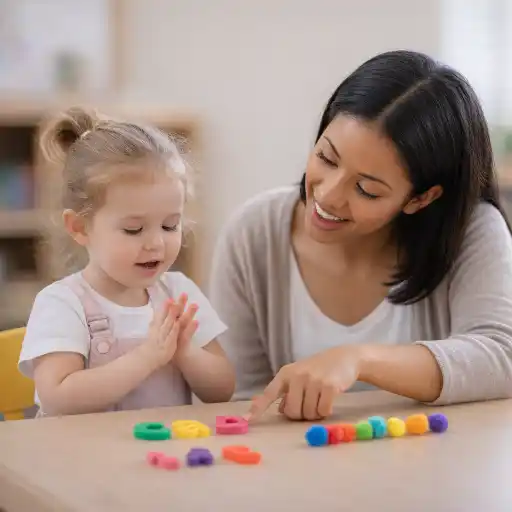
Start with familiar spoken words and model the process. Say the word naturally, repeat it at a comfortable pace, and make one clear movement for each syllable. Children can clap, tap a knee, move a counter, or place one scoop on a pretend ice-cream cone. A picture-based Ice Cream Syllable Sort Buy Now $1.49 offers a playful way to say each pictured word, clap its parts, and sort it under a one-, two-, or three-syllable cone.
- Choose common words children know, such as “sun,” “picnic,” and “watermelon.” Check vocabulary before asking children to sort.
- Model aloud: “Picnic—pic-nic. I hear two parts, so I’ll tap twice.”
- Let children respond in different ways: clapping, pointing, tapping, signing, or using a communication device.
- 🎵 Add rhythm with a quiet drum, finger taps, or a familiar chant; adjust volume and movement to children’s needs.
- Keep practice brief and repeat it in daily routines—names at arrival, food words at snack, or story words during read-aloud.
Activities such as the NAEYC examples of word play show how sound-focused practice can fit naturally into classroom routines. Make the activity about listening rather than reading: picture cards and real objects are often more useful than printed word labels when the target is syllable awareness.
How can educators support different learners and observe progress?
Children bring different language experiences, vocabularies, speech patterns, and ways of communicating. A child who is learning English may already have sound-awareness skills in a home language, while some sound patterns differ between languages. Invite families to share familiar words, songs, and rhymes. Use meaningful vocabulary, gestures, photographs, and objects, and allow children to demonstrate understanding without requiring a spoken answer every time.
Observe a specific behavior rather than judging a child’s overall literacy ability. During a game, note whether the child can identify the picture, repeat or attend to the word, produce a movement for each syllable, and sort it by number of parts. If a response is unclear, model the word and offer another relaxed opportunity. One missed answer is only one observation, not a conclusion about a child’s development.
Common pitfalls are easy to avoid: do not confuse letter naming with sound awareness, use unfamiliar words without explaining them, insist that every child respond by clapping, or treat variation in pronunciation as lack of understanding. Offer multiple entry points and gentle repetition. When concerns persist across settings and activities, document patterns and follow your program’s process for partnering with families and consulting appropriate specialists. State requirements vary - check your state licensing agency.
Conclusion: How can providers keep sound and print learning distinct?
Hearing syllables and naming letters are different because one focuses on spoken sound parts and the other on recognizing and labeling written symbols. Children benefit when providers understand the difference, teach each skill intentionally, and connect sound to print without blending the objectives. Syllable games can begin with the ear, voice, rhythm, and movement; alphabet experiences can focus on identifying letter forms and names.
In practice, choose familiar words, model listening, offer flexible ways to respond, and observe what children can do over time. Playful routines such as the Ice Cream Syllable Sort Buy Now $1.49 make sound structure tangible, while thoughtful connections to letters extend learning when appropriate. For additional professional learning, explore ChildCareEd’s Reading Aloud and Storytelling Buy Now $16.00, Assessment of Language and Literacy Skills Buy Now $24.00, and Language Development in Early Childhood Buy Now $16.00. Together, these practices help providers nurture children’s #listening, #language, #literacy, and growing curiosity about words.
- CDA Certification en Español: Recursos y Consejos para Educadores Bilingües
- 🌙 ¿Cómo afecta el tiempo frente a las pantallas el sueño y el comportamiento infantil? 😴
- 🥦✨ ¿Cómo apoyar a los niños selectivos a probar nuevos alimentos sin presión?
- Qué capacitación se requiere para ser director de cuidado infantil en Texas?
- Requisitos Para Ser Maestra Principal En Un Daycare: Lo Que Necesitas Para Empezar
- Que es Título 22 en California?
- ¿Cuáles son las mejores actividades del Día de la Tierra para niños en casa o en el aula?
- ¿Cuál es la diferencia entre un certificado CDA y la credencial CDA?
- ¿Cómo puedo usar escenarios de juego de roles de primeros auxilios en mi aula?
- 10 Ejemplos de Cómo la Cultura Influye en el Desarrollo Infantil
- ¿Cómo solicito la licencia para una guardería en California?
- Regulaciones de Licenciamiento de Cuidado Infantil en California para Centros y Hogares de Cuidado Infantil Familiar
- Cómo Trabajar en el Cuidado Infantil en Georgia: Requisitos y Pasos
- Cómo Trabajar en el Cuidado Infantil en California: Requisitos y Pasos
- Cómo Ser Maestra de Preescolar en Wisconsin
- Cómo simplificar la capacitación para sus empleados de daycare
- Why Is Beginning-Sound Bingo a Smart Step Toward Reading?
- Why Is Hearing Syllables Different from Naming Letters?
- Teaching Syllables Through Play: What Should Preschoolers Notice?
