When preschoolers clap, tap, or sort a word into its spoken beats, they are building an early literacy skill without needing to read a single letter. The Science of Reading Foundations in the Pre-K Classroom Buy Now $16.00 course offers a broader look at phonological awareness and other early literacy foundations; for practical support in designing developmentally appropriate activities, explore Lesson Planning for Preschoolers  Buy Now $24.00. Keep reading for ways to make a playful syllable activity purposeful, inclusive, and easy to weave into your classroom day.
Why should preschoolers notice syllables through play?
Syllables are the spoken beats or parts in a word. When children hear and count those parts, they are practicing syllable awareness, one component of phonological awareness—the ability to notice and work with the sound structure of spoken language. This learning is auditory and oral: children can listen, speak, move, and play with words before they are expected to connect sounds with print.
Play gives young learners a meaningful reason to attend to sound. A familiar word such as “sun,” “sandal,” or “watermelon” can be spoken, stretched naturally, and represented with a clap or tap. The goal is not to memorize a rule or deliver a perfect performance. It is to notice that words have parts, listen carefully, and try different ways to represent what is heard.
These experiences contribute to a wider language-rich environment and provide a foundation for later literacy learning. As NAEYC describes in its guidance on playful phonological awareness, educators can weave sound play into planned activities and everyday routines. Short, repeated opportunities can help children participate with growing confidence.
What should children listen for when sorting syllables?
In a preschool syllable-sorting activity, children can focus on three connected ideas: the word they hear, its spoken parts, and the number of parts they can count. A syllable is a unit of sound in speech, often organized around a vowel sound. For a young child, however, a simple cue such as “listen for the beats” is usually more useful than a technical definition.
Use clear, familiar examples and say the whole word before emphasizing its parts. For instance, say “sun,” then “san-dal,” then “wa-ter-mel-on.” Invite children to clap or tap once for each part and count the actions together. Remember that syllable boundaries in speech are not a spelling lesson; preschoolers can work entirely with spoken language and picture prompts.
- One spoken beat: “sun” or “shell.”
- Two spoken beats: “sand-al” or “pic-nic.”
- Three spoken beats: “wa-ter-mel-on” or “lem-on-ade.”
Pronunciation can vary across speakers and languages, so listen to the word as the child says it rather than insisting that every response sound identical. When children are unsure, model the word gently and invite them to try again. Careful listening—not speed—is the meaningful work.
How can you make an Ice Cream Syllable Sort engaging and purposeful?
A themed sorting game gives children a concrete way to connect a word’s sound pattern with a category. In ChildCareEd’s Ice Cream Syllable Sort Buy Now $1.49, children cut out picture scoops, say each pictured word, clap its syllables, and place or glue each scoop under a cone labeled for one, two, or three syllables. A bonus “Your Turn” page invites children to think of and sort their own words.
Before beginning, check that children recognize or understand the pictured objects. If the vocabulary is unfamiliar, introduce it first with a picture, gesture, or real object. Then model one complete turn: name the picture, say the word naturally, clap each spoken part, count the claps, and explain where the card belongs. Starting with a few cards keeps the task manageable and leaves room for conversation.
- Show one picture and invite children to name it or identify it.
- Say the word, then repeat it slowly enough for the spoken parts to be heard.
- Clap, tap, or move once for each syllable.
- Count the movements together and place the picture in the matching group.
- Ask, “What did you hear?” rather than turning the response into a test.
The printable works best as one option in a playful routine—not as a substitute for active interaction. You can sort at a small-group table, use pretend scoops and cones in dramatic play, or invite children to choose a word for the group.
How can movement and music help children hear the beats?
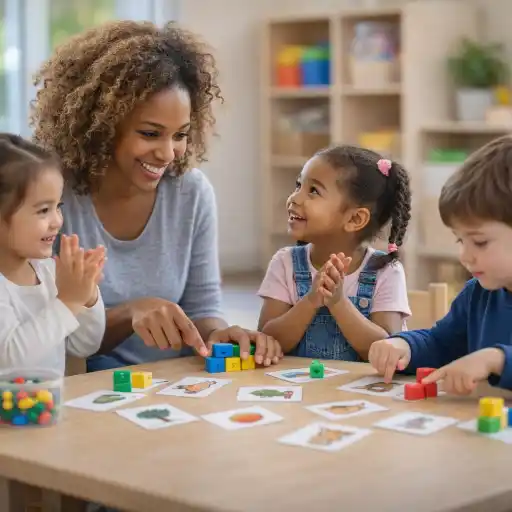
Movement makes an auditory pattern tangible. A clap, knee tap, hop, drumbeat, or pretend scoop can stand for one spoken syllable. Pair the movement directly with the word so children can connect what they hear with what they do. If the group is energetic, let children move to a sorting station; if a child prefers a quieter response, offer seated tapping, finger movements, or pointing.
- 🎵 Clap the parts in children’s names before transitioning to outdoor play.
- Tap rhythm sticks once for each part in “sun,” “san-dal,” and “wa-ter-mel-on.”
- Invite children to march to the one-, two-, or three-beat picture group.
- Use a quiet finger tap or visual choice for children who are sensitive to sound or movement.
Songs and chants add enjoyable repetition, but keep the target clear. Pause before counting the beats in a familiar word so children have time to listen and respond. NAEYC’s word-play guidance highlights movement, music, books, and creative expression as possible contexts for intentional sound activities. Adjust volume, tempo, and group size to suit the children; more stimulation is not always more useful.
How can you include children with different language and learning needs?
Children bring different vocabularies, communication styles, language backgrounds, and motor abilities to a group activity. Provide more than one way to participate: a child might say the word, point to a picture, sign, tap a drum, show fingers, use a communication device, or watch a model before trying. These are meaningful ways to engage with the sound task.
For dual language learners, welcome words from home languages and invite families to contribute familiar vocabulary or songs. The sound patterns of a word may differ from language to language, and a child’s home-language knowledge is an asset. When the English word is new, teach its meaning first; otherwise, a vocabulary gap may look like difficulty hearing syllables.
- Use large, clear pictures or real objects, and introduce unfamiliar names before sorting.
- Offer one-, two-, and three-syllable choices before adding longer or less familiar words.
- Adapt materials with larger cards, tactile pieces, or accessible tools when helpful.
- Practice in pairs or a small group so each child has time to respond.
Use strengths-based prompts such as, “Let’s listen again,” or “Show me how you heard the parts.” Avoid making pronunciation a measure of understanding. If concerns about a child’s communication or development persist, document observations and follow your program’s established procedures for partnering with families and seeking guidance. State requirements vary - check your state licensing agency when aligning activities or professional development with local expectations.
How can educators observe learning and avoid common pitfalls?
Assessment can happen naturally while children play. Notice whether a child identifies the picture, attempts the word, represents each spoken part with a movement, counts the movements, and sorts the card. These observations help you decide what support to offer next: vocabulary introduction, another model, a different movement, or an opportunity to sort more independently.
- Vocabulary: Does the child recognize or name the picture?
- Listening and segmenting: Does the child make one movement for each spoken part?
- Counting: Can the child identify how many parts were represented?
- Sorting: Can the child choose a matching category, with or without support?
Record specific examples and revisit the skill with different familiar words. A single response is only a snapshot, not a judgment about a child’s ability. Common pitfalls include using too many cards at once, choosing unfamiliar vocabulary, relying only on worksheets, and correcting children harshly. Keep the activity brief, model patiently, and treat mistakes as useful information about what to teach next.
Directors can help staff make the practice sustainable by agreeing on a simple prompt sequence, sharing accessible materials, and setting aside time to reflect on children’s responses. For added professional learning, Classroom Tools for Emergent Literacy Buy Now $25.00 explores classroom strategies such as interactive read-alouds and literacy materials, while Reading Aloud and Storytelling Buy Now $16.00 focuses on using stories to support early language and literacy.
Conclusion: What should preschoolers notice when learning syllables through play?
Preschoolers should notice that spoken words have parts they can hear, represent, count, and compare. Playful routines such as the Ice Cream Syllable Sort make that idea concrete: children name a picture, listen for its beats, move once per part, and place it in a group. Keep the focus on listening and oral language, with familiar words, brief practice, and patient modeling.
Offer multiple ways to respond, honor children’s home languages, and observe progress without turning the activity into a test. By repeating sound play across songs, transitions, stories, and centers, providers can make syllable awareness a joyful part of everyday teaching—and plan each experience with a clear purpose.
- Understanding Print Knowledge in Preschool
- Science of Reading Foundations in the Pre-K Classroom
- 45 Hour Preschool Methods and Materials
- DAP for Preschool
- Birth to Five CDA Credential with Portfolio Review
- Pediatric RSV First Aid & CPR/AED
- CDA Bridge Bundle: Preschool without Portfolio Review
- Creating Environments that Nurture Growth and Community
- Classroom Tools for Emergent Literacy
- Supporting Families and Caregivers in Language and Literacy
- CDA Certification en Español: Recursos y Consejos para Educadores Bilingües
- 😫🧸 ¿Qué hacer cuando un bebé no quiere dormir la siesta en el aula?
- ¿Cómo puedo usar escenarios de juego de roles de primeros auxilios en mi aula?
- ¿Cómo puedo enseñar habilidades de primeros auxilios con escenarios de juego de roles?
- Actividades de Motricidad Gruesa que Desarrollan el Equilibrio, la Coordinación y la Fuerza
- Actividades de Otoño Fáciles para Preescolares esta Temporada
- What are fun language-learning games preschool teachers can use?
- Celebrando la amistad en el cuidado infantil durante el Día de los Mejores Amigos
- How can preschool programs build early literacy every day?
- First Week of Preschool Lesson Plans: 5 Days of Easy Activities and Routines
- How Can Sound Bingo Sharpen Listening Skills in Preschoolers?
- Why Do Predictable Books Help Preschoolers Feel Like Readers?
- How Can Teachers Build Early Literacy Without Screens or Worksheets?
- How Can Printable Books Help Preschoolers Fall in Love With Reading?
- What Should a 3-Year-Old Be Learning at Preschool?
- What Speech and Language Milestones Should Child Care Providers Know?
- How Can Shape Vocabulary Strengthen Early Reading Practice?
- How Can Transportation Interests Motivate Beginning Readers?
- Teaching Syllables Through Play: What Should Preschoolers Notice?
- Teaching Syllables Through Play: What Should Preschoolers Notice?
