What if a two-minute song could turn a transition, diaper change, or cleanup into meaningful language practice? Songs and rhymes give children repeated, memorable opportunities to listen, imitate, predict, and communicate; for deeper guidance, explore Mind's Medicine: Music in Early Childhood  Buy Now $16.00 to strengthen your planning of developmentally appropriate musical experiences. Providers who want a broader literacy foundation may also benefit from Language Development in Early Childhood Buy Now $16.00, which offers practical strategies for supporting verbal and nonverbal communication and may help meet applicable professional-learning goals.
Why do songs and rhymes matter for language development?
Songs and rhymes organize language into predictable patterns. Melody, rhythm, repetition, and gesture slow spoken language down and make its structure easier for young children to notice. A familiar refrain also lowers the pressure to produce original speech: children can hum, move, fill in a word, or participate through eye gaze and gestures before they are ready to sing independently.
This is particularly valuable because language learning depends on responsive interaction, not simply exposure. When an educator pauses, watches for a response, and expands a child’s attempt, the song becomes a shared conversation. Research on infant-directed singing suggests that musical interaction can attract attention, support pattern processing, and contribute to early vocabulary learning. Preschool research likewise reports gains in receptive vocabulary when musical activities intentionally connect sounds with movement and visual cues.
- Vocabulary: repeated words become easier to understand and use.
- Listening: children practice attending to changes in tempo, pitch, and words.
- Memory: melody and repetition provide retrieval cues.
- Phonological awareness: rhyme and syllable patterns help child
The goal is not performance quality. It is frequent, joyful participation that makes language meaningful. As guidance from songs and stories in toddler language development emphasizes, short and repeated interactions can support vocabulary, memory, narrative growth, and early literacy.
How can providers choose songs that support specific language goals?
Begin with the language you want children to hear and use. Rather than selecting a long playlist, choose a small repertoire and identify one or two teachable targets for each song. A greeting song might highlight names and feelings; a body-part song can reinforce nouns and action verbs; a counting rhyme can combine number words with one-to-one correspondence.
Effective songs generally have a clear structure, repeated phrases, and opportunities for children to respond. Consider the group’s developmental level, cultural context, communication styles, and sensory needs. Infants may benefit from gentle face-to-face songs with pauses. Toddlers often engage with gestures, object cues, and predictable endings. Preschoolers can experiment with rhyming substitutions, syllable clapping, and invented verses.
- For vocabulary, choose one or two concrete words such as cup, more, open, or fast.
- For grammar, emphasize repeated sentence frames: “The wheels go round,” or “I see a ___.”
- For sound awareness, select songs with clear rhyme, alliteration, or syllable patterns.
- For narrative language, use songs with a sequence, problem, action, and ending.
- For social communication, use call-and-response and turn-taking songs.
Use children’s names, family traditions, and home languages whenever possible. A song is more powerful when it reflects children’s lives. Avoid choosing music only because adults find it entertaining; identify the learning purpose and observe whether children can participate meaningfully.
How can educators turn singing into interactive language practice?
Interactive singing requires more than pressing play. Face children when possible, sing at a manageable pace, pair words with gestures, and leave intentional space for responses. These strategies make children active contributors rather than passive listeners.
- Model: sing the verse while showing the movement or prop.
- Invite: encourage children to join in through voice, gesture, sign, instrument, or movement.
- Pause: stop before a predictable word and wait several seconds.
- Expand: respond to the child’s attempt: “You said ‘bus.’ Yes, the big bus is moving.”
- Repeat: sing the same song again later, changing only one feature.
Use props strategically. A toy duck, picture card, scarf, or felt-board piece can connect an unfamiliar word to a visible referent. For toddlers, teach one or two target words rather than explaining every word in the song. For preschoolers, ask questions that invite thinking: “What might come next?” “Which words sound alike?” or “How could we make a new verse?”
Movement is also a language scaffold. Children can clap syllables, stomp to a beat, stretch for “high,” crouch for “low,” or freeze when they hear a target word. These embodied experiences help make abstract sound and meaning relationships concrete. Include children who communicate without speech by accepting pointing, signs, vocalizations, switches, and eye gaze as valid responses.
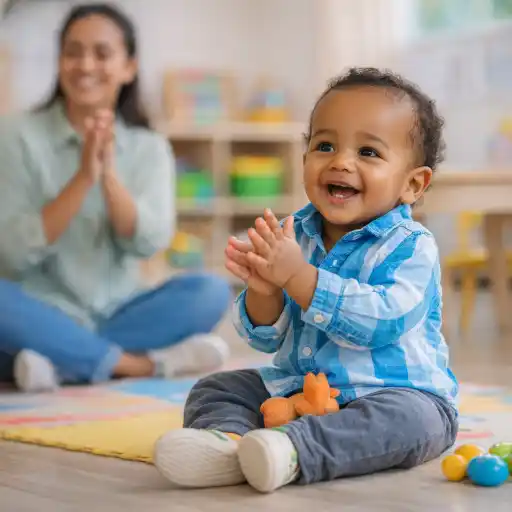
How can songs and rhymes strengthen phonological awareness and early literacy?
Phonological awareness involves noticing and manipulating the sound structure of spoken language. It develops through listening and playful oral language before children need to read printed words. Rhymes are especially useful because they draw attention to similarities and differences in word endings, while rhythm makes syllables easier to feel and count.
NAEYC describes developmentally appropriate word play involving rhyming, alliteration, sentence segmentation, syllabification, onset-rime blending, and phonemic awareness. Songs provide a natural setting for these skills because children can hear, say, move, and repeat sounds without a worksheet.
- 🎵 Clap names: clap once for each syllable in children’s names or theme words.
- Complete the rhyme: pause before a predictable ending and let children supply it.
- Find the rhyme: offer two picture choices and ask which matches the song’s ending sound.
- Change one word: replace a song word with a silly rhyming word.
- Hear alliteration: create phrases such as “Mia moves” or “sleepy snakes.”
- Connect sound and print: occasionally point to a repeated word or display a song chart.
Keep the progression playful and responsive. Do not require children to identify individual phonemes before they are developmentally ready. Begin with participation, rhythm, rhyme recognition, and syllables; gradually introduce more complex sound work as children show interest and readiness. A child who listens closely, taps the beat, or fills in the final word is already engaging in meaningful literacy learning.
How can directors and providers include every child and family?
Inclusive musical practice recognizes that children participate in different ways. One child may sing loudly; another may watch, tap, sign, use a communication device, or join only for a familiar phrase. These differences are not failures. They are information about how each child accesses communication and comfort.
- Offer seated, standing, and low-movement versions of activities.
- Use visual schedules, picture cards, gestures, and objects alongside spoken directions.
- Adjust volume, tempo, and instrument choices for children with sensory sensitivities.
- Provide quiet space and predictable warnings before loud or fast songs.
- Invite children to lead a gesture, choose a song, or hold a prop.
- Include songs, rhymes, and lullabies from children’s families and communities.
Home languages are assets. Invite families to share a short song, pronunciation, or rhyme, and display multilingual words in the music area. Children may respond in any language; educators can affirm the response and add an English translation when appropriate. Supporting more than one language does not require eliminating the home language. It strengthens identity, connection, and opportunities for meaningful communication.
Directors can support consistency by creating simple song cards that list the learning goal, target vocabulary, materials, adaptations, and observation prompt. State requirements vary - check your state licensing agency, particularly when documenting professional learning or planning activities involving equipment, supervision, and noise.
How can programs plan, observe, and improve song-based learning?
A practical routine can be small and consistent. Choose one welcome song, one transition or action song, and one calming song. Repeat them across the week so children can anticipate the language. Add a short rhyme or sound game during snack, outdoor play, or book time. Integration is more sustainable than creating a separate music lesson every day.
Use an intentional planning cycle:
- Identify a goal: for example, children will use the word more or clap two-syllable words.
- Select a song: choose a predictable tune with a natural opportunity to practice the goal.
- Plan access: decide how children can respond through speech, movement, signs, pictures, or instruments.
- Observe: note participation, imitation, target-word use, turn-taking, or sound awareness.
- Adjust: shorten the activity, repeat it, simplify the target, or add a visual cue.
Avoid common mistakes such as introducing too many new words, singing for too long, correcting every error, forcing participation, or using music only as background noise. Instead, teach one small target, allow wait time, and treat approximations as progress. Brief observation notes can guide future planning without turning joyful music into a test.
For additional professional learning, consider Reading Aloud and Storytelling Buy Now $16.00 to connect oral language with interactive books and narrative development, Building Vocabulary Buy Now $16.00 for intentional word learning, and Building Bridges for Dual Language Learners Buy Now $16.00 for culturally and linguistically responsive practice.
Conclusion: What is the most effective way to use songs and rhymes?
The most effective approach is brief, repeated, interactive, and purposeful. Choose songs with clear language patterns, connect words to movement and meaningful objects, pause for children’s responses, and revisit familiar songs across daily routines. Use rhymes to build vocabulary, listening, memory, narrative understanding, and phonological awareness while honoring every child’s communication style and home language.
Start tomorrow with one greeting song, one target word, and one intentional pause. Watch what children do, build on their attempts, and share the song with families. When providers use music as a responsive relationship rather than background entertainment, ordinary moments become powerful opportunities for #language, #rhythm, #vocabulary, #literacy, and #belonging.
- CDA Home Visitor Subject Area 2 Part 3 Birth to 5
- Positive Attention: Interactions and Supervision of Infants and Toddlers: For Workforce Solutions
- The ABCs of Behavior: Turning Challenges into Learning Opportunities
- Pediatric RSV First Aid & CPR/AED
- Positive Attention: Interactions & Supervision for Infants & Toddlers
- Sensitive Periods in Montessori: Guiding Natural Learning
- Supporting Families and Caregivers in Language and Literacy
- Language Development in School Age
- Resources: Building Blocks to Excellence
- Language for Our Littlest Learners: Building Communication From the Start
- How to Foster Early Literacy Skills
- How Can Teachers Support Language and Literacy Every Day?
- How can child care providers use the science of reading to boost early literacy in New York?
- How Do Early Language Skills Affect a Child's Success in School?
- What are fun language-learning games preschool teachers can use?
- Canciones, juegos y preguntas de círculo para niños
- What simple early literacy activities really work for preschoolers?
- How can North Dakota child care programs lay reading foundations the right way?
- How can songs and stories encourage toddler language development?
- Can we build early literacy skills through play in high-quality child care?
- How can child care programs build strong readers before kindergarten?
- How can child care providers build early literacy skills through play?
- Is Your Child Ready for Kindergarten? A Kindergarten Readiness Checklist
- How Can Songs and Rhymes Build Young Children’s Language Skills?
- How Can Child Care Providers Build Phonological Awareness in Preschool?
- How Can Simple Music and Movement Activities Build Early Literacy Skills?
- What Speech and Language Milestones Should Child Care Providers Know?
