Can one playful November invitation bring letter learning, creativity, and classroom community together? A “Hats, Hands, and Helping” experience gives preschoolers meaningful ways to notice the letter H while talking, making, and cooperating. For a ready-to-use sequence of letter activities, explore ChildCareEd’s The Letter H Teaching Guide: Happy Helpers for Preschool and Kindergarten Buy Now $1.75; for deeper professional learning on language-rich classroom practice, consider the Language and Literacy Foundations in Pre-K course  Buy Now $16.00. The guide supports practical planning, while the course helps strengthen your knowledge of language, communication, and emerging literacy.
November can be a busy month, and providers often need activities that feel joyful without adding complicated preparation. A simple letter H invitation can connect familiar objects—hats and hands—with meaningful acts of helping. Children may trace an H, talk about a hat, make a handprint, listen for /h/, or offer an idea for helping a classmate. These experiences are adaptable for different ages, communication styles, and abilities.
Why connect letter learning with helping?
Preschool literacy grows through more than worksheets or isolated letter drills. Children build early knowledge as they hear language, notice print, talk about ideas, listen to others, and experiment with marks and letter shapes. A letter H theme provides an accessible focus for these experiences: children can connect the visible letter with the sound they hear in words such as hat, hand, and help.
Adding helping gives the theme a social purpose. Children can talk about what helpers do, notice their own contributions, and practice cooperative language in real classroom routines. This is not about expecting preschoolers to perform a perfect act of kindness; it is about noticing everyday care and giving children opportunities to participate in ways that suit them.
Playful literacy experiences can combine conversation, movement, art, and sound awareness. NAEYC describes how play and intentional educator interactions support early literacy learning, while Reading Rockets recommends integrating phonological awareness and interactive reading into daily practice. Together, these ideas offer a useful reminder: keep the learning goal clear, but let children approach it through active, meaningful experiences.
How can you introduce the letter H through hats and hands?
Begin with a small group gathering and a few familiar objects: a hat, a hand mirror, a picture of a house, or a toy horse. Show uppercase H and lowercase h, name each letter, and invite children to look for the two vertical lines joined by a horizontal line. Keep the introduction brief and conversational; children do not need to master letter formation in one sitting.
Say /h/ clearly and naturally, without adding an extra vowel sound. Stretch the breathy sound gently, then connect it to familiar vocabulary: “Hat starts with /h/. Can you feel the soft breath when you say it?” Invite children to suggest other words, accepting approximations and modeling the word back when needed.
- Offer hats for sorting, trying on, describing, or drawing. Ask open prompts such as “What might someone wear this hat for?”
- Trace a large H in the air, on a tabletop, or in a tray of a safe sensory material.
- Compare uppercase H and lowercase h using large, high-contrast cards.
- Use a mirror or hand outline to notice what hands can do: wave, hold, point, build, and help.
- 🧢 Invite children to choose how to participate—talk, point, gesture, draw, build, or watch before joining.
For a simple printable practice option, ChildCareEd’s Letter H activity Buy Now $0.00 connects the uppercase letter H with the word “hat” and offers tracing and visual recognition practice. Use it as one choice among several, rather than the entire lesson.
How can a letter H invitation become a language-rich experience?
Build the invitation around interaction, not a long teacher explanation. During a short read-aloud or picture walk, pause when children notice an H word or an illustration that connects with helping. Ask questions that invite more than a one-word answer: “What do you notice about the hat?” “How might this person help?” or “What could the character try next?” Follow the child’s answer with a related comment or a new word, rather than rapidly moving through a list of questions.
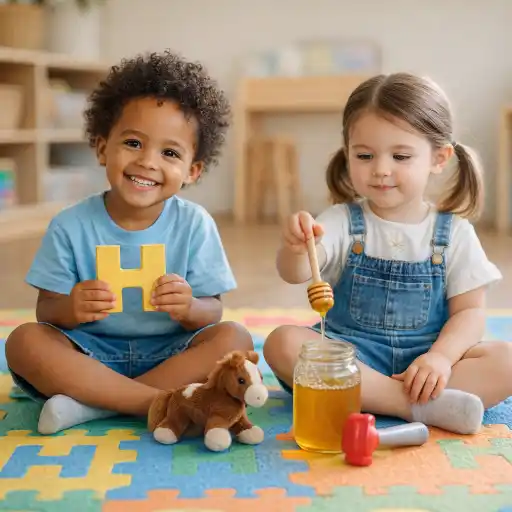
Children can dictate a class “Happy Helpers” message, label a drawing with an adult’s support, or make a picture card for someone who contributes to the classroom. Some may write H-like marks; others may dictate, select a picture, or communicate with gestures or assistive tools. These are all meaningful forms of participation. The goal is to connect oral language, print, and children’s ideas in an authentic context.
Sound play can happen throughout the day. Invite children to listen for /h/ in a short set of familiar words, clap the syllables in “help-er,” or notice when two words begin with the same sound. Keep the practice light and responsive; if a word is unfamiliar, explain it with an object, picture, or action. ChildCareEd’s article on phonological awareness in early childhood education outlines playful ways to notice sounds, rhymes, and word parts. NAEYC also offers examples of word play throughout the day, including movement, books, and conversation.
How can helping be practiced without forcing participation?
Helping is most meaningful when children have agency and a real, manageable role. Invite them to contribute to everyday classroom life: carry a book to the shelf, pass a clean napkin, water a plant with supervision, or help a peer find a missing block. Model a specific phrase such as, “Would you like help?” and teach children to respect a “no” or a different preference. Helping should feel collaborative, not like a demand or a reward children must earn.
Use a “Happy Helpers” dramatic-play area to extend the letter theme. Add play hats, dolls, simple tools, picture cards, and pretend notes. Children might act out caring for a toy, building a house, or welcoming someone to a pretend classroom. Narrate the language you hear—“You offered the hat, and your friend chose the blue one”—so children can connect actions with communication and cooperation.
Offer different routes into the activity. A child may choose materials, point to a picture, imitate an action, observe first, or join alongside an adult. For children who use home languages or communicate without speech, include familiar words, visuals, gestures, and communication supports. The goal is not identical participation; it is meaningful access and belonging for each child.
- Demonstrate one helpful action at a time and describe it in simple, respectful language.
- Offer choices rather than assigning a child a permanent “helper” identity.
- Notice effort specifically: “You held the basket while we put the books away.”
- Make room for children to decline, pause, or return later.
How can you adapt activities and notice learning?
Plan for a range of skills from the start. Use large materials for children who benefit from easier grasping, sturdy picture cards for matching, and tactile or movement-based options for children who learn best through hands-on exploration. Reduce the number of objects if a busy sensory arrangement is distracting, and offer a quieter place or a brief pause when needed. For children learning English alongside another language, invite family-informed vocabulary and pair words with images, objects, and gestures.
Observe what children do and say rather than expecting a single correct performance. A child might recognize H on a sign, hear /h/ in “hat,” attempt the letter shape, use a new word, or suggest a way to help. Capture brief notes or a work sample, then use those observations to decide what to offer next. One child may be ready to compare H and h; another may benefit from repeated listening and word-picture matching.
Keep the activity welcoming and safe. Check materials for age suitability, supervise small objects and art tools, and follow program procedures for allergies and sanitation if food is part of the plan. Avoid treating a completed craft as proof of learning or comparing children’s letter formation. State requirements vary - check your state licensing agency if your activity raises questions about materials, supervision, or program rules.
Conclusion: What makes a November Letter H invitation successful?
A successful “Hats, Hands, and Helping” invitation combines a clear literacy focus with joyful, flexible participation. Introduce uppercase H and lowercase h, connect the letter to familiar /h/ words, and weave sound play, conversation, books, art, and dramatic play into the day. Let helping emerge through authentic classroom routines and cooperative pretend play, while honoring children’s choices and communication styles.
The central question is how a November letter invitation can support more than letter recognition. The answer is to make learning purposeful and connected: children notice print and sounds, express ideas, practice new vocabulary, and experience themselves as valued members of a group. Use observation to adjust the next step, and treat every attempt as information about how a child is learning. The ChildCareEd teaching guide can help you organize letter-focused activities, while the Language and Literacy Foundations in Pre-K course offers a fuller professional learning experience for strengthening everyday language and literacy practice.
Five useful ChildCareEd courses for continued learning
- Language and Literacy Foundations in Pre-K Buy Now $16.00 — strategies for language-rich interactions and emerging literacy.
- Science of Reading Foundations in the Pre-K Classroom Buy Now $16.00 — foundational topics including alphabet knowledge, vocabulary, and phonological awareness.
- Reading Aloud and Storytelling Buy Now $16.00 — practical ways to use shared stories to support communication and comprehension.
- Building Vocabulary Buy Now $16.00 — understanding vocabulary growth and enriching learning experiences.
- Inclusive Lessons for Preschoolers Buy Now $16.00 — approaches for adapting activities so children can participate in different ways.
- CDA Home Visitor Subject Area 3 Part 3 Birth to 5
- Birth to Five CDA Credential with Portfolio Review
- Working Together: Teachers & Preschoolers
- CDA Bridge Bundle: Preschool without Portfolio Review
- Lesson Planning for Preschoolers
- Texas Director Credential Renewal
- Texas Director Credential
- Letter & Number Planning in Child Care
- 45-Hour Infant and Toddler Curriculum
- CDA Certification en Español: Recursos y Consejos para Educadores Bilingües
- ¿Cómo empiezo mi certificación CDA en Florida en línea?
- Cómo Crear Tu Portafolio CDA Paso a Paso
- Proporciones de Cuidado Infantil y Tamaños de Grupo por Edad en Maryland (Guía Rápida para Centros y Hogares)
- Cómo Trabajar en el Cuidado Infantil en Carolina del Norte: Requisitos y Pasos
- Celebrando la amistad en el cuidado infantil durante el Día de los Mejores Amigos
- Canciones, juegos y preguntas de círculo para niños
- How Can You Plan a November Preschool Curriculum Around Gratitude and Community?
- How Can November STEM Activities Encourage Curiosity and Discovery?
- How Can November Classroom Observations Guide Developmentally Appropriate Activities?
- How Can November Progress Updates Build Stronger Parent-Teacher Relationships?
- What Simple November Activities Build Cooperation and Social Skills?
- How Can November Classroom Activities Help Preschoolers Build School Readiness Skills?
- What Should You Keep in the Classroom After Halloween Ends?
- How Can Child Care Providers Encourage Cooperative Play in November?
- How Can Child Care Providers Strengthen Family Engagement in November?
- How Can Everyday November Routines Grow Cooperative Play?
- How Can a November Letter H Invitation Help Preschoolers Learn, Create, and Help?
- How Can Child Care Programs Make November Family Updates Easier to Follow?
- How Can Woodland Mail Make Fall Dramatic Play a Meaningful Writing Experience?
