Fall cleanup can be more than a seasonal chore: it can help children classify, count, communicate, and care for a shared space. Explore Creating the Natural Outdoor Classroom  Buy Now $16.00 for practical guidance on planning engaging outdoor experiences, and consider Early Mathematics Through Play Buy Now $24.00 to strengthen the math connections in everyday routines. A few purposeful roles and safe, age-appropriate tasks can turn a yard reset into meaningful learning.
Why does fall cleanup matter as a learning experience?
When children help gather and return outdoor materials, they do more than make the yard look orderly. They notice similarities and differences, decide where items belong, follow a sequence, and coordinate with others. Sorting fallen leaves by color or collecting large, safe play items by type gives children a concrete reason to use mathematical language such as same, different, more, fewer, and group.
The teamwork is just as valuable. Children practice waiting, negotiating roles, asking for help, and contributing to a common goal. These are genuine social skills, not extras added after the “real” lesson. Outdoor play itself offers opportunities for exploration, collaboration, movement, and discovery, as described in NAEYC’s discussion of outdoor play and healthy development. A seasonal cleanup can extend those experiences while helping children build a sense of belonging and responsibility.
Keep the purpose developmental rather than perfectionistic. Children are learning the routine; they are not responsible for completing adult maintenance. A child’s careful attempt to place a basket or match objects to a picture label matters more than finishing quickly. Treating children as capable contributors supports #independence and makes repeated routines more purposeful.
How can you plan safe, manageable cleanup jobs?
Before inviting children to help, inspect the outdoor area and decide which tasks are appropriate for them. Make the work visible and limited: one small zone, a few clear jobs, and containers that children can carry without strain. The goal is to offer real participation while adults maintain responsibility for hazards, sanitation, and supervision.
- Choose safe, familiar items: large toys, balls, sturdy baskets, or clean, dry leaves that are appropriate for the group.
- Keep children away from sharp objects, broken equipment, animal waste, chemicals, standing water, and unknown plants.
- Use picture-and-word labels or photographs to show where materials belong.
- Set boundaries and supervision positions before the activity begins.
- Offer a seated sorting role or a lighter alternative for children who need it.
Outdoor safety guidance from the CDC emphasizes active supervision and attention to outdoor hazards. Children should not handle disinfectants, hazardous waste, or heavy equipment. State requirements vary - check your state licensing agency before changing outdoor procedures, sanitation practices, or supervision plans. For more ideas about setting up nature-rich spaces, explore ChildCareEd’s creative ways to use nature as your classroom.
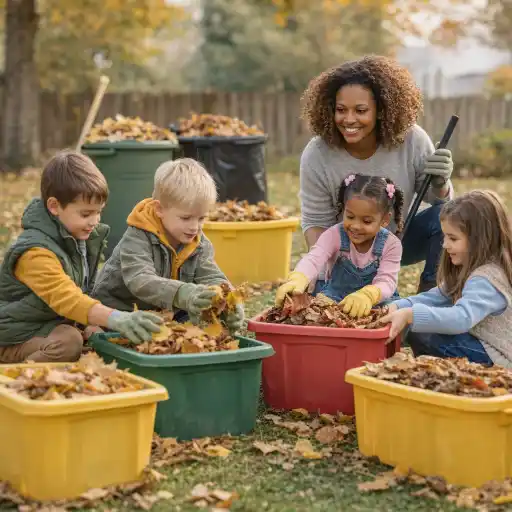
What sorting and counting challenges make cleanup purposeful?
Start with one clear sorting rule so children can focus on noticing and reasoning. Depending on the materials and children’s ages, invite them to group items by type, color, size, or destination. Fall leaves offer a natural prompt, but you can also sort clean outdoor toys, buckets, or gardening tools. Keep materials large and safe for the children participating.
- “Can you find the large leaves and place them on this mat?”
- “Let’s put the balls in one basket and the scoops in another.”
- “How many baskets have we filled? Which has more?”
- “Can you find two things that belong together? What made you choose them?”
- “Where should this go: beside the garden tools or inside the toy bin?”
These questions connect classification with counting, comparison, and spatial language. The emphasis is on explaining a choice, not racing to a correct answer. If a child creates an unexpected category, invite them to describe the rule. This approach is consistent with the everyday math opportunities outlined in ChildCareEd’s article on cleanup as sorting, counting, and teamwork. For children who are ready, encourage them to sort the same collection in a new way. That simple change develops flexible thinking and shows that objects can be organized according to different features.
How can job cards encourage cooperation and inclusion?
Job cards make a broad direction such as “Let’s clean up” easier to understand. A card might show a child collecting balls, a pair carrying a lightweight basket, or a helper matching objects to a shelf label. ChildCareEd’s Creating the Natural Outdoor Classroom Buy Now $16.00 course can help providers think intentionally about outdoor materials and learning spaces; job cards can translate that planning into child-friendly tasks.
Introduce roles with a brief demonstration, then rotate them so the same children are not always assigned the most visible jobs. Offer roles such as collector, sorter, label matcher, or area checker. Model useful language: “Would you like to help me?” “You carry this side,” and “Let’s decide where it belongs.” Notice specific collaboration—for example, “You waited for your partner before lifting the basket.”
Participation can look different for each child. A child might point to the correct picture, sort objects at a table, use a communication device, or direct a peer to a bin. These are meaningful contributions. Adapt the number of steps, materials, and movement demands to children’s abilities and comfort. Keep the task cards flexible rather than making them a test of speed or compliance; the intention is shared responsibility and successful participation for every child.
How can providers make the routine predictable and avoid common pitfalls?
A familiar sequence reduces uncertainty: give a brief warning, show the job cards, complete a small task, check the area together, and transition to what comes next. State directions concretely—“Put the large balls in the blue basket”—instead of “Clean everything.” Allow enough time for children to hear, process, and act. A simple cleanup song or visual cue can help, but avoid turning the routine into a race.
Common pitfalls include assigning too many jobs at once, expecting children to handle unsafe materials, and correcting every choice before hearing a child’s reasoning. Reduce the number of materials and tasks if the activity feels overwhelming. If objects are repeatedly put in the wrong place, check whether the label or storage location is unclear before assuming children are not paying attention. Adults should handle hazardous items and any cleaning procedures that require chemicals or specialized sanitation.
Directors can support consistency by reviewing the task cards with staff, agreeing on safe boundaries, and observing which roles invite participation. Keep documentation brief: note one example of sorting, counting, cooperation, or a support that helped a child join. Outdoor learning is strongest when safety checks and active supervision are built into the plan, not left to chance.
Conclusion: What can fall cleanup teach children?
Fall cleanup can become a real-life lesson in sorting and teamwork when children have safe, understandable tasks and adults make the learning visible. Picture-supported job cards can help children match materials to their homes, while open-ended questions encourage classification, counting, comparison, and explanation. Rotating roles and adapting tasks let every child contribute to the group’s shared goal.
Start small: choose one outdoor area, offer two or three jobs, and model one sorting challenge. Keep adult-only sanitation and hazard management with staff, supervise actively, and adjust the routine based on what children show you. In this practical, seasonal routine, #sorting, #counting, #teamwork, and care for the #outdoors can grow together—one leaf, basket, and helpful partnership at a time.
For additional professional learning, explore CDA: Creating the Outdoor Classroom Buy Now $16.00, TEAM: Together Everyone Achieves More Buy Now $16.00, and Every Moment Matters: Schedules and Transitions Buy Now $55.00$45.00.
- Creating the Natural Outdoor Classroom
- 45 Hour School Age Methods and Materials
- 24 Hour Texas Pre-Service
- CDA: Creating the Outdoor Classroom
- Building Equity: Inclusionary Practices in Preschool
- Emergent Learning & Development
- Sensitive Periods in Montessori: Guiding Natural Learning
- Connections That Count: Building Relationships in Child Care
- Texas Director Credential
- Spaces that Support Discovery
- Actividades de Otoño Fáciles para Preescolares esta Temporada
- Fall Sensory Activities for Toddlers and Preschoolers
- Pumpkin, Leaves, and Apples: Fall Activities for Preschoolers
- Crunch, Stomp, Scoop! Fall Activities Toddlers Can’t Resist
- What’s Happening Outside? Fall Science Adventures for Preschoolers
- Count It, Sort It, Find It! Fall Math Games for Preschoolers
- Fall Detectives: 10 Questions Pre-K Kids Can Investigate This Season
- How Can Recycled Materials Create Engaging Learning Centers?
- Why Are Reusable Printables a Smart Investment for Child Care Providers?
- How Can Hands-On Sorting Support Math and Language Together?
- What Should Providers Put in a Classroom Waiting Basket?
- How Can Cleanup Time Become a Lesson in Sorting, Counting, and Teamwork?
- How Can Simple Sorting Activities Build Sustainable Habits in Early Childhood?
- How Can You Choose Recycled Classroom Materials With a Real Purpose for Play?
- How Can Classroom Recycling Questions Grow into a Meaningful Learning Project?
- How Can Fall Foods Help Children Explore Family Traditions?
- How Can Fall Cleanup Become a Real-Life Sorting and Teamwork Activity?
- How Can You Plan Fall Activities for a Mixed-Age Family Child Care Group?
- How Can You Extend Fall Dramatic Play into November Without Starting Over?
- How Can One Fall Activity Work for Three Age Groups in Family Child Care?
