Recycled materials become valuable classroom resources when they invite children to do more than handle or decorate them—they need a meaningful purpose in play. The Beautiful Junk: Using Recycled Materials in the Classroom  Buy Now $16.00 course offers practical ideas for turning everyday objects into engaging learning tools, helping you strengthen classroom practice while building your professional knowledge. Check ChildCareEd’s Recycle or Trash Sort Buy Now $1.49 resource. Read on to see how a simple Recycle or Trash sort can grow into purposeful play, inquiry, and everyday environmental learning.
Why does a real play purpose matter?
A classroom collection of recyclables is not automatically a learning experience. The purpose emerges when materials connect to children’s interests, invite meaningful action, and give children room to make choices. A cardboard box might become a delivery truck in dramatic play, a structure in the block area, or a container for a sorting investigation. In each case, the material supports a real intention rather than sitting on a shelf as decoration.
Open-ended materials can encourage children to imagine, classify, negotiate, and revise their plans. Pennsylvania State University’s Better Kid Care describes loose parts as objects children can move, combine, redesign, and use in many ways, with the child directing the experience. A recycled object’s value, then, is not simply that it was diverted from waste; it is that it offers possibilities for purposeful #play and learning.
Starting with a clear purpose also helps providers avoid collecting items “just in case.” Before saving an object, ask: What might children do with it? Which area or interest could it support? What learning could become visible? This small planning habit helps keep materials intentional, manageable, and connected to children’s daily experiences.
How can you select materials that invite purposeful play?
Choose materials based on a play idea, not on the size of the donation bag. Sturdy, clean, versatile objects are often more useful than unusual items with limited possibilities. Consider what children are currently exploring: building, role play, sorting, making marks, or investigating how things work.
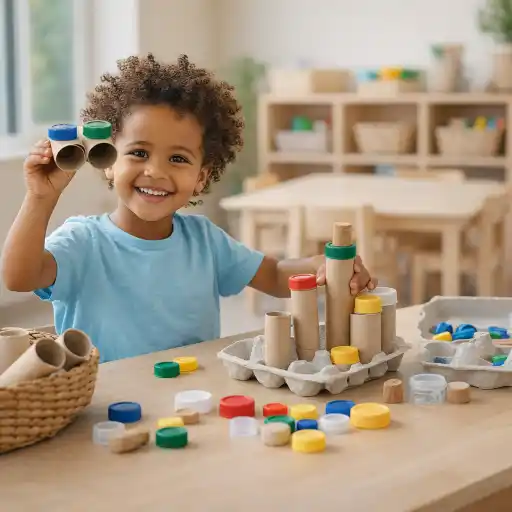
- For construction: clean, sturdy cardboard boxes, tubes, and large lids can support building, balancing, and pretend structures.
- For dramatic play: clean food containers, paper bags, and boxes can help children set up a market, café, or delivery service.
- For sorting and early math: large, intact examples of paper, cardboard, and packaging can prompt children to compare, group, and explain.
- For art and design: paper scraps, cardboard, and fabric pieces can be offered as open-ended materials, without requiring a matching finished product.
Think about what the object affords: Can a child carry, stack, connect, fill, or transform it? Does it relate to a current classroom investigation? Offer a small, purposeful selection rather than every item collected. A focused assortment supports deeper engagement and makes supervision and cleanup easier. The aim is to select #materials that extend children’s ideas—not to create a miniature recycling warehouse.
How can a Recycle or Trash sort lead to meaningful learning?
ChildCareEd’s Recycle or Trash Sort Buy Now $1.49 resource invites children to cut out familiar items and sort them into recycle or trash categories. Used thoughtfully, this can be more than a worksheet: it can launch discussion about what objects are made of, how they are used, and what choices people make after an item is no longer needed.
Begin with a brief, concrete invitation. Show a picture or safe, clean example and ask what children notice. Invite them to name the material, describe how it feels, or suggest another use before deciding where it belongs. Sorting develops classification and comparison; the conversation brings in vocabulary, reasoning, and an opportunity to share different ideas.
- 🧰 Offer a few familiar examples and clear picture labels for “Recycle” and “Trash.”
- Ask, “What makes you think this belongs here?” or “Could we use it again for something?”
- Allow children to explain, point, gesture, draw, or demonstrate their thinking.
- Check local recycling guidance with children when an item’s category is uncertain.
Local recycling systems differ, so avoid presenting one community’s rules as universal. A useful classroom phrase is, “Let’s find out what our community accepts.” The activity can also connect to purposeful reuse: after sorting, children might decide whether a clean box could become a dramatic-play prop or construction piece.
How do you keep recycled materials safe and accessible?
Safety begins before an object reaches a child. Inspect materials carefully, considering the child’s age, development, sensory needs, and the supervision available. Use clean, dry items in good condition; remove sharp edges, staples, residue, loose components, and anything that breaks easily. Do not provide objects that pose choking, strangulation, toxic exposure, or other hazards. Keep unsafe or confusing examples as adult-held visuals, or use photographs instead.
Head Start safety practices emphasize that materials should be clean, safe, age-appropriate, and arranged to support appropriate supervision. For a sorting activity, choose sturdy, familiar examples and offer larger materials for younger children. Infants and toddlers need especially careful selection and close supervision; small pieces, plastic bags, batteries, magnets, and broken items should not be accessible to them.
- Clean and dry reusable items before use, and discard anything that cannot be cleaned effectively.
- Store materials in labeled bins away from food preparation and eating areas.
- Check materials regularly and remove damaged or worn items promptly.
- Set up the activity where staff can supervise and children can reach materials comfortably.
State requirements vary - check your state licensing agency before introducing unfamiliar materials or changing classroom procedures. Practical, consistent checks let children explore with confidence and help staff feel prepared.
How can you adapt the experience and extend the play?
A purposeful activity should offer more than one way to participate. Children can sort by placing an object in a bin, pointing to a picture, matching a card, describing an item, or watching a peer and joining when ready. Use picture cues alongside words, and consider labels in the home languages of children in your group. Provide a stable surface, reachable containers, larger examples, and additional time for children who benefit from motor or sensory adaptations.
Let children’s questions guide what happens next. If they wonder whether a box can become a bus, provide it in dramatic play. If they notice that paper and plastic feel different, invite them to compare textures or sort by material. A simple observation can lead to counting, a picture graph, a reuse project, or a classroom cleanup routine.
Adults deepen learning by observing first and then offering brief, open-ended prompts: “What are you noticing?” “What else could this become?” or “How might we find out?” Avoid stepping in to supply the “right” answer too quickly. Document a moment of thinking—a child’s comment, a photo of a design, or a note about a changed decision—and use it to plan the next invitation.
Families can contribute knowledge about household routines and local recycling practices, but participation should be flexible. Invite ideas, stories, or safe materials without making donations a requirement. When children see familiar objects and community knowledge reflected in the #classroom, the play can feel more connected and inclusive.
Conclusion: What makes a recycled material worth keeping?
A recycled classroom item earns its place when it is safe, accessible, and connected to a real purpose in children’s play. Start with children’s interests, choose a manageable set of materials, and give them opportunities to imagine, sort, investigate, reuse, and explain. The Recycle or Trash Sort can be a useful starting point, especially when it opens into conversation about local practices and creative reuse rather than a one-time right-or-wrong exercise.
For providers asking how to choose recycled classroom materials with purpose, the answer is to plan from the play outward: decide what children might explore, select suitable materials, prepare them safely, and stay responsive to children’s ideas. A focused collection and thoughtful adult prompts can turn ordinary objects into meaningful learning opportunities. To explore more classroom-ready approaches, consider the Beautiful Junk course Buy Now $16.00 as a next step in developing your practice.
Further learning for providers
- Basic Science in Early Childhood Buy Now $25.00 — strategies for inquiry and investigation.
- CDA: Curriculum Alignment & Materials Buy Now $16.00 — selecting developmentally appropriate materials for different children and centers.
- Classroom Setup for Child Care Buy Now $24.00 — arranging welcoming and purposeful learning environments.
- Creating Safe & Healthy Child Care Environments Buy Now $55.00 — strengthening environmental safety practices.
- Beautiful Junk: Using Recycled Materials in the Classroom
- Beyond the Classroom: Connecting Families to Essential Services
- Birth to Five CDA Credential with Portfolio Review
- CDA Bridge Bundle: Family Child Care without Portfolio Review
- CDA Bridge Bundle: Infant/Toddler without Portfolio Review
- CDA Bridge Bundle: Preschool without Portfolio Review
- Creating Engaging and Meaningful Learning Experiences
- Creating Environments that Nurture Growth and Community
- Texas Director Credential
- 45-Hour Infant and Toddler Curriculum
- 🪁¿Cómo puede el juego apoyar de manera poderosa a los niños con autismo?🧩
- 💛🧩 ¿Cómo puedo hacer que mi enseñanza sea inclusiva para los niños con autismo?
- ¿Cuáles son las mejores actividades del Día de la Tierra para niños en casa o en el aula?
- 10 Ejemplos de Cómo la Cultura Influye en el Desarrollo Infantil
- Cómo Iniciar el Proceso de Obtención de la Licencia de Cuidado Infantil
- Proporciones de Cuidado Infantil y Tamaños de Grupo por Edad en Maryland (Guía Rápida para Centros y Hogares)
- Proporciones de Cuidado Infantil y Tamaños de Grupo por Edad en Nueva Jersey (Guía Rápida para Centros y Hogares)
- Proporciones de Cuidado Infantil y Tamaños de Grupo por Edad en Virginia (Guía Rápida para Centros y Hogares)
- Celebrando la amistad en el cuidado infantil durante el Día de los Mejores Amigos
- Canciones, juegos y preguntas de círculo para niños
- Made by Me! Labor Day Crafts for Preschoolers That Celebrate Hard Work
- Labor Day Crafts for School-Age Kids That Go Beyond Coloring Pages
- How Can Printable Activities Save Teachers Hours of Prep Time?
- How Can Child Care Providers Create Effective Learning Centers in Small Spaces?
- Why Are Reusable Printables a Smart Investment for Child Care Providers?
- Which Printable Activities Belong in Every Preschool Classroom?
- How Can Open-Ended Summer Art Encourage Planning and Creativity?
- How Can Simple Sorting Activities Build Sustainable Habits in Early Childhood?
- How Can You Choose Recycled Classroom Materials With a Real Purpose for Play?
