Fall foods can make sensory play vivid and memorable, but ingredients that invite touch and exploration can also introduce allergy and cross-contact risks. Before adding apples, oats, seeds, or squash, use a clear family-informed safety process—and consider the Prevention of and Response to Allergic Reactions  Buy Now $8.00 course to strengthen staff knowledge of prevention and emergency response. For a practical classroom tool, explore ChildCareEd’s Food Allergy Safety Toolkit Buy Now $1.00, which includes family information forms, safety checklists, labels, and a child-friendly sorting activity.
Why should providers pause before adding seasonal ingredients?
A bin of dried corn, oats, pumpkin seeds, or apple slices may look like a simple invitation to play. Yet food can travel from hands to mouths, shared tools, tables, clothing, and other materials. For a child with a food allergy, an exposure may happen through contact or cross-contact rather than intentional tasting. Allergy safety therefore needs to be part of activity planning—not an afterthought once the bin is already on the table.
This does not mean providers must avoid every seasonal experience. It means making an informed choice based on each child’s needs, written care plan, family communication, and program procedures. Sensory play can still be rich when children sort photographs, handle large washable objects, explore leaves, or use non-food materials.
Thoughtful preparation also supports inclusion. Children should not be singled out or excluded because an activity uses an ingredient they must avoid. A classroom-wide alternative can preserve the shared learning goal and keep participation welcoming.
Use questions like these as a quick planning pause:
- What learning goal does this ingredient serve, and could a non-food material meet it?
- Do current records and care plans identify relevant allergies or other restrictions?
- Can staff supervise, prevent cross-contact, and clean the activity space effectively?
What should you learn from families and written care plans?
Before selecting ingredients, review current health information and the child’s written allergy care plan. The Child Care Technical Assistance Network’s guidance on caring for children with food allergies recommends that families disclose known allergies and that each child with a food allergy have a health care provider–written plan describing foods to avoid and treatment steps.
Do not rely on memory, an old enrollment form, or a general statement such as “no nuts.” Ask families specific, activity-related questions through the program’s approved communication process. Clarify whether the child may be near, touch, or participate around the proposed ingredient, and follow the care plan and program policy when deciding. Providers should not interpret medical instructions or independently determine that an ingredient is safe.
- Are allergy records current, and has the family reported any changes?
- Does the care plan explain avoidance steps, symptoms, medication, and emergency response?
- Are there dietary, cultural, religious, or sensory considerations to plan around as well?
- Do all staff supervising the activity know where the child’s plan and emergency medication are located?
Keep sensitive health details private while ensuring authorized staff have the information they need. If information is incomplete or unclear, pause food use and ask the family or designated health professional for clarification. State requirements vary - check your state licensing agency.
Could the ingredient cause allergen exposure or cross-contact?
Think beyond the food itself. An allergen can transfer from an ingredient to a scoop, bin edge, table, child’s hands, apron, or another toy. A child may also mouth materials unexpectedly, particularly in mixed-age groups or when developmentally appropriate supervision is challenging. The CDC explains that food allergies can cause severe reactions and that prevention and emergency planning belong in early care and education settings; see its food allergy guidance.
Check every ingredient and packaged product against each relevant child’s plan. Read labels every time; product ingredients and manufacturing information can change. Do not treat “natural,” “taste-safe,” or “allergy-friendly” as proof that an item is safe for a particular child. Those labels do not replace the child-specific care plan or family guidance.
- Could children transfer material from the bin to their mouths, faces, clothing, or nearby surfaces?
- Will tools or hands be shared between children or used in other activities?
- Can you separate materials, supervise closely, and clean the area using program procedures?
- Could loose seeds, small pieces, or hard foods pose a choking risk for this age group?
When an ingredient’s safety is uncertain, choose a non-food substitute instead of experimenting. This is a practical precaution, not a missed learning opportunity: children can compare colors, textures, shapes, and quantities with other materials.
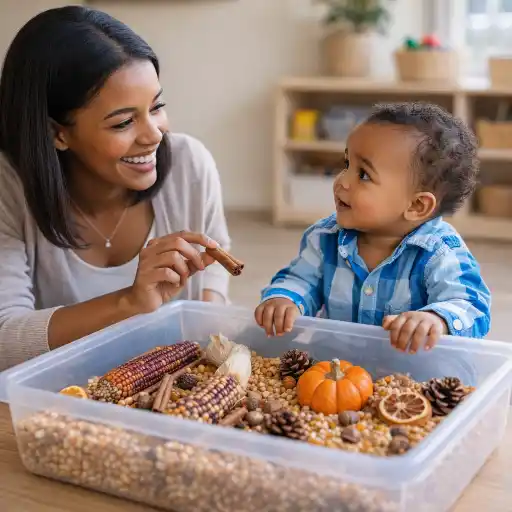
How can you choose a safer, inclusive fall-bin alternative?
Start with the developmental purpose rather than the seasonal ingredient. If children are practicing sorting, counting, describing, or transferring objects, many materials can support the same learning. Large fabric leaves, washable plastic pumpkins, sturdy scoops, picture cards, and clean pinecones screened for size and condition can create a fall-themed invitation without edible ingredients. Select materials based on children’s ages, mouthing behaviors, sensory preferences, and program procedures.
Non-food does not automatically mean risk-free. Inspect every item for small parts, sharp edges, breakage, contamination, or other hazards. Avoid objects that are not appropriate for children who mouth materials, and ensure staff can maintain active supervision throughout play.
- 🍂 Try large fabric leaves, felt shapes, or washable seasonal toys for sorting and storytelling.
- Use picture cards of apples, squash, and other harvest foods for matching, vocabulary, and classification.
- Offer scoops and sturdy containers with a non-food base suitable for the group and setting.
- Invite children to observe real produce from a distance or through an adult-led demonstration, if that fits the child’s plan and program policy.
Offer multiple ways to participate: touching, using a tool, pointing, describing, watching, or choosing another station. Do not require tasting or direct contact. A child who observes closely is still engaged in learning.
What procedures make a food-based activity safer if you use one?
If program policy and the child’s individual plan support using a food ingredient, design the activity around clear roles and safeguards. Decide in advance who verifies labels, prepares materials, supervises children, responds to concerns, and completes cleanup. Keep the child’s written plan and required emergency medication accessible to authorized staff according to the plan and program procedures.
Prevent sharing of food and tools, and use clean equipment and surfaces. Build handwashing with soap and water into setup and cleanup; sanitizer alone may not remove food allergens. After play, clean and sanitize surfaces and reusable items according to product instructions and the program’s procedures. The CDC’s cleaning guidance for early care and education settings distinguishes cleaning from sanitizing and emphasizes following product labels. Keep cleaning chemicals secured and out of children’s reach.
- Tell families in advance which ingredients and materials are planned, and follow their child’s care instructions.
- Use separate tools and materials when called for by the written plan and program procedures.
- Keep children actively supervised and stop the activity if safe conditions cannot be maintained.
- Follow the child’s emergency plan and program response procedures if exposure or symptoms are suspected.
Avoid promising that an environment is completely allergen-free unless the program has a verified basis for that claim. Be candid about the safeguards in place and their limits. State requirements vary - check your state licensing agency.
What common mistakes should directors help staff avoid?
Well-intentioned seasonal activities can become risky when planning happens in a hurry. A common mistake is assuming an ingredient is harmless because it is familiar, used in cooking, or described as taste-safe. Another is checking a label once and assuming the product will not change. Even a sensory activity that is not intended for eating can expose children through hands, tools, and surfaces.
Directors can help by making a short pre-activity review part of classroom practice. Keep current allergy information available to authorized staff, establish a reliable family communication process, and provide a clear route for staff to ask questions before materials are introduced. The ChildCareEd Food Allergy Safety Toolkit Buy Now $1.00 offers forms and checklists that can support this consistent approach.
- Mistake: Relying on an old allergy list. Better approach: Confirm current information and follow the individual written plan.
- Mistake: Assuming taste-safe means allergy-safe. Better approach: Verify ingredients against each child’s care instructions.
- Mistake: Using shared scoops or allowing food sharing. Better approach: Establish clear tool-use and no-sharing routines.
- Mistake: Treating a non-food alternative as automatically safe. Better approach: Inspect materials for choking, sanitation, and developmental hazards.
Staff who want focused professional learning can explore ChildCareEd’s Prevention of and Response to Allergic Reactions Buy Now $8.00, a one-hour course addressing prevention and response in child care. Training complements—not replaces—individual care plans, program procedures, or applicable licensing requirements.
Conclusion: What questions should guide your decision?
Before using fall foods in a sensory bin, ask whether the ingredient is necessary for the learning goal, whether every child’s current needs and care plan have been reviewed, and whether your team can prevent exposure, supervise effectively, and clean the space safely. If any answer is uncertain, pause and choose a suitable non-food alternative while you clarify the details.
Keep the central goal in view: meaningful, joyful participation—not the use of a particular ingredient. A thoughtfully selected set of washable seasonal materials can support language, sorting, fine-motor practice, and curiosity while making inclusion easier. The most important protections are reliable family communication, current documentation, staff awareness, and consistent routines.
Use these five planning anchors: #allergies, #safety, #families, #sensory, and #inclusion. With those priorities guiding the decision, fall play can be engaging and responsive to the children in your care.
- Pumpkin Spice and Sensory Delight: Easy Autumn Sensory Bins for Early Learners
- 😫🧸 ¿Qué hacer cuando un bebé no quiere dormir la siesta en el aula?
- Cómo usar tu certificación de 90 horas en Maryland para completar tu CDA
- ¿Cuáles son los pasos, requisitos y opciones en línea para la certificación de 90 horas en cuidado de Infantes/Toddlers en Maryland?
- ¿Cómo pueden los equipos de cuidado infantil practicar habilidades rápidas de primeros auxilios en situaciones reales?
- Capacitación en Salud y Seguridad Preventiva en Línea para Proveedores de Cuidado Infantil
- Regulaciones de Licenciamiento de Cuidado Infantil en California para Centros y Hogares de Cuidado Infantil Familiar
- Proporciones de Cuidado Infantil y Tamaños de Grupo por Edad en Maryland (Guía Rápida para Centros y Hogares)
- Actividades de Otoño Fáciles para Preescolares esta Temporada
- Lista para Guardería en Casa en California: Cómo Iniciar una Guardería en el Hogar
- Lista para Guardería en Casa en Texas: Cómo Iniciar una Guardería en el Hogar
- Capacitación Previa al Servicio para Proveedores de Cuidado Infantil en Dakota del Norte
- Calabazas, hojas y manzanas: actividades de otoño para preescolares
- How can childcare programs celebrate the harvest season in ways that are inclusive, safe, and sensory-rich?
- Rainy Fall Day? 12 Indoor Activities Preschoolers Won’t Want to Stop
- Hello, Fall! Cozy Activities to Help Babies Explore the Season
- What’s for Snack Again? Easy Daycare Ideas Kids Won’t Get Bored With
- How Can Fall Food Activities Support Children Who Aren’t Ready to Taste?
- How Can Child Care Providers Offer Fall Foods While Honoring Each Infant’s Feeding Plan?
- What Should Child Care Providers Ask Before Using Fall Foods in a Sensory Bin?
