Fall turns an ordinary yard, pumpkin, or leaf into a laboratory for young investigators. Use the questions below to build language, early #science, mathematics, and confidence through playful observation; for deeper support with developmentally appropriate inquiry, explore Building Early Science Foundations  Buy Now $16.00, which helps providers plan exploration, experimentation, and discovery.
Why does fall make such a meaningful context for inquiry?
Seasonal change is visible, tangible, and close to children’s daily lives. Leaves change color, temperatures shift, fruits mature, animals prepare for winter, and daylight becomes shorter. These phenomena give children authentic reasons to notice, wonder, compare, and explain.
Fall investigations also support integrated learning. A leaf walk can become a vocabulary lesson, a sorting activity, a movement experience, and an opportunity to practice prediction. A pumpkin can invite measurement, seed counting, sensory description, and discussion about life cycles. These experiences matter because children are not merely memorizing facts; they are developing habits of mind that support later reasoning.
Research-informed classroom guidance consistently emphasizes the value of observing before answering, offering open-ended prompts, and revisiting children’s ideas. The ChildCareEd resource teaching preschoolers to ask better questions and make predictions similarly recommends a simple cycle: ask, predict, test, and reflect.
- Use real materials whenever possible.
- Invite children to draw, gesture, build, or speak their ideas.
- Celebrate surprising results rather than only correct predictions.
What are ten fall questions children can investigate?
Present one question at a time and allow children to generate their own related questions. The goal is not to complete all ten in one week; it is to sustain curiosity through repeated investigation.
- Why do leaves change color? Compare leaves from different trees and discuss color, sunlight, and seasonal change.
- Which leaves are the biggest, smallest, smoothest, or roughest? Measure, sort, and describe collections.
- Will a leaf, acorn, apple, or small pumpkin sink or float? Invite predictions before testing in a shallow water tub.
- Why do some pinecones open and close? Place pinecones in dry and damp locations and observe changes.
- How many seeds are inside a pumpkin or apple? Estimate, count, group, and represent results.
- Which pumpkin is heavier? Compare pumpkins by lifting, balancing, or using a scale.
- What happens to a leaf when it gets wet, frozen, or dry? Observe texture and flexibility over time.
- Which surface makes a toy car travel farthest? Test ramps covered with cardboard, fabric, leaves, or foil.
- What sounds can we hear outdoors in fall? Record rustling leaves, birds, wind, footsteps, and human-made sounds.
- How do plants or animals prepare for colder weather? Look for seeds, nests, changing foliage, migration, or stored food.
These questions are adaptable for small groups, outdoor walks, discovery tables, and family extensions. Natural-material ideas are also described in autumn-themed STEM projects using pumpkins, pinecones, and leaves.
How can teachers turn each question into a genuine investigation?
A strong investigation follows a predictable structure while leaving room for children’s ideas. Begin with observation: “What do you notice?” Then invite a prediction: “What do you think will happen?” Next, provide a safe way to test the idea. Finally, reflect: “What happened, and how was it the same as or different from our guess?”
Teacher language should amplify thinking rather than replace it. Try phrases such as:
- “Tell me more about what you see.”
- “What makes you think that?”
- “How could we find out?”
- “What should we change, and what should stay the same?”
- “What surprised you?”
Wait several seconds after asking a question. Children need time to process, formulate language, and decide whether to contribute. Dual-language learners may communicate through home-language words, gestures, drawings, or demonstrations; each is a valid form of participation.
Keep the adult role intentionally modest. Demonstrate safe tool use, introduce useful vocabulary, and offer a small challenge, but avoid directing every step. When children’s predictions are inaccurate, respond with interest: “That is different from what we expected. What evidence do we have now?” This approach protects agency and strengthens #inquiry.
How can you organize fall investigations for a busy classroom?
Effective inquiry does not require elaborate equipment. Establish a small investigation area with a tray, a question card, and a limited selection of materials. Rotating two or three invitations weekly helps children revisit concepts without becoming overwhelmed.
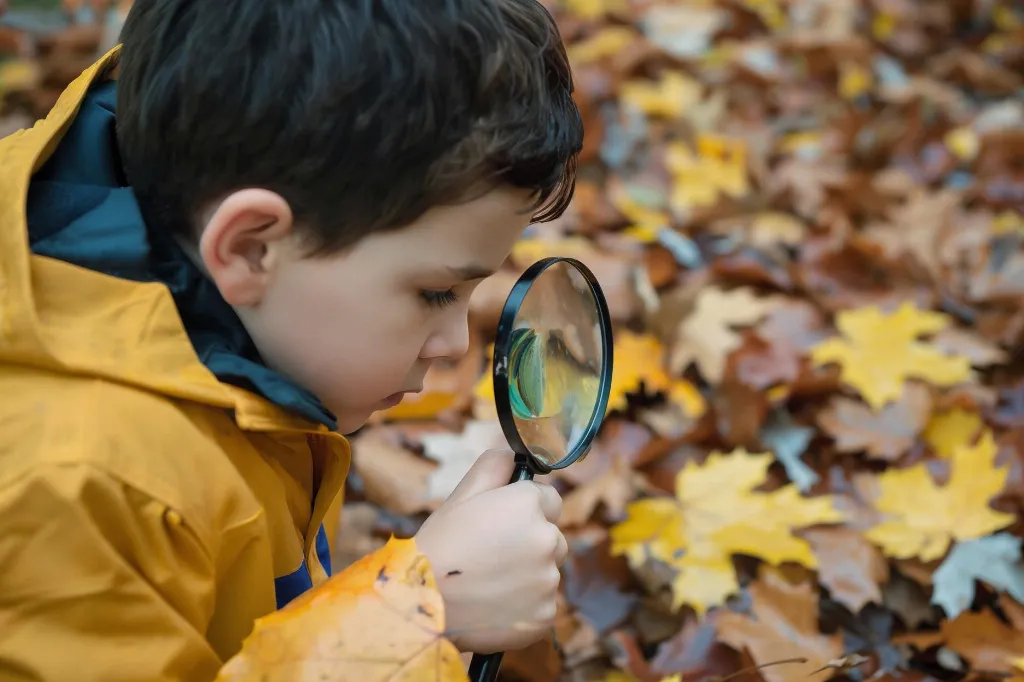
A practical station might include leaves, magnifiers, sorting bowls, rulers, clipboards, crayons, and picture labels. Another might include a shallow tub, towels, large natural objects, and a prediction chart. For pumpkin work, provide a small pumpkin, scoops, measuring tape, a scale, and a documentation sheet. Use child-accessible storage so children can participate in setup and cleanup.
- 🧭 Begin with a five-minute outdoor observation or question of the day.
- Keep focused investigations approximately 10–20 minutes, adjusting for engagement.
- Use trays, smocks, and washable surfaces to make messy learning manageable.
- Offer seating, adapted tools, visual steps, and peer support as needed.
- Prepare an indoor alternative when weather, air quality, or accessibility requires it.
Safety must guide every design decision. Inspect natural materials, remove choking hazards for younger children, supervise water play, check for allergies, and pre-cut pumpkins or fruit when necessary. Never assume that a seasonal activity is automatically safe; state requirements vary - check your state licensing agency.
For guidance on taking learning outdoors, consider Creating the Natural Outdoor Classroom Buy Now $16.00. Its focus on colors, sounds, textures, scents, and nature-based discovery complements fall investigations.
How should providers document children’s discoveries?
Documentation should be brief enough to sustain and meaningful enough to inform planning. A photograph, one child quote, and one observation can show far more than a worksheet completed without discussion. Record what the child noticed, predicted, tested, or explained.
- Photo sequence: Capture the prediction, investigation, and result.
- Child voice: Write the child’s words as accurately as possible.
- Simple data: Use tallies, stickers, drawings, or picture graphs.
- Revisit: Repeat the investigation later with one variable changed.
- Planning note: Identify a possible next question based on children’s interests.
For example, after a sink-or-float investigation, a teacher might write: “Maya predicted the apple would sink because it felt heavy. After testing, she noticed it floated and suggested trying a cut piece.” This record demonstrates prediction, evidence-based revision, vocabulary, and causal reasoning.
Documentation also supports family partnerships. Send home a photograph and a prompt such as, “Ask your child what they thought would happen when the pinecone got wet.” Families can investigate leaves, apples, weather, or household objects without recreating the classroom exactly.
To strengthen observation and assessment practices, explore Preschool Assessments & Observations Buy Now $24.00. The course can help providers connect objective observation with individualized planning while keeping assessment strengths-based.
What common mistakes should teams avoid?
Even thoughtful educators can unintentionally narrow inquiry when time is short. The most common mistake is answering too quickly. When a child asks, “Why did the leaf fall?” responding with a complete explanation may end the investigation. Instead, acknowledge the question and invite evidence: “That is something we can observe. What do you notice about the tree?”
Other pitfalls include:
- Too many materials: Offer a few flexible objects rather than an overwhelming collection.
- Too many questions: Ask one focused prompt and allow wait time.
- One correct result: Emphasize the process of testing and revising ideas.
- Adult-controlled experiments: Let children handle materials whenever safety permits.
- No follow-up: Return to an investigation so children can compare results.
- Exclusion through language or motor demands: Accept multiple forms of communication and provide adaptations.
Directors can support consistency by modeling inquiry language during team meetings, posting question stems near investigation areas, and reviewing documentation during planning time. Staff need permission to be curious, tolerate manageable mess, and treat unexpected results as valuable information.
Children at the Wheel: Emergent Curriculum offers a particularly relevant next step because it connects children’s interests to planning through a cycle of inquiry. Explore the course at Children at the Wheel: Emergent Curriculum Buy Now $25.00.
How can fall detective work become an ongoing classroom culture?
Fall detective work is most powerful when it becomes a habit rather than a theme-day performance. Begin with one question, one small group, and one simple form of documentation. Follow children’s observations: a question about a leaf may lead to trees, weather, animal habitats, art, measurement, or storytelling.
Keep a visible question board with children’s drawings, photographs, and dictated ideas. Revisit it during circle time and ask which questions have been explored and which remain open. Invite families to contribute seasonal observations from home. When children see their ideas shaping the curriculum, they experience belonging and intellectual agency.
Quick FAQ
- Do we need special science kits? No. Leaves, pumpkins, water, cardboard, blocks, and reused containers are often sufficient.
- How long should an investigation last? A focused invitation may take 10–20 minutes; deeper projects can continue across several days.
- What if children’s predictions are wrong? Treat the result as evidence and invite children to revise their thinking.
- How can all children participate? Use visuals, gestures, home languages, adapted tools, peer support, and multiple ways to record ideas.
- What safety rules apply? Follow your program policies and remember that state requirements vary - check your state licensing agency.
Conclusion: How can pre-K children become fall detectives?
Pre-K children become fall detectives when adults give their observations time, materials, and respectful attention. The ten questions in this guide can support #observation, prediction, comparison, measurement, language, collaboration, and persistence through experiences that feel joyful and real.
Choose one question this week. Invite children to notice, predict, test, and reflect. Document one quote or discovery, then use it to plan the next investigation. With a small invitation and a thoughtful question, your classroom can become a community of confident investigators—ready to look closely, wonder freely, and learn from what they find.
References consulted: ChildCareEd: Questions and Predictions; Nature’s Classroom; Pumpkin Science; Encouraging Curiosity; Autumn STEM Projects; Hands-On Scientific Thinking; Nature-Based Science; Fall Sensory Activities; Pumpkins, Leaves, and Apples; Easy Fall Activities; Pre-K Pages Fall Science; Preschool Inspirations; Living Life and Learning; Fall STEM Activities; Fall Science Experiments; Fantastic Fun and Learning; Leaves and Trees Planning; Simple STEM Activities; STEM and Curiosity; and ChildCareEd course resources Buy Now $16.00.
- CDA Home Visitor Subject Area 3 Part 3 Birth to 5
- Birth to Five CDA Credential with Portfolio Review
- Children at the Wheel: Emergent Curriculum
- Pediatric RSV First Aid & CPR/AED
- Art from the Heart for Preschoolers: Open Ended Art Projects that Build Self-Esteem
- Positive Attention: Interactions & Supervision for Infants & Toddlers
- Montessori Cultural Activities: Exploring the World Through Play and Learning
- Building Early Science Foundations
- Enhancing STEM Education for Infants and Toddlers
- Nature’s Classroom: Why Fall Is the Best Season for Sensory Learning Outdoors
- Pumpkins, Pinecones, and Leaves: Autumn-themed STEM Projects
- Sleeping Through the Confetti: How to Help Kids Catch Zzz’s
- CDA Certification en Español: Recursos y Consejos para Educadores Bilingües
- 🥦✨ ¿Cómo apoyar a los niños selectivos a probar nuevos alimentos sin presión?
- 👶 ¿Cuáles son las proporciones y grupos requeridos en Dakota del Norte? 🏫
- ¿Cómo afecta la dopamina a los niños: señales, efectos e influencias diarias?
- ¿Qué preguntas aparecen en el examen CDA para bebés y niños pequeños?
- 10 Ejemplos de Cómo la Cultura Influye en el Desarrollo Infantil
- ¿Qué preguntas aparecen en el examen CDA para preescolar?
- ¿Qué Preguntas Vienen en el Examen CDA de Nacimiento a los Cinco Años?
- Cómo Empezar una Guardería en Casa: Requisitos y Pasos
- Cute Fall Picture Ideas Teachers Can Try in the Classroom
- How can we use nature-based learning through Minnesota's outdoor seasons?
- How can childcare programs create high-quality outdoor classrooms and nature-based care?
- What’s Happening Outside? Fall Science Adventures for Preschoolers
- Fall Detectives: 10 Questions Pre-K Kids Can Investigate This Season
- How Can We Help Children Understand Mixed Emotions Beyond the Feelings Chart?
