Waiting periods can quickly become stressful when children have nothing meaningful to do. A thoughtfully prepared basket gives children purposeful choices while supporting language, self-regulation, independence, and smooth transitions; for broader guidance on designing engaging activity areas, explore Spicing Up the Classroom: Learning Centers  Buy Now $16.00, a 2-hour course that helps providers plan learning centers and earn professional development credit. Pairing that training with a practical waiting basket can help you turn unpredictable pauses into manageable learning moments.
Why does a classroom waiting basket matter?
Children wait throughout the day: for handwashing, meals, transportation, a small-group turn, a family pickup, or an educator who is helping another child. These moments are not necessarily problems, but they can become difficult when the wait is unclear, too long, or disconnected from children’s needs.
A waiting basket provides a predictable response. Instead of repeatedly saying “wait,” educators can offer a small set of familiar activities that children can begin with minimal assistance. This supports #selfregulation because children practice choosing, sustaining attention, managing materials, and stopping when the next routine begins.
The basket should not function as a reward, punishment, or substitute for active supervision. It is a thoughtfully designed environmental support. Research-informed guidance on no-prep activities emphasizes that short experiences can be meaningful when teachers connect them to language, movement, problem-solving, and observation. Likewise, NAEYC describes routines and transitions as important parts of a supportive classroom.
- It reduces idle time and repeated adult directions.
- It gives children concrete choices during unpredictable pauses.
- It supports independent and cooperative play.
- It creates opportunities for teachers to observe children’s interests and strategies.
What materials belong in a waiting basket?
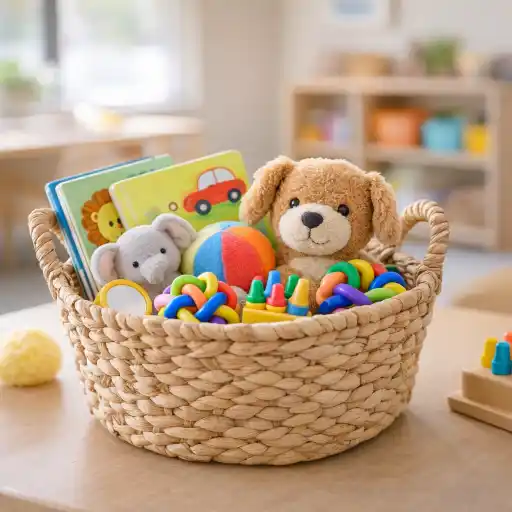
Choose compact, durable materials that children understand quickly and can use in several ways. The best items are engaging without requiring a lengthy explanation or a complicated cleanup process. A waiting basket might include:
- Picture books, small board books, and simple story cards.
- Large puzzles, matching cards, and durable memory games.
- Paper, crayons, chunky pencils, stickers, and clipboards.
- Large linking cubes, magnetic tiles, or felt shapes.
- Sorting objects, color cards, and pattern strips.
- Finger puppets, animal figures, or storytelling props.
- Visual breathing cards and simple feeling-face cards.
- Reusable activity cards with one brief invitation per card.
Activity cards are especially useful because they make the basket easy for every staff member to use. A card might say, “Find three things that are blue,” “Make a pattern with two shapes,” “Tell a story using these pictures,” or “Show a quiet way to move your fingers.” Task cards work best when they invite action rather than demand a single correct answer.
For preschoolers, prioritize hands-on materials over worksheets. Morning-tub guidance similarly recommends play-based tools such as puzzles, manipulatives, play dough, and matching materials instead of relying on paper tasks. The basket should feel like an invitation to #exploration, not extra schoolwork.
How can providers organize the basket for independence?
Organization determines whether a waiting basket saves time or creates more work. Select a sturdy container that children can carry safely, but avoid making it so large that materials become difficult to manage. Use photo-and-word labels when possible, especially for children who are still developing language or learning English.
Consider organizing materials in small pouches or compartments:
- Look: books, picture cards, and visual search prompts.
- Make: paper, crayons, stickers, and drawing invitations.
- Build: large blocks, cubes, or magnetic pieces.
- Think: puzzles, matching games, and sorting cards.
- Calm: breathing visuals, soft fabric squares, or quiet finger activities.
Introduce the basket during a calm group meeting. Model how to select one item, use it respectfully, ask for help, and return it before joining the next routine. Practice the sequence explicitly: “Choose, use, notice the signal, and return.” Children may need several rehearsals before they can manage the system independently.
Limit the number of choices available at one time. Too many materials can increase conflict and make cleanup difficult. Rotate a few items based on children’s interests, developmental needs, and observed engagement. A basket that remains unchanged for months may lose its usefulness, while constant rotation can prevent children from developing familiarity.
Which activities support learning while children wait?
A strong waiting basket includes activities from several developmental domains. The goal is not to cover every curriculum area in one container; it is to provide varied ways for children to participate successfully during short periods.
- Language and literacy: Invite children to retell a familiar story with picture cards, find objects that begin with a target sound, or create a story from three images.
- Mathematics: Offer sorting cards, large counters, pattern strips, or prompts such as “Make a group with more and a group with fewer.”
- Fine motor development: Use stickers, chunky crayons, lacing cards, large clips, or movable felt pieces. Avoid small parts for children who may mouth objects.
- Social-emotional learning: Include feeling cards, puppet scenarios, and prompts such as “Show what you could say when you want a turn.”
- Movement and regulation: Provide seated finger plays, breathing cards, or quiet movement prompts that can be completed safely in a limited space.
Open-ended activities are valuable because children can participate at different levels. One child may name pictures, another may tell a complex story, and another may sort by a self-created rule. Teachers can extend learning with brief comments: “You grouped these by color. What other rule could you try?”
✨ Include at least one activity that children can complete with a partner. Waiting does not have to mean isolated play; cooperative matching, shared storytelling, and turn-taking games provide natural practice with communication and #empathy.
How can adults use the basket safely and inclusively?
A waiting basket is only effective when it fits the children, environment, and supervision plan. Inspect materials regularly for damage, loose pieces, sharp edges, and sanitation concerns. Keep choking hazards away from children who mouth objects, and use materials that can be cleaned according to program procedures.
Active supervision remains essential. Educators should position themselves so they can see and hear children, interact when appropriate, and notice when an activity is no longer successful. A basket should never be used to occupy children while adults leave the room or stop monitoring the group.
Inclusive design may involve:
- Using photographs, symbols, objects, and words together.
- Offering larger pieces, thicker tools, or alternative ways to respond.
- Providing seated and movement-based choices.
- Including home-language labels or familiar cultural images.
- Using visual timers, “first-then” cards, or a clear end signal.
- Adjusting the number of choices for children who become overwhelmed.
Some children need an adult nearby, a peer partner, or a shorter waiting task. Others may need sensory reduction rather than more materials. Observe patterns instead of assuming the basket will work equally well for everyone. State requirements vary - check your state licensing agency, particularly for supervision, sanitation, choking hazards, ratios, and transitions.
How can programs avoid common waiting-basket mistakes?
The most common mistake is treating the basket as “busy work.” If activities are repetitive, overly academic, or disconnected from children’s interests, they may increase frustration rather than support engagement. Start with the purpose of the wait and select materials that match the available time, space, and developmental level.
- Too many materials: Begin with five to eight choices and add only when the system is working.
- Materials that require constant help: Choose activities children can understand after a brief demonstration.
- Small or unsafe pieces: Match materials to age, individual development, and supervision conditions.
- No cleanup plan: Use labeled pouches, picture labels, and a consistent return routine.
- Using the basket for every transition: Preserve movement, conversation, and authentic participation in routines.
- Expecting silence: Teach appropriate voice levels while allowing language and social interaction.
Directors can strengthen consistency by placing a short instruction card inside the basket, reviewing its use during staff meetings, and asking educators to record one successful activity and one needed adjustment. Documentation can be brief: “Picture story cards sustained engagement during a seven-minute wait; add duplicate cards for partner play.”
Programs may also connect waiting-basket materials to classroom learning centers. The ChildCareEd article on engaging learning centers for preschoolers emphasizes accessible materials, clear routines, limited choices, active supervision, and meaningful teacher interaction. For additional professional learning, explore Moving About the Classroom: Effective Transitions for Everyday Buy Now $35.00, From Tantrums to Triumphs: Equipping Preschoolers with Self-Regulation Skills Buy Now $25.00, Inclusive Lessons for Preschoolers Buy Now $16.00, and Effective Supervision in Child Care Buy Now $25.00.
Conclusion: What should providers put in a classroom waiting basket?
A classroom waiting basket should contain a small, rotating collection of safe, accessible, developmentally appropriate materials that help children look, create, build, think, communicate, and calm their bodies. Picture books, activity cards, large manipulatives, drawing tools, puzzles, puppets, sorting materials, and visual regulation supports can transform unavoidable waiting into purposeful participation.
The most important design principles are simple: choose materials children can use with limited adult direction, make the routine visible, provide inclusive options, supervise actively, and reflect on what works. A waiting basket is not a replacement for responsive teaching; it is one environmental tool that helps educators protect children’s dignity and engagement during short pauses.
Start with one basket and a few carefully selected choices. Watch how children use them, invite their ideas, and revise the collection. With thoughtful preparation, waiting becomes less about keeping children occupied and more about giving them meaningful opportunities to practice #independence, communication, problem-solving, and joyful learning.
- CDA Home Visitor Subject Area 3 Part 3 Birth to 5
- CDA Home Visitor Subject Area 2 Part 3 Birth to 5
- Moving About the Classroom: Effective Transitions for Everyday
- Creating Engaging and Meaningful Learning Experiences
- Sensitive Periods in Montessori: Guiding Natural Learning
- Creating Environments that Nurture Growth and Community
- Texas Director Credential
- Supporting Families and Caregivers in Language and Literacy
- Moving About the Classroom: Effective Transitions for Everyday
- Supporting Children's Independence
- 🤔 ¿Cómo hablo con los padres cuando un niño no está avanzando en el entrenamiento para ir al baño?
- 😫🧸 ¿Qué hacer cuando un bebé no quiere dormir la siesta en el aula?
- Recursos en Español sobre el Sueño Seguro del Bebé
- Proporciones de Cuidado Infantil y Tamaños de Grupo por Edad en Maryland (Guía Rápida para Centros y Hogares)
- Retraso del Habla en la Guardería: Cómo Pueden Ayudar los Proveedores
- Capacitación Previa al Servicio para Proveedores de Cuidado Infantil en Dakota del Norte
- Why Is My Preschool Classroom So Chaotic? 7 Classroom Management Fixes to Try
- How Can Child Care Programs Strengthen Executive Function in Young Children?
- How Can Smoother Classroom Transitions Reduce Challenging Behavior?
- How Can Child Care Providers Support Children Who Struggle with Transitions?
- How Can Providers Build Strong Routines That Reduce Challenging Behavior?
- How Can Transition Routines Keep Toddlers Engaged Between Activities?
- What Should Providers Put in a Classroom Waiting Basket?
- How Can Child Care Providers Handle a Child Who Refuses to Follow Directions?
- What Should You Do When a Preschooler Refuses to Clean Up?
- How Do Classroom Jobs Build Responsibility and Confidence in Toddlers?
- Why Do Two Teachers Respond Differently to the Same Classroom Choice?
- How Can You Turn Everyday Classroom Routines Into Learning Opportunities?
- How Can Order Help Children Become Independent During a Montessori Arrival Routine?
- What Are the Best Transition Activities for Preschool Classrooms?
