When a child can say who is first in line but struggles to explain who is third in a picture, a playful parade can make the idea click. Explore practical ways to teach position, sequence, and math language with an autumn scene, and build your teaching toolkit with Math Foundations in Early Childhood  Buy Now $16.00 and Early Mathematics Through Play Buy Now $24.00. These courses offer broader strategies for integrating hands-on math into classroom routines and play—useful learning to explore as you plan this seasonal activity.
Why are ordinal numbers worth teaching through play?
Ordinal numbers describe position in an ordered group: first, second, third, and so on. They differ from cardinal numbers, which tell how many. A child may count five parade participants correctly yet still need support to identify the one in third place. Teaching ordinals helps children coordinate number words with spatial relationships, follow sequences, and communicate precisely.
A fall parade offers an inviting context: children can arrange illustrated squirrels, pumpkins, leaves, or other parade characters and discuss who appears where. The seasonal theme makes the learning concrete and memorable without requiring a complicated setup. The What Works Clearinghouse recommends developing math through a progression, describing the world mathematically, monitoring what children understand, and integrating math across the day (Teaching Math to Young Children).
Ordinal language also belongs naturally in everyday interactions: the first story read, the second step in a routine, or the third child choosing a song. When children hear and use the words in varied contexts, they can connect a worksheet or scene to real experiences. Keep the focus on reasoning and participation rather than speed or winning; the parade is a shared investigation, not a competition.
How can you introduce the Autumn Parade Ordinal Number Scene?
Begin with a small group of three to five parade figures. Establish a clear starting point and direction before asking position questions. Without a shared reference, “first” can be confusing: first from the door, first from the window, or first to join the line? Point out the front of the parade and keep that orientation visible as children explore.
Invite children to name or describe the figures, then model the position words aloud: “The fox is first. The pumpkin is second. The owl is third.” Ask children to point, move a figure, or place a matching numeral card. Connect spoken words to numerals when developmentally appropriate: first/1st, second/2nd, third/3rd. The change in suffixes can be challenging; prioritize the meaning of the position before expecting children to memorize written forms.
- Start with three characters and add more when children are ready.
- Use questions such as “Who is third?” and “Which character is right before the owl?”
- Invite children to explain how they know, rather than only naming a number.
- 🟠 Let children rearrange the characters and notice how a figure’s position changes when the order changes.
Concrete play with toys or picture cards can precede more abstract numeral matching. This gradual movement from objects to images and symbols is consistent with practical guidance on ordinal numbers and hands-on learning.
Which teaching sequence helps children build understanding?
A useful sequence moves from action to representation and then to symbols. First, let children physically create the parade by placing figures in a row. Next, show the same order in an illustrated scene and ask them to locate positions. Finally, introduce ordinal words and written forms as meaningful labels for places in the line. This progression supports children who understand position physically but are still developing number vocabulary.
Keep the group short at first. Ask children to identify the first, second, or third character from the agreed starting point; then invite them to place an ordinal card beside it. To deepen thinking, vary the question: “Who is after the squirrel?” or “What place is the leaf in if we start counting from this end?” The latter question helps reveal whether children understand that position depends on direction.
Observe each child’s strategies. Does the child count each figure from the starting point? Does the child identify the requested position without recounting? Can the child explain the relationship between adjacent figures? These observations help you choose the next challenge instead of assuming that one successful answer signals mastery. Developmental progression and progress monitoring are emphasized in the federal practice guide for teaching math to young children.
For additional practice, connect the scene to other seasonal activities. Children might arrange collected leaves by size, put story events in order, or sequence steps in a classroom routine. The goal is a flexible understanding of order, not simply reciting the ordinal list.
How can you adapt the activity for different learners?
Children bring different language, attention, motor, and mathematical experiences to a group activity. A supportive setup gives everyone a way to participate. Offer larger figures, high-contrast cards, tactile objects, or a smaller set of positions. A child can point, gesture, use a communication device, or tell a peer where to place a character; speaking the answer aloud is not the only evidence of understanding.
For children who are learning English or another classroom language, pair the ordinal word with a gesture and a visual. Repeat the word in short, meaningful phrases, and invite families to share equivalent terms from home languages when they wish. Consistent vocabulary across teachers and routines helps children focus on the math concept.
Adjust complexity based on observation:
- For an introductory challenge, use three figures and ask “first,” “second,” and “last.”
- For growing confidence, extend to five or ten figures and match word cards to positions.
- For a further challenge, reverse the direction, remove a figure, or ask children to describe a position relative to another character.
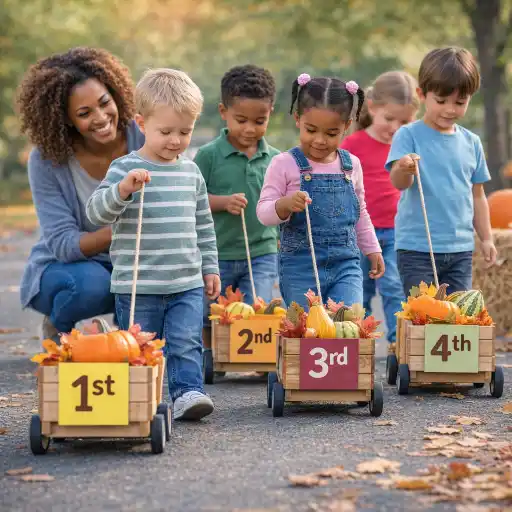
Let children opt out of performing in front of the group; they can explore the scene with a partner or during a center choice instead. Autumn materials can make math feel relevant, as illustrated by fall-themed math activities for preschool. Maintain safe, age-appropriate materials and adapt small items to your program’s supervision and choking-prevention practices.
What common teaching pitfalls should providers avoid?
One common pitfall is asking “Who is third?” without clarifying the starting point. Children may interpret the lineup from opposite ends, and both answers may make sense from their perspective. State the direction, point to the front, and keep the reference consistent. Later, deliberately reverse the direction so children can discover that changing the starting point changes the ordinal description.
Another pitfall is treating ordinals as a memorization task. Repeating “first, second, third” is not enough if children cannot use the words to identify positions. Ask children to point, move, compare, and explain. Distinguish “three pumpkins” (quantity) from “the third pumpkin” (position) through contrasting examples.
Avoid turning the parade into a race for the “best” place. Ranking children can create unnecessary pressure and distract from the concept. Use objects, figures, or cooperative roles instead, and affirm thoughtful attempts. If a child answers incorrectly, model the counting path again and invite another try without making the error a public performance.
Finally, do not assume that worksheet completion alone demonstrates understanding. Combine the scene with observation during play and ordinary routines. If you use a printable, treat it as one representation among several rather than the whole lesson. For more activity ideas, see ordinal number games and activities and hands-on ways to practice ordinal numbers.
How can you assess learning and extend the parade?
Assessment can be brief and woven into play. Ask a child to identify one position, then observe the strategy used. A note such as “identified third by touching each figure from the front” is more informative than a simple mark for correct or incorrect. Revisit the activity later with a different lineup to see whether the child can transfer the concept beyond one familiar arrangement.
Extend the scene by asking children to make their own parade order, dictate a caption, or draw the character who comes after the fox. Pair ordinal language with storytelling: What happened first in the parade? Which character joined second? What came third? These prompts bring together mathematical sequencing, oral language, and narrative comprehension.
Use the activity as a doorway into a math-rich classroom, not a one-time seasonal event. Children can practice position with classroom jobs, the daily schedule, calendar routines, or toy arrangements. The National Association for the Education of Young Children highlights playful math learning and how children develop mathematical understanding (NAEYC: Math).
For professional development beyond this single lesson, consider Math Foundations in Early Childhood Buy Now $16.00, Early Mathematics Through Play Buy Now $24.00, No Such Thing as Boring Math Buy Now $24.00, Letter & Number Planning in Child Care Buy Now $24.00, and Enhancing STEM Education for Infants and Toddlers Buy Now $16.00. These English-language trainings address early math, play, planning, or STEM; review each course’s details to determine fit. Training-hour acceptance varies—check your state licensing agency.
Conclusion: What should providers remember about teaching ordinals?
How can fall parade play help children understand ordinal numbers? Give children a clear starting point, let them arrange and move parade figures, and use position words in conversation before expecting written notation. Connect concrete objects, pictures, and ordinal symbols gradually, and adapt the number of characters and response options to each learner.
Notice children’s reasoning, not just the answer. Ask them to point, compare, describe, and try the scene from another direction. Keep the experience cooperative and joyful, then carry ordinal language into stories, routines, and classroom play. With intentional prompts and brief observation, a seasonal parade can support lasting mathematical understanding—and give providers a practical way to make early math visible throughout the day.
- 45 Hour Child Growth and Development
- 45 Hour Preschool Methods and Materials
- What Makes Me Special: An Overview of Autism and ADHD
- 45 Hour Infant and Toddler Methods and Materials
- Math Foundations in Early Childhood
- CDA Bridge Bundle: Family Child Care without Portfolio Review
- CDA Bridge Bundle: Infant/Toddler without Portfolio Review
- Bienvenido! Welcoming All Families
- 45-Hour Infant and Toddler Curriculum
- CDA Certification en Español: Recursos y Consejos para Educadores Bilingües
- 🪁¿Cómo puede el juego apoyar de manera poderosa a los niños con autismo?🧩
- 💛🧩 ¿Cómo puedo hacer que mi enseñanza sea inclusiva para los niños con autismo?
- ¿Cuáles son las mejores actividades del Día de la Tierra para niños en casa o en el aula?
- ¿Cómo puedo usar escenarios de juego de roles de primeros auxilios en mi aula?
- Actividades de Motricidad Gruesa que Desarrollan el Equilibrio, la Coordinación y la Fuerza
- 10 Ejemplos de Cómo la Cultura Influye en el Desarrollo Infantil
- Capacitación en Salud y Seguridad Preventiva en Línea para Proveedores de Cuidado Infantil
- Proporciones de Cuidado Infantil y Tamaños de Grupo por Edad en Maryland (Guía Rápida para Centros y Hogares)
- Proporciones de Cuidado Infantil y Tamaños de Grupo por Edad en Nueva Jersey (Guía Rápida para Centros y Hogares)
- Proporciones de Cuidado Infantil y Tamaños de Grupo por Edad en Virginia (Guía Rápida para Centros y Hogares)
- Actividades de Otoño Fáciles para Preescolares esta Temporada
- Lista para Guardería en Casa en Illinois: Cómo Iniciar una Guardería en el Hogar
- Por Qué la Supervisión Activa Es Clave para la Seguridad en el Cuidado Infantil
- Consejos de Supervisión Activa para Salones de Preescolar y el Juego al Aire Libre
- Cómo Trabajar en el Cuidado Infantil en Carolina del Norte: Requisitos y Pasos
- Celebrando la amistad en el cuidado infantil durante el Día de los Mejores Amigos
- Canciones, juegos y preguntas de círculo para niños
- Cómo simplificar la capacitación para sus empleados de daycare
- How Can Fall Parade Play Help Children Understand Ordinal Numbers?
