Can a handful of leaves, sticks, and pinecones become an engineering laboratory? Fall gives preschoolers abundant, flexible materials for building, testing, revising, and collaborating; the Creating the Natural Outdoor Classroom  Buy Now $16.00 course can help you turn these experiences into intentional outdoor learning while strengthening classroom practice and professional knowledge.
Why do fall building challenges matter for preschoolers?
Building with natural materials is more than seasonal entertainment. It invites children to investigate balance, stability, weight, texture, force, and spatial relationships through direct experience. When a child adjusts a stick bridge or rearranges a pinecone shelter, the child is engaging in an early engineering process: identifying a problem, generating an idea, testing it, and modifying the design.
These challenges also support the whole child. Children practice #problem-solving, fine-motor coordination, language, persistence, cooperation, and creative thinking. Open-ended materials are especially valuable because they do not dictate one correct product. A leaf may become a roof, a plate, a sail, or a sleeping bag for a pretend animal.
Research on young engineers describes block building and ramp exploration as meaningful contexts for developing concepts related to stability, balance, physical properties, number, and spatial reasoning. Similarly, nature-based learning resources emphasize that outdoor environments encourage observation, prediction, testing, and imaginative play.
- Invite curiosity rather than demand a finished product.
- Use descriptive vocabulary such as balance, support, sturdy, compare, design, and revise.
- Value the process, including unsuccessful attempts.
How can you prepare safe and engaging natural materials?
Begin with a purposeful collection rather than placing every available object outdoors. Invite children to gather dry leaves, sturdy sticks, pinecones, smooth stones, bark pieces, seed pods, and large acorns from approved areas. Inspect materials before use, remove sharp or moldy items, and establish a respectful collection rule: take only what has already fallen and leave living plants and animal habitats undisturbed.
For preschoolers, materials should be large enough to reduce choking risk and easy enough to manipulate independently. Avoid poisonous plants, unknown berries, thorny branches, treated wood, and objects contaminated by animal waste. Wash hands after collecting and before eating. Food-based materials require allergy awareness, family communication, and careful supervision.
Create a simple outdoor construction area with baskets, tarps, clipboards, measuring tools, and picture cards. A quiet observation space can support children who prefer to plan before joining group construction. Accessibility matters: provide lightweight alternatives, seated building surfaces, adaptive grips, and peer partnerships.
Remember that state requirements vary - check your state licensing agency. A brief hazard scan and clear supervision zones make nature-based building more reliable for the entire team.
Which fall building challenges work well with preschoolers?
Offer one challenge at a time and allow repeated trials. The goal is not architectural perfection; it is thoughtful experimentation. Here are adaptable provocations:
- 🍁 Leaf shelter: Build a small shelter for a toy animal using sticks, leaves, and bark. Ask what will keep the animal dry or protected.
- Pinecone pathway: Design a path that guides a pinecone from a starting point to a basket. Children can change slopes, surfaces, and barriers.
- Stick bridge: Build a bridge between two logs or boxes that can support a toy. Compare wide, narrow, flat, and angled designs.
- Nature tower: Stack pinecones, stones, and wood slices. Count layers and investigate what makes a tower stable.
- Leaf maze: Arrange leaves and sticks into a pathway. Children can walk, roll a ball, or direct a toy through the maze.
- Bird nest model: Design a nest that holds several large “eggs,” using flexible grass, leaves, and twigs. Discuss how real birds use natural materials.
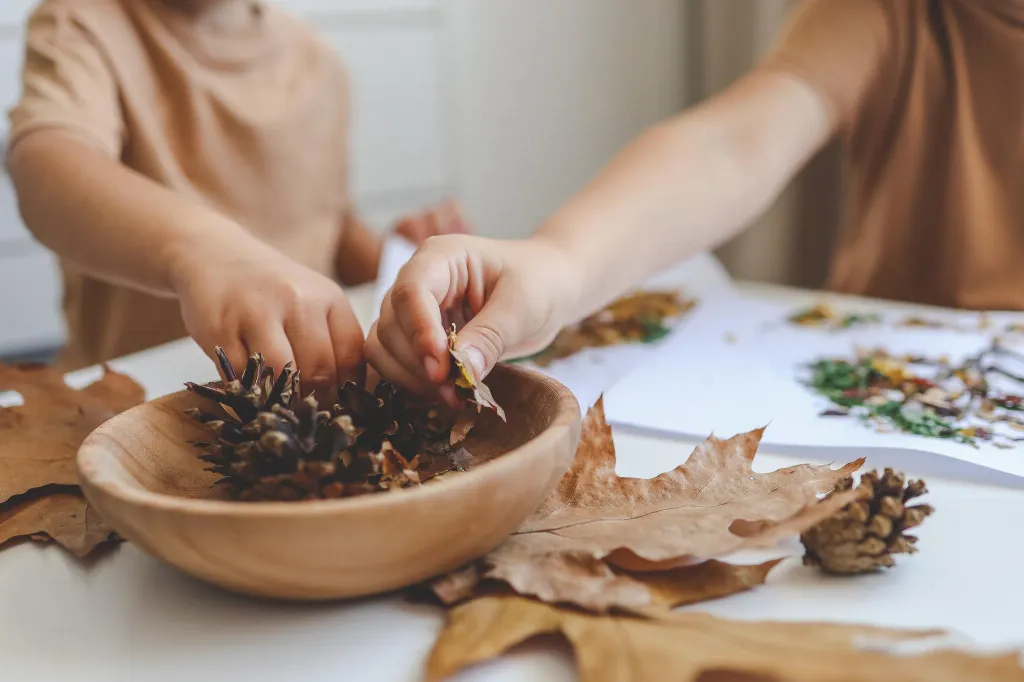
These ideas connect with fall STEM suggestions involving apple towers, pinecone investigations, leaf sorting, and outdoor scavenger hunts. Keep the challenge playful and allow children to reinterpret it.
How should teachers guide inquiry without taking over?
The educator’s role is to make thinking visible while protecting children’s ownership. Start by observing. Notice whether children are testing weight, copying a peer, negotiating roles, or repeatedly changing one material. Then offer a question that extends the investigation rather than supplying the solution.
- “What do you notice about the pieces that stayed in place?”
- “How could we make the bridge stronger?”
- “What might happen if the ramp were higher?”
- “Which material could support the roof?”
- “How will we know whether your design works?”
Use an inquiry cycle: ask, predict, build, test, and revise. Give children time to experience productive frustration. If a structure falls, respond with curiosity: “It collapsed. What could we change?” This communicates that failure is evidence, not a personal deficit.
Support language development by recasting children’s statements with precise words. If a child says, “It keeps falling,” you might respond, “You are noticing that the structure is unstable. Let’s compare the base and the top.” Invite children to explain plans to peers, draw a design, or dictate a reflection. These conversations integrate science, mathematics, oral language, and social learning.
How can you adapt challenges for inclusion and assessment?
One challenge can serve a mixed preschool group when the materials, questions, and expectations are differentiated. Younger or less experienced children may sort, carry, place, and imitate. Older or more experienced children may predict, measure, compare repeated trials, or explain why one design is more stable.
- Provide visual step cards showing gather, plan, build, test, and clean up.
- Offer choices between active building and a seated planning or observation role.
- Use larger, lighter materials for children with limited strength or motor control.
- Pair children intentionally to support communication, turn-taking, and leadership.
- Accept drawings, gestures, home-language explanations, photographs, or dictated words as evidence of thinking.
Assessment can remain manageable. Record one observable behavior, one child quote, and one possible next step. For example: “Maya placed three sticks across the gap, tested the bridge with a pinecone, and said, ‘The middle needs help.’ Next: offer a wider support piece and invite comparison.” This documentation demonstrates learning without interrupting play.
Connect observations to goals such as spatial reasoning, persistence, cooperation, descriptive vocabulary, counting, and fine-motor coordination. Share a photograph and a brief explanation with families so they can continue the conversation at home.
How can directors make nature-based building part of program practice?
Consistency comes from simple systems. Directors can provide a labeled nature-materials kit, schedule short construction invitations, and include outdoor inquiry in lesson-plan templates. Staff meetings can include a ten-minute reflection: What did children try? What materials supported deeper thinking? What safety adjustment is needed?
Common mistakes are usually easy to correct:
- ❌ Showing children exactly what to build — ✅ Present a problem and welcome multiple solutions.
- ❌ Providing too many materials — ✅ Offer a focused selection and rotate it.
- ❌ Correcting every unstable structure — ✅ Let children test and revise when safe.
- ❌ Ignoring access needs — ✅ Plan varied tools, surfaces, roles, and communication supports.
- ❌ Skipping documentation — ✅ Capture one photo, quote, and learning note.
Professional learning can help teams connect these experiences to intentional curriculum. The CDA: Creating the Outdoor Classroom Buy Now $16.00 course focuses on designing outdoor environments that support children’s physical and intellectual development. Additional relevant options include Basic Science in Early Childhood Buy Now $25.00, Lesson Planning for Preschoolers Buy Now $24.00, and 1,2,3, Eyes on Me: Classroom Safety Buy Now $32.00$24.00.
Conclusion
Yes—preschoolers can build meaningful structures with fall materials, and the process offers rich opportunities for engineering, mathematics, language, motor development, collaboration, and creativity. Start with one safe, open-ended challenge, ask thoughtful questions, allow revision, and document children’s ideas. When educators treat leaves, sticks, pinecones, and stones as tools for investigation rather than disposable craft supplies, fall becomes a vibrant setting for capable young designers and #engineers.
Explore the five cited professional resources and courses as you plan your next invitation. A small basket of natural materials, a clear question, and patient adult support may be all your classroom needs to begin.
- 45 Hour Child Growth and Development
- CDA Preschool Credential with Portfolio Review
- 45 Hour Preschool Methods and Materials
- From Tantrums to Triumphs: Equipping Preschoolers with Self-Regulation Skills
- CDA Bridge Bundle: Preschool
- 45 Hour School Age Methods and Materials
- Art from the Heart for Preschoolers: Open Ended Art Projects that Build Self-Esteem
- 45-Hour Infant and Toddler Curriculum
- Texas Director Credential
- How Can Childcare Educators Thrive in the Big Apple?
- Tiny Hands, Big Dreams: Fostering Creativity in Preschoolers
- Nature’s Classroom: Why Fall Is the Best Season for Sensory Learning Outdoors
- Pumpkins, Pinecones, and Leaves: Autumn-themed STEM Projects
- Pumpkin Spice and Sensory Delight: Easy Autumn Sensory Bins for Early Learners
- CDA Certification en Español: Recursos y Consejos para Educadores Bilingües
- 💛🧩 ¿Cómo puedo hacer que mi enseñanza sea inclusiva para los niños con autismo?
- Curso de Comunicación de 9 Horas de Maryland
- Apoyo en Español para Capacitaciones Grupales Presenciales y por Zoom en Cursos Selectos
- Proporciones de Cuidado Infantil y Tamaños de Grupo por Edad en Maryland (Guía Rápida para Centros y Hogares)
- Actividades de Otoño Fáciles para Preescolares esta Temporada
- Ejemplos de Crianza Respetuosa vs. Crianza Permisiva
- Pumpkin, Leaves, and Apples: Fall Activities for Preschoolers
- Celebrando la amistad en el cuidado infantil durante el Día de los Mejores Amigos
- How can seasonal activities (spring, summer, fall, winter) combine fun with clear educational goals?
- Go on a Fall Hunt! Outdoor Learning Challenges for Preschoolers
- Can You Build It With Fall? Nature-Based Building Challenges for Preschoolers
- Can You Build a Leaf Bridge? Fall STEM Challenges for Pre-K
- How Can STEM Activities Turn Everyday Preschool Play Into Powerful Learning?
- ¿Qué habilidades preceden al recorte y cuándo deben aprender los niños a usar tijeras?
