When scissors are still a challenge, children can explore autumn art without waiting on a skill they are still developing. A torn-paper landscape offers meaningful practice with hand coordination, creative choices, and seasonal language; the ChildCareEd course Inclusive Lessons for Preschoolers  Buy Now $16.00 can help you adapt activities so more children can take part, and build practical knowledge for inclusive lesson planning. Read on for an easy studio setup, adaptable steps, and ways to keep the experience joyful and developmentally responsive.
Why offer tearing, arranging, and gluing before expecting confident scissor use?
Scissor use combines several developing abilities: hand strength, finger control, visual attention, stable posture, and coordination between both hands. Children still learning these movements can participate fully in art through tearing, arranging, and gluing. Tearing paper gives each hand a distinct role—one steadies the material while the other pulls—and invites children to adjust force and direction. These actions exercise coordination and hand control, though they are not a guarantee of any particular milestone or a substitute for individualized support.
Most importantly, an art experience should not make scissors the entrance fee for creativity. When cutting is not the lesson’s central goal, alternative ways to prepare collage pieces preserve the shared purpose while reducing frustration. Children can still make decisions, experiment with color and texture, and tell a story through their work.
A layered fall landscape also supports conversation and observation. Children might notice that the ground is darker than the sky, compare paper textures, or describe what autumn looks like in their neighborhood. Providers can observe how each child approaches materials and offer a manageable next step without judging the finished product.
- Keep the focus on exploration and participation, not matching a sample.
- Offer choices in how children make and place collage pieces.
- Recognize effort, planning, and persistence as part of the learning.
How do you prepare a welcoming autumn collage studio?
Set up a small, organized space that makes materials easy to see and reach. Use sturdy paper or lightweight cardboard as the base, such as construction paper or a clean cereal-box panel. Provide autumn colors—red, orange, yellow, brown, and green—along with a few contrasting colors so children can follow their own ideas. Recycled artwork, tissue paper, magazine pages, and crepe paper add different colors and resistance for tearing.
Before inviting children, decide what support may make the activity accessible. Some may enjoy tearing large sheets; others may find short, pre-started strips easier to grasp. A tray for paper scraps helps contain materials, while glue sticks, glue sponges, or carefully supervised glue bottles offer different ways to attach pieces. Keep the table uncluttered and provide enough elbow room for children who need a stable surface.
Introduce the project with an open invitation rather than a finished model: “Let’s make a place you might see in autumn. What could go in your landscape?” A quick outdoor observation or a few photographs of local seasonal changes can spark ideas, including in places where leaves do not turn vivid colors.
- Base: cardstock, construction paper, or light cardboard.
- Collage: assorted clean paper in different colors, weights, and textures.
- Tools: glue sticks or another age-appropriate adhesive; optional brushes for spreading glue.
- Optional: crayons or markers for details, if children choose to add them.
How can children create a torn-paper autumn landscape?
Begin by inviting children to explore the paper and tear it at their own pace. Demonstrate slowly: hold the paper with both hands, keep the hands close together, and pull in opposite directions. Rather than insisting on straight strips, let children notice how different pulls make different edges. If a large sheet feels difficult, offer shorter strips or paper with a small starting tear. Children may also choose larger pieces, which can be easier to grasp and arrange.
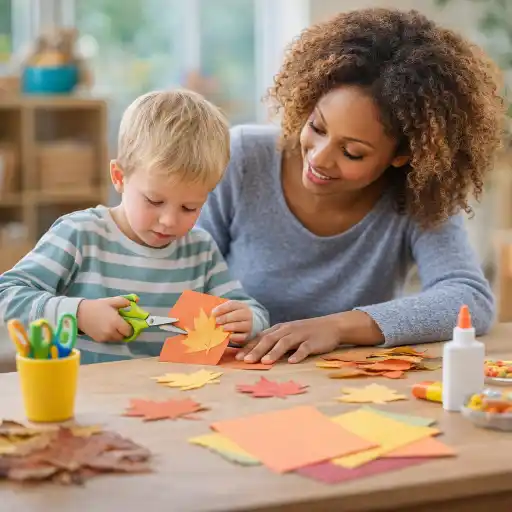
Once children have a collection of pieces, invite them to place and move the pieces before gluing. They might build a sky, a line of hills, a path, trees, falling leaves, or an entirely invented scene. Suggest layering pieces to show foreground and background, but treat this as an option—not a required result. When a child is ready, ask where they want a piece to go, then let them press it onto a small amount of glue.
Keep the process flexible. One child may spend most of the time tearing; another may focus on careful placement or color groupings. Both are participating in the art experience. A child who wants scissors can have a brief, closely supervised opportunity appropriate to their current abilities, while peers continue tearing and arranging.
- Offer a starting tear or narrower strips if tearing a full sheet is frustrating.
- Invite children to arrange first, then glue when they are satisfied—or change their plan.
- 🍂 Ask, “What else might belong in your autumn place?” and welcome imaginative answers.
How can you adapt the activity for different abilities and stages?
Start with the child and the purpose of the activity, not a one-size-fits-all expectation. Some children may tear independently, while others benefit from larger pieces, a stabilized sheet, a visual example of the tearing motion, or help opening a starting notch. Children can contribute by choosing colors, pointing to where a piece should go, arranging materials, pressing paper into glue, or describing an idea for an adult to place. These are meaningful roles when they reflect the child’s choices and remain connected to the shared art.
Adjust the materials and steps rather than requiring every child to perform them in exactly the same way. Try a glue stick or glue sponge for children who find squeeze bottles difficult; offer a tray to keep scraps within reach; or use larger, high-contrast paper pieces for easier visual tracking. Children who avoid sticky or rough textures can use a tool, wear a smock, or choose a different paper. Watching first can also be a valid way to approach a new sensory experience.
Use brief directions, model one action at a time, and allow wait time. Avoid taking over the child’s work; offer only the assistance needed to keep participation possible. For additional professional development, Effective Approaches for Autism and Inclusion Buy Now $55.00 explores practical ways to adapt materials and support communication and sensory needs. The Art from the Heart for Preschoolers Buy Now $35.00 course offers further ideas for open-ended art and children’s confidence.
What safety and teaching practices help the activity succeed?
Plan for safety before the table fills with paper and glue. Select materials that fit children’s ages and abilities, supervise actively, and keep small pieces out of reach of children who may mouth them. Check recycled paper for staples, sharp edges, or contamination. Follow product directions and program procedures for adhesives, cleanup, and storage. If scissors are included, use appropriate tools, teach clear handling expectations, and maintain close supervision. State requirements vary - check your state licensing agency.
Support learning with descriptive language instead of praise limited to appearance. Try, “You chose three shades of orange,” “You held the paper steady while you pulled,” or “You moved the hill after looking at the whole picture.” Open-ended prompts can invite children’s thinking: “What do you notice outside?” or “How could you make the path longer?” Accept spoken words, gestures, pointing, signs, or communication devices as ways to share ideas.
Common pitfalls include expecting identical landscapes, offering too many materials at once, and turning the activity into a test of fine-motor performance. Keep the invitation simple, add materials in response to children’s interest, and allow time for revision. Document the process with a brief note, child quote, or photo, following your program’s privacy practices. Observe what supports engagement and use that information to plan a next experience.
- Keep adhesive and tools within the supervised work area.
- Offer a low-pressure alternative when a texture or step is uncomfortable.
- Notice what the child does and what support helps, rather than ranking finished pieces.
Conclusion: What should providers remember about fall collage for emerging scissor users?
Tearing, arranging, and gluing make autumn collage accessible to children who are still learning to use scissors, while providing rich opportunities to explore materials, coordinate both hands, make choices, and express ideas. Prepare a simple studio, demonstrate tearing without demanding uniform pieces, and give children meaningful control over how their landscape develops. Adapt the size, texture, tools, and number of steps to the child, and keep scissors optional unless cutting is a specific learning goal.
The central aim is not a perfect seasonal picture; it is a welcoming art experience in which every child can contribute. Observe effort and strategies, supervise materials, and let children’s interpretations shape the scene. For a deeper course in accessible preschool lesson planning, explore Inclusive Lessons for Preschoolers Buy Now $16.00.
Additional ChildCareEd courses: Lesson Planning for Preschoolers Buy Now $24.00, How Preschoolers Develop Buy Now $32.00, and Open Heart, Open Art Buy Now $16.00.
References
- Tear Paper Amazing Fine Motor Activity - The OT Toolbox
- Paper Tearing Activities to Build Fine Motor Skills - Empowered Parents
- Colorful Fall Collage Art with Toddlers
- Torn Paper Landscapes Art Project
- Colorful Autumn Scene Lesson Plan
- What Skills Come Before Cutting, and When Should Children Learn to Use Scissors?
- Adapt the Activity, Not the Child
- How Can After-School Crafts Include Children Who Find Cutting and Assembly Difficult?
- How Can Providers Plan Creative Sensory and Fine-Motor Activities for Young Children?
- How Can Fall Art Leave Room for Children’s Ideas Beyond Matching Pumpkins?
- Art Exploration for Kids: Colors, Textures, and Creativity
- How Can You Adapt Fall Learning Activities for Children of Different Ages?
- Tearing Paper Activities for Preschoolers to Boost Fine Motor Skills
- Paper Tearing Activities: This is How to Improve Fine Motor Skills
- Autumn Leaf Mosaic Collage
- Fabulous Fall Collage for Toddlers
- 19 Fall Process Art Activities for Preschool, Pre-K, and Kindergarten
- Benefits of Collage Art for Early Childhood Development
- Scissor Skill Development Checklist for Ages 2-6
- What Makes Me Special: An Overview of Autism and ADHD
- CDA Bridge Bundle: Family Child Care without Portfolio Review
- Art from the Heart for Preschoolers: Open Ended Art Projects that Build Self-Esteem
- CDA Bridge Bundle: Infant/Toddler without Portfolio Review
- CDA Bridge Bundle: Preschool without Portfolio Review
- Engaging Indoor Activities for Inclement Weather
- Creating Engaging and Meaningful Learning Experiences
- Texas Director Credential Renewal
- Texas Director Credential
- Montessori Cultural Activities: Exploring the World Through Play and Learning
- CDA Certification en Español: Recursos y Consejos para Educadores Bilingües
- 🔍 ¿Qué ves cuando observas a un niño aprender?
- 💛🧩 ¿Cómo puedo hacer que mi enseñanza sea inclusiva para los niños con autismo?
- Actividades de Motricidad Gruesa que Desarrollan el Equilibrio, la Coordinación y la Fuerza
- Capacitación en Salud y Seguridad Preventiva en Línea para Proveedores de Cuidado Infantil
- Proporciones de Cuidado Infantil y Tamaños de Grupo por Edad en Maryland (Guía Rápida para Centros y Hogares)
- Proporciones de Cuidado Infantil y Tamaños de Grupo por Edad en Nueva Jersey (Guía Rápida para Centros y Hogares)
- Proporciones de Cuidado Infantil y Tamaños de Grupo por Edad en Virginia (Guía Rápida para Centros y Hogares)
- Actividades de Otoño Fáciles para Preescolares esta Temporada
- Apoyo en Preescolar para Retrasos del Habla: Estrategias Simples que Ayudan
- Calabazas, hojas y manzanas: actividades de otoño para preescolares
- Celebrando la amistad en el cuidado infantil durante el Día de los Mejores Amigos
- Canciones, juegos y preguntas de círculo para niños
- Cómo simplificar la capacitación para sus empleados de daycare
- Rainy Fall Day? 12 Indoor Activities Preschoolers Won’t Want to Stop
- How Can Halloween Fine-Motor Activities Be Fun Without Being Scary?
- How Do Cut-and-Paste Activities Build Fine-Motor Control and Planning?
- How Can Providers Plan Creative Sensory and Fine-Motor Activities for Young Children?
- Juego Compartido y Autismo: Cómo Fomentar la Participación sin Exigir Contacto Visual
- How Can Fall Collage Activities Support Children Still Learning to Use Scissors?
